
&imwidth=800&imheight=600&format=webp&quality=medium "300,000-year wildfires - 'Hellish' fires burned through Europe after supercontinent Pangea broke up")
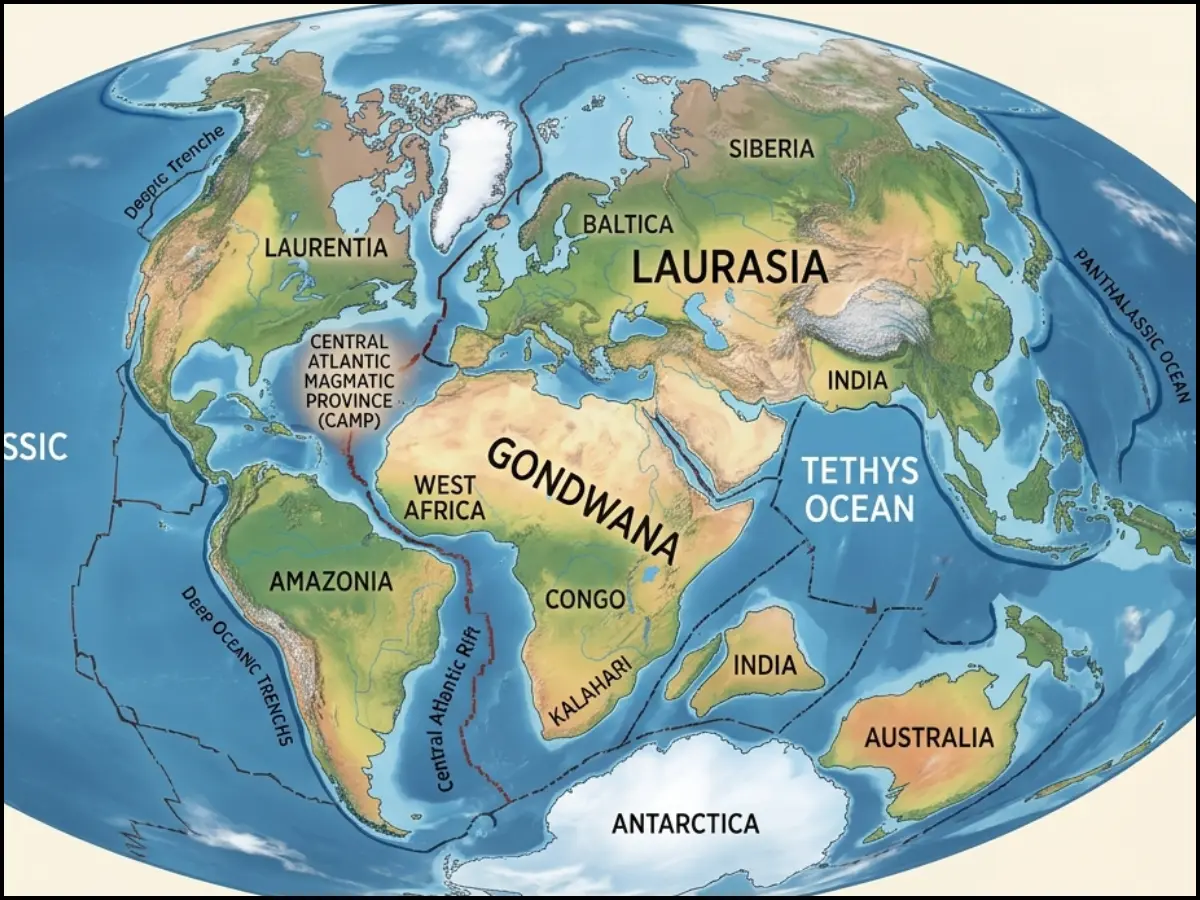
Scientists have discovered that a fire kept burning in Europe for between 40,000 and 300,000 years following the end-Triassic mass extinction nearly 201 million years ago. As supercontinent Pangea began to break apart, volcanoes erupted, primarily from the Central Atlantic Magmatic Province (CAMP). This event wiped out approximately 76 per cent of all terrestrial and marine species. Huge quantities of carbon dioxide were released into the atmosphere as temperatures climbed by an estimated 5 to 10 degrees Celsius worldwide.
Forests collapsed, and Northwest Europe was soon covered by ferns. An international team of scientists led by geologists at Utrecht University have suggested that the ferns were vulnerable to fire, which triggered the spread of massive wildfires. The study in the journal Nature Geoscience states that the ferns also provided the fuel in many cases, which further fuelled the wildfires.
The team drilled four cores of sediments, one of which came from a depth of nearly 2,100 feet.

They measured fossil charcoal and organic compounds produced in wildfire smoke called polycyclic aromatic hydrocarbons (PAHs) to recreate the ancient wildfires. They found that during the main extinction interval, massive fires burnt in the region. This period coincided with the rapid spread of ferns.
Testing the sediment
Trending Stories
)
‘Kill all in the name of...’: FBI arrests 21-year-old over alleged ISIS-inspired mass-casualty attack plot
)
Space mines, lasers & robotic arms: Lt Gen Pannu decodes US disclosure of weapons in space
)
Bitter Zelensky snubs Trump for playing politics with Ukraine war | Gravitas
)
Passengers scream as Iran flight suffers mid-air scare: Boeing 737 shakes violently after take-off | VIDEO
)
US fires up to 70 interceptors against Iran attack on Jordan, putting supplies under pressure
)
India’s imports from Russia jump 57% in five months; China remains top import source
)
‘US military task force aiding Saudi Arabia forces with intel, planning support’: Official
)
OpenAI boss Sam Altman repeats AI 'slow down' call, says world 'right to be afraid'
)
Top military commanders from US, Israel, and 7 Arab nations held secret meeting on Iran War
)
Sydney Sweeney defends provocative ad choice, the internet is still not impressed
)
'Definitely feel bad for yourself': Kuldeep Yadav opens up on India Test snubs
)
Ex-India all-rounder Yuvraj Singh wants India to avoid 'massive changes' before ODI World Cup 2027
)
Ed Sheeran’s US tour loses all support acts after Macklemore’s removal | Controversy explained
)
China's property crisis deepens as investment plunges nearly 20%
)
Messi set to play in farewell match on October 6 in Argentina vs Benin friendly
)
2,200 people donate Rs 1.5 crore for 'docile' Georgia donkey 'HeeHaw' shot dead by police officer
)
Putin-linked Russian oligarch, Melania links: Why Trump skipped his son’s Bahamas wedding bash?
)
800 million years old - Scientists discover 'fingerprints' of supercontinent Gondwana in ancient rocks
)
Trump's name cannot return to Kennedy Center, US judge rules
)
Water equivalent to two Pacific Oceans could be stashed 2,900 km inside Earth
)
1,200 Indian and US troops begin high-altitude and desert drills
)
Ex-CIA officer caught with gold bars worth $40 million seeks plea deal | Gravitas
&im=FitAndFill=(700,400))
New OTT releases this week (September 14-20, 2026): Lust Stories 3, Waiting Hai, Irumudi- 5 new titles coming on Netflix, Prime Video and more
)
Trump's Iran war faces fresh House rebuke; 7 Republicans join Democrats in push to end conflict ahead of midterms
)
US Treasury yields cross 5% as Scott Bessent warns of ‘global issues’ impacting bonds
)
Who is Kalyan Bainsla, accused in the Gurugram hit-and-run case involving woman biker?
)
Saudi Arabia discovers 110 million tonnes of Uranium-rich ore in Madinah region
)
'Now Trump is copying us': Shivakumar links US $5,000 plan to Congress guarantees
)
Elephants hide behind trees, stage surprise attack on poachers targeting rhinos in South Africa
)
Los Angeles helicopter crash: At least three dead, several injured; NTSB to investigate
)
West Bengal IPS officer Bushra Bano transferred after objections to ‘Assalamualaikum’, ‘Inshallah’
)
India summons top Pakistan diplomat after Pak Navy ship collides with Indian warship at high seas
)
Spanish officer sent home from NATO base over affair with 'Russian spy' | Gravitas
)
Saudi Arabia accuses Houthis of drone attack on Mecca, first-ever red alert in Islam's holiest site sparks panic
)
'Like a thug you are using agency to go after..': Kash Patel grilled by Senate Democrats over FBI firings, journalist investigations and hiring policy
However, charcoal can break down into fragments and smoke-related molecules can travel far from the fires, exaggerating the intensity of the fires. So the team "used a simple and very low-cost technique that quantifies the ‘darkness’ of fossil pollen and spores, a so-called Palynomorph Darkness Index."
Samples gathered from the deepest points, which were also the oldest, had light colored pollen and spores. The extinction interval fossils became progressively darker and became extremely dark brown. After the extinction interval ended, they turned a light yellow colour. When the unusual darkening was compared with other indicators of ancient fires, they found a pattern, leading them to conclude that intense wildfire activity occurred along with fern abundance during the "Dark Zone".
Some fern species can grow back quickly, especially after a fire. Even after the leaves above the ground burn up, roots remain, which allows the plant to cover the burned areas again. Since the fern kept bouncing back, the fires persisted. The researchers estimate that they could have burnt for 40,000 years and for as long as 300,000 years.
Some fern species form savannahs across the landscape. "When the ferns dry out, the thick mats act as the ideal fuel to trigger massive wildfires," senior author Dr Bas van de Schootbrugge said. "Ferns responded to and delivered the fuel that fanned the flames, triggering repeated massive wildfires. A truly hellish world."
Van de Schootbrugge said that the study shows that climate change, deforestation, and certain species can once again set the stage for a new storm.

