Sealed and filled jar of wine recovered with burials of dead Roman in tomb

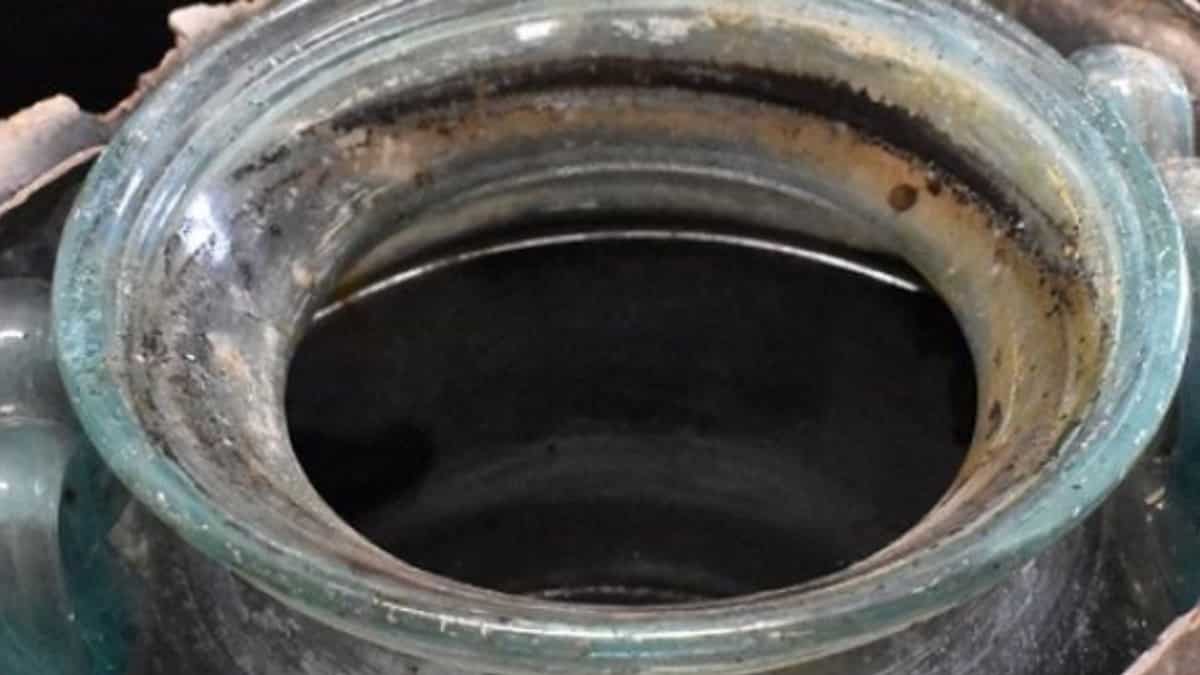
Image of glass urn with the wine inside.
Archaeologists made an unexpected discovery when they unearthed a jar of wine - which was filled with the drink and tightly sealed - in an ancient tombnearly 2,000 years after it was buried.
The wine was recovered among the grave goods which were accompanying a Roman man in his burial. The Romans had filled his cremated remains in a glass container before sealing it.
The wine, which was once sweet, has now a reddish colour and is filled with human dust.

With the reddish stain and human dust, this wine is now the oldest known vintage of the world, going beyond the 4th century CESpeyer wine bottleby hundreds of years.
Archaeologist Juan Manuel Román of Carmona's Museum of the City said, "We were very surprised that liquid was preserved in one of the funerary urns."
)
'Driven and courageous': Salman Khan backs student protests, urges education system reforms without political interference
)
Trump blames AI for viral video of mystery objects thrown from White House window, WH says ‘maintenance’. Who's lying?
)
'Nothing is more important than...': PM Modi announces BIG decision as Delhi student protest grows
)
'George Soros playbook': Understanding the foreign funding network around Sonam Wangchuk
)
Ukrainian drone wrecks irreplaceable Russian bomber 800km inside the country, satellite images show it halved
&im=FitAndFill=(700,400))
Why US fighter jets use seamless bubble canopies compared to Russian jets
)
He predicted COVID-19 and 2008 economic crisis, was labeled fearmonger. Now he has another dire warning
)
'Is that a back-up Trump?' Mysterious look-alike standing behind Donald Trump baffles netizens
&im=FitAndFill=(700,400))
Meet top 5 Indian batters with most T20I runs against Zimbabwe
&im=FitAndFill=(700,400))
New OTT releases this week (July 20-26, 2026): Musafir Cafe, Adarsh Baal Vidyalaya, 72 Hours- 5 new titles coming on Netflix, Prime Video and more
)
'Guru is the...': Indian Education Minister Dharmendra Pradhan shares message on education amid calls for his resignation
&im=FitAndFill=(700,400))
Meet top 5 batters with most runs in India vs Zimbabwe T20Is
)
'National mourning in America': Iran's IRGC issues chilling 9/11-style threat to US
)
'Don't waste...': CJI Surya Kant breaks silence on Delhi police brutality against protesting students
)
ICC ODI Rankings: Joe Root jumps big, India trio close in on No. 1 spot
)
Sonam Wangchuk says the government has agreed to consider Dharmendra Pradhan’s resignation
)
Pan Am plane wreckage that remained untraceable for 74 years has finally been found
)
Did Putin help Iran target CIA bases? US probes Russia's role in Gulf drone strikes
)
Employer pays Rs 4.25 lakh for driver's surgery. What he said to the doctor is an even bigger lesson in kindness
)
Dharmendra Pradhan's daughter deactivates IG, LinkedIn as protesters demand her father's resignation, target her university page
)
Dharmendra Pradhan's 1997 paper leak protest surfaces amid calls for resignation
)
Balen Shah's diplomatic U-turn? Nepal PM to hold one-on-one meetings with India, China envoys
&im=FitAndFill=(700,400))
World's top 7 most liveable cities in 2026 — Check where India and Pakistan stand
)
Man with babyish face spends Rs 10 lakh on beard transplant to be taken seriously at work
)
IND vs ZIM, 1st T20I: When and where to watch live streaming in India?
)
'Will intervene if...': CJI Surya Kant hears lawyer's plea over Delhi Metro station closures amid CJP student protest
)
FIFA 2026 | 'I am truly sorry': Argentina's Enzo Fernandez, who get red card in final, reacts to loss
)
Maharashtra Bandh call on July 23: What all you need to know
The mausoleum appears to be a collective tomb which belonged to a specific family and appears as a rarity.
Archaeologists in 2019 stumbled upon the chamber in southern Spain which was till then sealed and its contents were preserved for thousands of years.
The archaeologists found various luxurious grave goods – patchouli perfume, jewels and jewellery, fabrics, glass objects, and a large lead container.
However, after opening the container, the researchers were left shocked when they discovered a sealed glass urn which was half-filled with some sort of liquid.
In ancient Roman times, it was a known funerary practice to pour wine on the cremated remains. However, there is also little chance that the liquid entered into the urn by mistake.
How do scientists analyse the wine?
Headed by the University of Cordoba's chemist Daniel Cosano in Spain, the researchers held a comprehensive series of chemical analyses to determine what the liquid actually was.
Watch:Greece: Athens Acropolis closes due to heatwave
The pH of the liquid and organic matter within was measured. They used inductivelycoupled plasma mass spectrometry and identified the chemical elements present in the mineral salts in the liquid.
The high-performance liquid chromatography-mass spectrometry was used for identifyingpolyphenols, chemical compounds which can be found in food and drinks.
(With inputs from agencies)