Is there life on 'Enceladus'? New study questions 'Alien' hints on Saturn’s moon

&imwidth=600&imheight=450&format=webp&quality=medium "Is there life on 'Enceladus'? New study questions 'Alien' hints on Saturn’s moon")
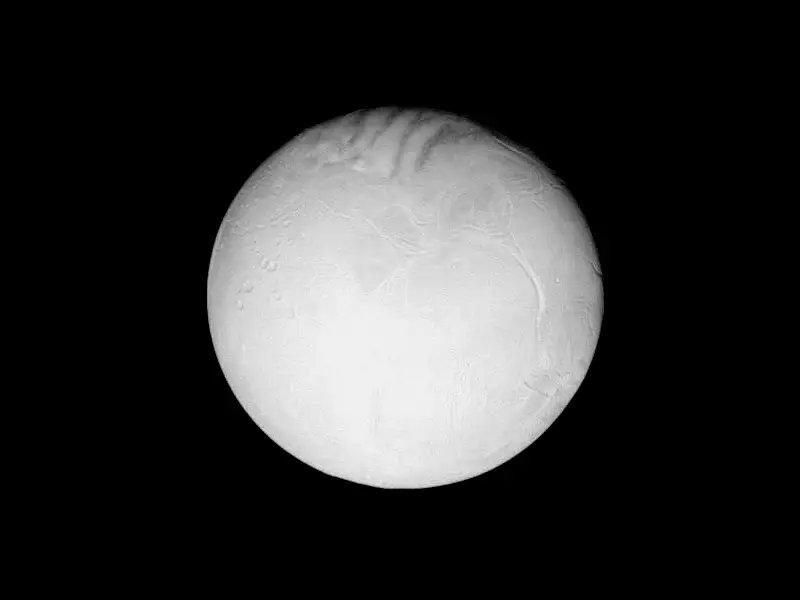
Saturn's small icy moons, Enceladus. Photograph: (Wikimedia Commons)
NASA's Cassini mission, which ended with a dramatic plunge into the atmosphere of Saturn in 2017, gave its first and only direct "taste" of Enceladus' geysers to researchers.
Saturn's small icy moons, Enceladus, measuring only about 300 miles (500 kilometers) across, have become a focal point for scientists to hunt for life beyond Earth. Despite its small size, it releases huge plumes of water vapour, ice particles and organic compounds from cracks near its south pole, which have been viewed as hints of a hidden ocean that could host life.
Surprisingly, new research unveiled at a planetary science gathering in Finland presents another possibility where researchers argued that several organic compounds previously detected in the plums could actually originate on the frozen surface of the moon, driven by relentless radiation from the magnetic field of Saturn, according to a report in Space.com.
The results raise doubts about whether these wings truly signal alien life or are merely the echoes of lifeless chemicals on a frozen shell. "Although this doesn't rule out the possibility that Enceladus' ocean may be habitable, it does mean we need to be cautious in making that assumption just because of the composition of the plumes," study lead Grace Richards of Italy's National Institute for Astrophysics said in a statement.
How did scientists find the possibility of life on Saturn's moon?
Richards and her colleagues regenerated the environment on Enceladus in miniature inside a specialised laboratory in Hungary for their experiment. Using an ice chamber, the team froze a mixture of water, carbon dioxide, methane and ammonia to a bone-chilling temperature of -420 degrees Fahrenheit (-253 degrees Celsius), similar to the cold conditions near the moon's surface. Then, the ices were bombarded with high-energy "water-group ions," similar charged particles which are found on Saturn that constantly irradiate Enceladus.
To study the chemical transformations caused by radiation, scientists employed infrared spectroscopy to track the unique molecular "fingerprints," or spectra, of the icy samples. As radiation interacted with the material, shifts in the spectra indicated the creation of new compounds. Across all five experiments, the irradiated ices generated carbon monoxide, cyanate, and ammonium, the same molecules identified in the plumes of Saturn’s moon Enceladus by NASA’s Cassini mission in 2005.
Trending Stories
)
)
)
)
)
)
)
)
)
)
)
)
)
)
)
)
)
)
)
)
)
)
)
)
)
)
)
)
)
)
)
)
)
)
&im=FitAndFill=(700,400))
)
)
)
)
When the samples were gradually warmed, more complex organic molecules emerged. These include carbamic acid, ammonium carbamate and potential amino acid precursors such as methanol and ethanol, as well as molecules like acetylene, acetaldehyde and formamide, known as fundamental ingredients for prebiotic chemistry, also formed, highlighting their potential role in supporting the chemical basis of life.
"Although many of these products have not previously been detected on Enceladus' surface, some have been detected in Enceladus' plumes," Richards and her colleagues wrote in the paper. This leads to "questions about whether plume material is formed within the radiation-rich space environment or whether it originates in the subsurface ocean," study lead Grace Richards of Italy's National Institute for Astrophysics also said in a statement.
NASA's Cassini mission, which ended with a dramatic plunge into the atmosphere of Saturn in 2017, gave its first and only direct "taste" of Enceladus' geysers for humankind. The instruments onboard the spacecraft, however, were not equipped to differentiate between molecules that may have originated in the moon’s deep ocean and those that could have formed within its icy crust.
In parallel, China is developing a multi-phase mission plan featuring an orbiter, a lander, and a drilling robot capable of penetrating the surface to access the subsurface ocean. The aim is to directly investigate for possible biosignatures.

