After 'Disregard', Google AI Overview has a spelling problem - 'P' in Google and 2 'M' in Gemini

&imwidth=600&imheight=450&format=webp&quality=medium "After 'Disregard', Google AI Overview has a spelling problem - 'P' in Google and 2 'M' in Gemini")
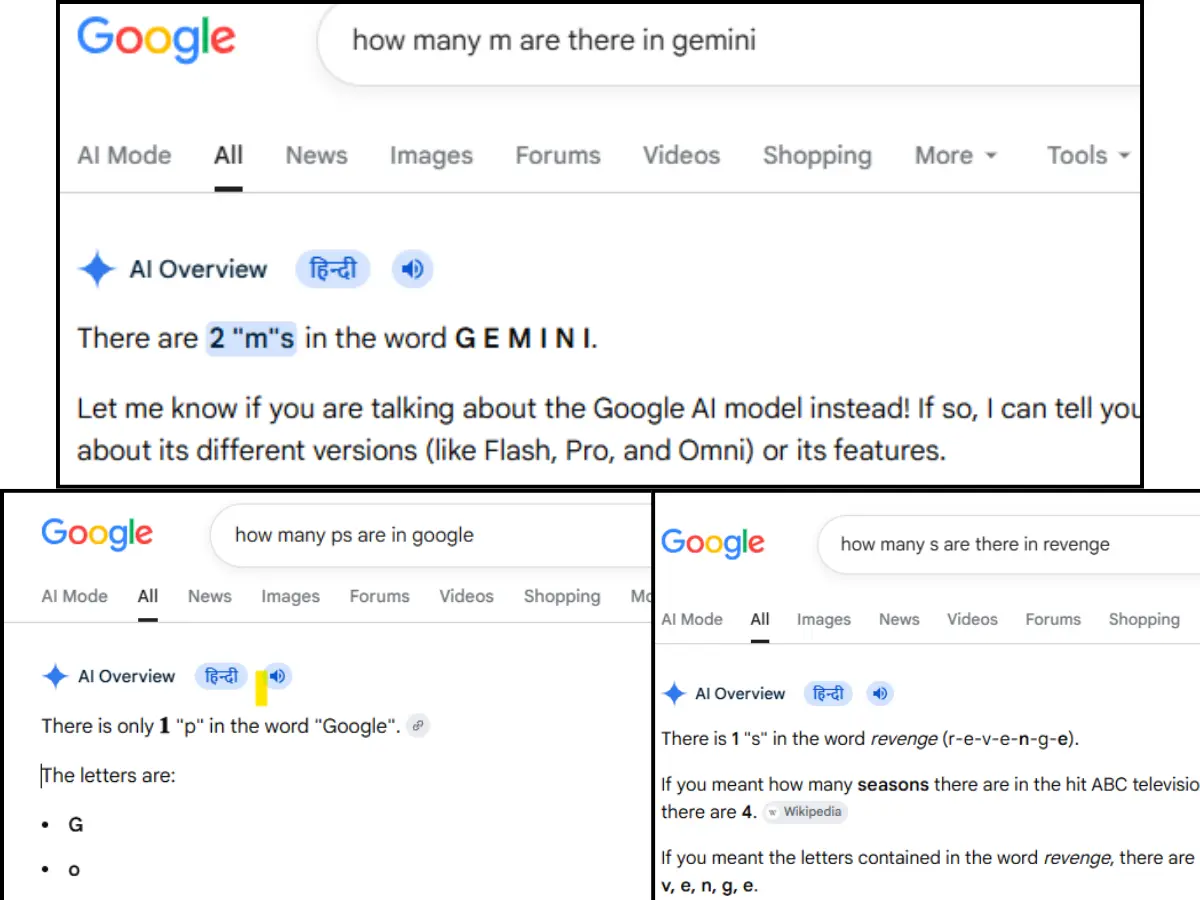
Google AI Overview cannot spell because of the way it processes data. Photograph: (Google)
Google AI Overview is getting spellings wrong, a problem Google has acknowledged. Even when you ask the tool the reason, it tells you it is because of how it processes information. It is adding letters to words, and even inventing entirely new spellings.
Google’s AI Overview has become the laughing stock over its inability to identify the number of letters in simple words, often giving the wrong number. Ask it "how many Ls are there in Google", and it says 2. Even when you ask it about its own AI tool - Gemini - it gets it wrong. When I asked the new search tool on Google, "How many Ms are there in Gemini?", it responded - 2. Even when I ask, how many times an alphabet appears in a word that doesn't even use the letter, it gives me a number. "How many Ps are there in Google?" I asked. It replied with - "There is only 1 ‘p' in the word "Google"." People are sharing similar screenshots of the new search misspelling words. With AI already becoming a topic of resentment across industries, when Google releases a product that fails to get right what a primary school child can tell, it is itself providing fodder for mockery.
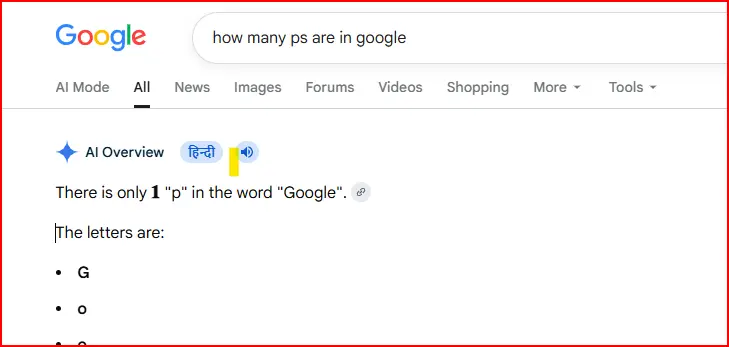
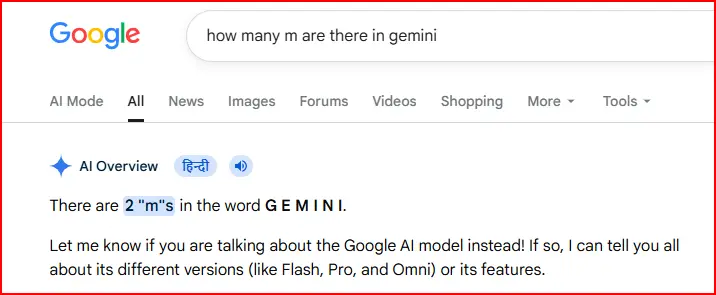
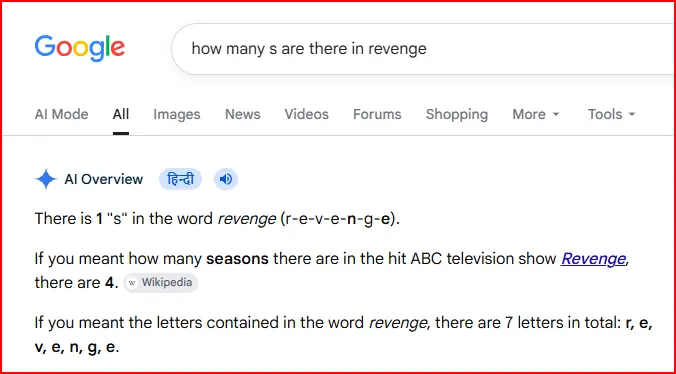
Other spelling mistakes it made include the word journalism, which it spelt as "j-o-u-r-n-a-d-i-s-m". It also goes on to claim the word contains two "Ds." It also gets the spelling of American President Donald Trump wrong, writing “t-r-p-u-m”. In one instance where it said there were 2 Ls in Google, it was actually relying on an article from 2009 about Google’s 11th birthday doodle «Goog11e». Google has acknowledged the problem which has been flagged by users in the past as well. The company says counting letters within words remains a known challenge for large language models, or LLMs.
Also Read: 'My bad! Good catch': Claude and ChatGPT say there are 2 Ls in Google. Then explain what went wrong
Trending Stories
&imwidth=280&imheight=210&format=webp&quality=medium)
&im=FitAndFill=(700,400)&imwidth=280&imheight=210&format=webp&quality=medium)
&imwidth=280&imheight=210&format=webp&quality=medium)
&imwidth=280&imheight=210&format=webp&quality=medium)
&imwidth=280&imheight=210&format=webp&quality=medium)
&imwidth=280&imheight=210&format=webp&quality=medium)
&imwidth=280&imheight=210&format=webp&quality=medium)
&imwidth=280&imheight=210&format=webp&quality=medium)
&imwidth=280&imheight=210&format=webp&quality=medium)
&imwidth=280&imheight=210&format=webp&quality=medium)
&imwidth=280&imheight=210&format=webp&quality=medium)
&imwidth=280&imheight=210&format=webp&quality=medium)
&imwidth=280&imheight=210&format=webp&quality=medium)
&imwidth=280&imheight=210&format=webp&quality=medium)
&imwidth=280&imheight=210&format=webp&quality=medium)
&imwidth=280&imheight=210&format=webp&quality=medium)
&imwidth=280&imheight=210&format=webp&quality=medium)
&im=FitAndFill=(700,400)&imwidth=280&imheight=210&format=webp&quality=medium)
&imwidth=280&imheight=210&format=webp&quality=medium)
&imwidth=280&imheight=210&format=webp&quality=medium)
&imwidth=280&imheight=210&format=webp&quality=medium)
&imwidth=280&imheight=210&format=webp&quality=medium)
&imwidth=280&imheight=210&format=webp&quality=medium)
&imwidth=280&imheight=210&format=webp&quality=medium)
&imwidth=280&imheight=210&format=webp&quality=medium)
&im=FitAndFill=(700,400)&imwidth=280&imheight=210&format=webp&quality=medium)
&imwidth=280&imheight=210&format=webp&quality=medium)
&imwidth=280&imheight=210&format=webp&quality=medium)
&imwidth=280&imheight=210&format=webp&quality=medium)
&imwidth=280&imheight=210&format=webp&quality=medium)
&imwidth=280&imheight=210&format=webp&quality=medium)
&imwidth=280&imheight=210&format=webp&quality=medium)
Why can't AI spell correctly? Here is what Gemini says
When you ask Gemini the reason for AI tools misspelling words, it says, "Rather than reading text like a human, these models dissect language into tokens—chunks of characters that can represent prefixes, syllables, or full words." It adds, "Because the model perceives ‘apple’ as a single ID (e.g., Token #402) rather than the sequence A-P-P-L-E, it lacks an inherent ‘eye' for individual characters." It acknowledged in the end - “An AI can write a brilliant essay on Shakespeare but may still stumble if you ask it to count the number of 'n's' in the word 'banana'.”
Disregard and Ignore in Google AI Overview
Users flagged another problem with Google AI Overview after it was launched, where it was treating certain words as a "command" and not actually answering the query about it. Typically, when you write "disregard" in a Google search, it would define the word and give contextual meaning. However, this time it replied - "Understood. Let me know whenever you have a new prompt or question! Similar things happened with words like "ignore" and "forget".

