

&imwidth=800&imheight=600&format=webp&quality=medium "5th-century Indian ship INSV Kaundinya embarks on maiden voyage; PM Modi hails Navy")
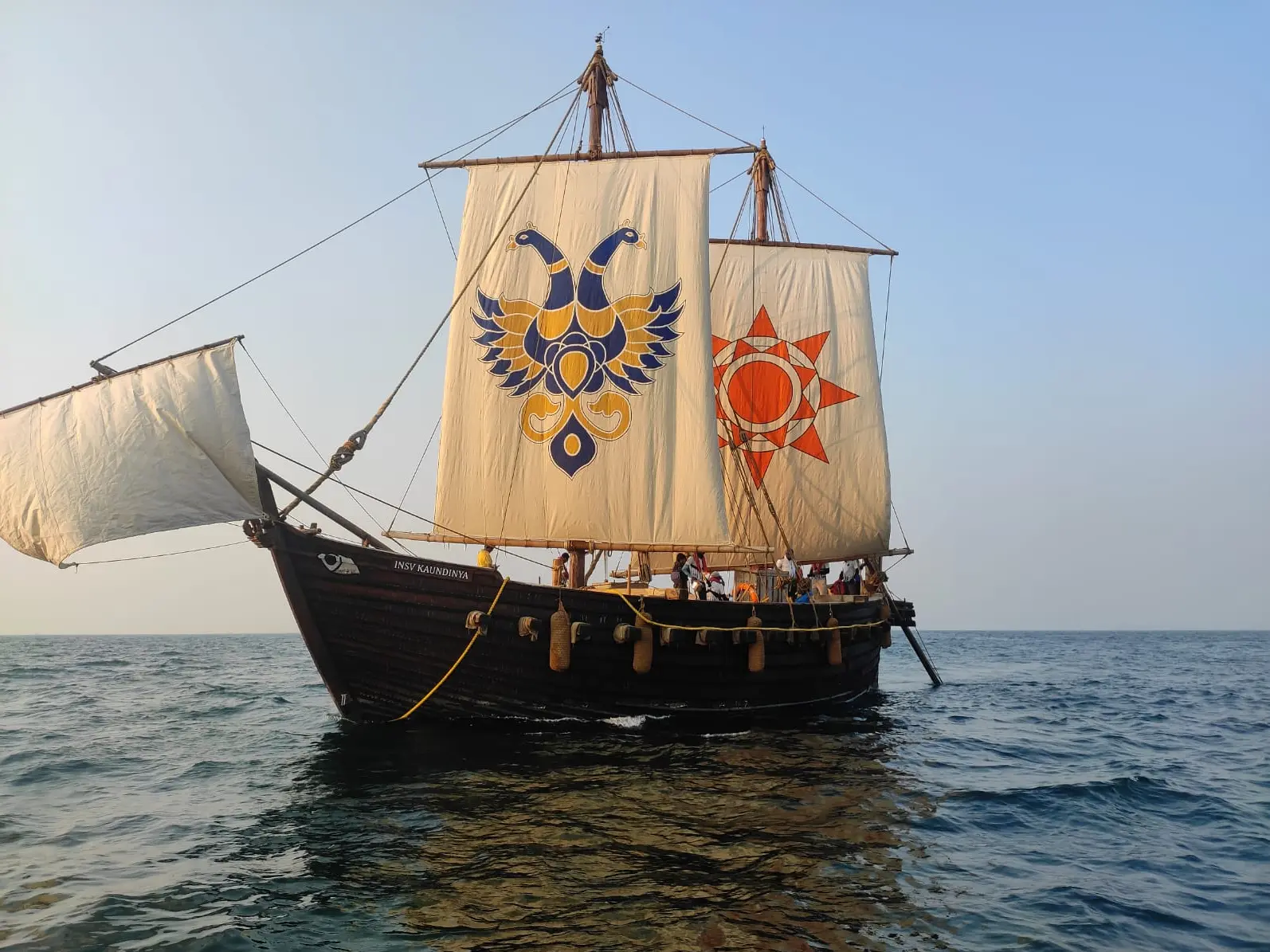
Indian Navy boasts its state-of-the-art aircraft carriers, submarines, warships, but its newest addition, a 5th-century vessel, takes pride in not employing any modern technology as Indian Naval Sailing Vessel Kaundinya, the Navy’s indigenously built traditional stitched sailing vessel, on Monday (Dec 29) embarked on its maiden voyage from Porbandar, Gujarat, to Muscat in Oman. The ship set sail for the Indian Ocean with the Naval band playing “Jai Ho” from Slumdog Millionaire.
Prime Minister Narendra Modi congratulated the people behind the project, saying that the ship highlights "India's rich maritime traditions."
"Wonderful to see that INSV Kaundinya is embarking on her maiden voyage from Porbandar to Muscat, Oman. Built using the ancient Indian stitched-ship technique, this ship highlights India's rich maritime traditions. I congratulate the designers, artisans, shipbuilders and the Indian Navy for their dedicated efforts in bringing this unique vessel to life. My best wishes to the crew for a safe and memorable journey, as they retrace our historic links with the Gulf region and beyond," he wrote in a post on X.
Why INSV Kaundinya is special
INSV Kaundinya is a stitched sail ship modelled on a 5th-century CE vessel depicted in the Ajanta Caves paintings. The project began in July 2023 under a tripartite agreement between the Ministry of Culture, the Indian Navy, and Hodi Innovations, with funding from the Ministry of Culture.
Named after the legendary mariner Kaundinya, who is believed to have sailed from India to Southeast Asia in ancient times, the ship reflects India’s historic maritime heritage.
Trending Stories
&imwidth=180&imheight=135&format=webp&quality=medium)
Brendan Taylor overtakes Andy Flower to become Zimbabwe’s leading ODI run-scorer
&imwidth=180&imheight=135&format=webp&quality=medium)
Researchers name newly discovered Andean plant after Argentina legend Lionel Messi
&imwidth=180&imheight=135&format=webp&quality=medium)
Lawrence Bishnoi gang claims responsibility for firing at Tiger Shroff over ties to Salman Khan
&imwidth=180&imheight=135&format=webp&quality=medium)
Flying car race: Alef Aeronautics welcomes Tesla Roadster '11 years' later, but are the two models the same?
&imwidth=180&imheight=135&format=webp&quality=medium)
KATSEYE performs at Victoria’s Secret show, teases Sophia Laforteza’s return
&imwidth=180&imheight=135&format=webp&quality=medium)
Shastri backs Shami comeback; lauds Bhuvi and warns Bumrah on format workload ahead of World Cup
&imwidth=180&imheight=135&format=webp&quality=medium)
Saudi Arabia asks skyscraper employees to work from home amid Houthi threats
&imwidth=180&imheight=135&format=webp&quality=medium)
Tiger Shroff shows injuries after Juhu firing incident; Eknath Shinde says Mumbai won’t tolerate gang wars
&imwidth=180&imheight=135&format=webp&quality=medium)
NFl 2026/27 - Saints vs Steelers to go ahead in Paris next week despite protest
&imwidth=180&imheight=135&format=webp&quality=medium)
4 killed, 19 critically injured in grass fire at Canada's largest military base
&imwidth=180&imheight=135&format=webp&quality=medium)
Nobel laureate Machado, who dedicated prize to Trump, confirmed as Venezuela opposition leader
&imwidth=180&imheight=135&format=webp&quality=medium)
After Kennedy Center and reflecting pool disputes, Trump turns to Washington golf course plan amid legal battle
&imwidth=180&imheight=135&format=webp&quality=medium)
Why France looks the most fragile in the G7 amid protests and budget deadlock
&imwidth=180&imheight=135&format=webp&quality=medium)
Asian Para Games: Nishad Kumar clinches T47 long jump gold; Ravi Budigina bags swimming silver
&imwidth=180&imheight=135&format=webp&quality=medium)
China responds to Trump's Press Secretary Katie Zacharia after toilet remark: 'Visit China more often'
&imwidth=180&imheight=135&format=webp&quality=medium)
Cattle feed found in biscuits of Indian company, FSSAI sends legal notice
&imwidth=180&imheight=135&format=webp&quality=medium)
Anthropic’s public benefit plan: What its 5% share commitment means for AI’s future
&imwidth=180&imheight=135&format=webp&quality=medium)
Girl 'dead' for 8 hours wakes up at her own funeral, dad insists she wasn't breathing
&imwidth=180&imheight=135&format=webp&quality=medium)
MI5 is opening an AI threat centre, and OpenAI just told MPs the worst isn't over
&imwidth=180&imheight=135&format=webp&quality=medium)
Elon Musk features on Lucknow's 'anti-India' Ravan poster alongside Rahul Gandhi, Akhilesh
&im=FitAndFill=(700,400)&imwidth=180&imheight=135&format=webp&quality=medium)
New OTT releases this week (October 19-25, 2026): Gajab Raat to Chaar Yaar-8 titles to watch during Dussehra week on Netflix, Prime Video and more
&imwidth=180&imheight=135&format=webp&quality=medium)
Kylie Jenner makes Victoria’s Secret debut in $50 million diamond-encrusted design as Timothée Chalamet cheers
&imwidth=180&imheight=135&format=webp&quality=medium)
Putin wants joint meeting with Trump-Xi summit on Ukraine war, proposes talks alongside APEC: Report
&imwidth=180&imheight=135&format=webp&quality=medium)
No Ravindra Jadeja, Yashasvi Jaiswal in India’s 2027 ODI World Cup plans: Report
&imwidth=180&imheight=135&format=webp&quality=medium)
India moves to buy 10,000 more AI chips for a national compute pool open to startups
&imwidth=180&imheight=135&format=webp&quality=medium)
Tiger Shroff attacked by three gunmen in Mumbai, actor safe, two injured
&imwidth=180&imheight=135&format=webp&quality=medium)
Anirudh Ravichander-Kavya Maran wedding: Telangana CM reveals Chennai reception date
&im=FitAndFill=(700,400)&imwidth=180&imheight=135&format=webp&quality=medium)
Tesla Roadster engineering: The hidden hardware behind its flying demonstration
&imwidth=180&imheight=135&format=webp&quality=medium)
US to review Russia sanctions waiver within 60 days as Rubio cites India’s ‘substantial’ Russian energy imports
&imwidth=180&imheight=135&format=webp&quality=medium)
'Grassroots leagues help bridge the gap': India's ODI WC winner Suresh Raina lauds ISCL ahead of Season 2
&imwidth=180&imheight=135&format=webp&quality=medium)
'We feel like Mr India': Gujarat’s undercover SHE team guard garba nights at Navratri
&imwidth=180&imheight=135&format=webp&quality=medium)
Cattle-feed bran in biscuits, detergent in milk: FSSAI acts against 3 companies
&imwidth=180&imheight=135&format=webp&quality=medium)
'It's a joy to see the makers bring it on such a grand scale': SS Rajamouli on Ramayana
&imwidth=180&imheight=135&format=webp&quality=medium)
Priest dies after crucifix falls on his head during livestreamed Mass in Ecuador | VIDEO
Its sails feature motifs of the Gandabherunda and the Sun, the bow is adorned with a sculpted Simha Yali, and a symbolic Harappan-style stone anchor sits on the deck, each element celebrating India’s rich seafaring traditions.
Facilities on board
The journey to Oman on board an ancient ship is not going to be an easy one, as the Ship's builders refused to utilise modern technologies and built it solely on traditional shipbuilding methods.
Sanjeev Sanyal, a member of the Economic Advisory Council to the Prime Minister, who pioneered the idea of rebuilding a stitched ancient ship, gave a glimpse of life on INSV Kaundinya "Modern amenities are minimal except for safety and communications. This is how it looks under the deck. As you can see, there are no cabins and just a dark hold for storing supplies. Mostly, we sleep on the open deck with sleeping bags," he wrote on X, sharing photos of the amenities onboard.
Regarding food for crew members, Sanyal, who himself is part of the crew, said, "We are carrying some fresh vegetables that should last the first 5-6 days. Thereafter, it is dry rations and any fish we catch. Fresh water is rationed to 4.5 litres a day per person, including drinking, a share of cooking water, and washing".
Significance of the Voyage
For India, the voyage also serves as a soft-power initiative, highlighting its role in ancient East-West trade and challenging the perception that China’s “Silk Road” caravans were dominant.
It challenges the popular perceptions that Indians were not great seafarers or that ancient India remained inward-looking, never undertaking great voyages apart from a few well-known endeavours during the Chola period around 1000 CE.
