
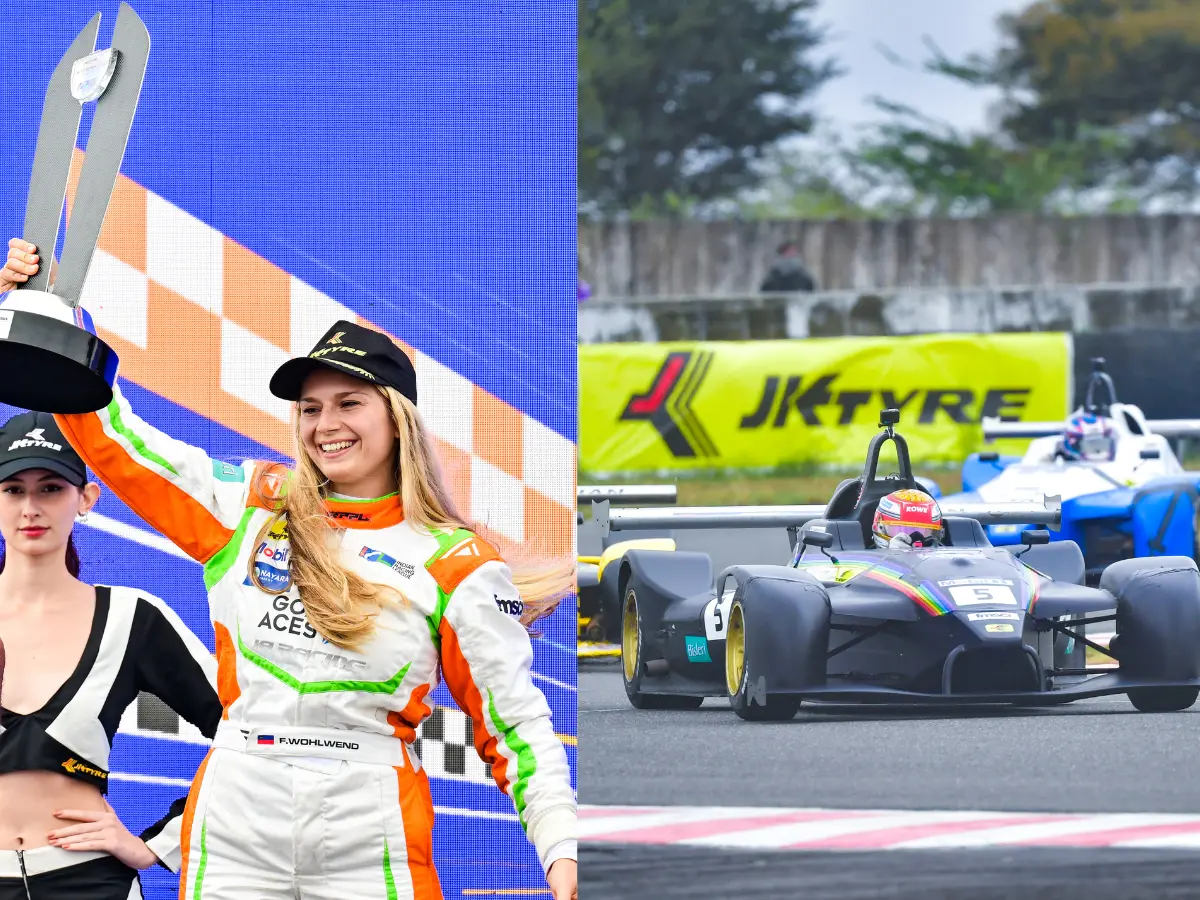
&imwidth=800&imheight=600&format=webp&quality=medium "WION Exclusive: Fabienne Wohlwend — The racer who refused to be limited by geography")
She doesn’t announce herself with noise. Fabienne Wohlwend arrives with composure, tall, blonde, sharp-featured, her gaze calm yet searching, like a driver already visualising the next corner. In photographs, she carries an effortless elegance; in a racing suit, that elegance hardens into focus. There is steel behind the smile, a quiet intensity shaped by years of fighting for space in a sport that rarely makes room easily.
From the outside, her story looks improbable. Liechtenstein, a country better known for alpine views and skiing slopes than race tracks, has no karting circuit, no motorsport pipeline, no legacy of racing heroes. And yet, from this unlikely setting emerged a driver who would go on to race Ferraris, conquer endurance circuits, and become a global symbol of what persistence looks like at 300 km/h.
Wohlwend’s romance with motorsport started at seven years old, not with privilege but with curiosity. She wanted a pony. Her brother received a go-kart instead. A family trip to a small karting track in Switzerland changed everything. After her first laps, she climbed out of the kart, looked at her father, and said she wanted to become a Formula One champion. It sounded like a childhood fantasy then. Today, it reads more like a mission statement.

Her early years were shaped by sacrifice. Racing wasn’t a business; it was a family project. Her father served as the mechanic, her mother managed logistics and meals, and weekends were spent travelling across Switzerland and northern Italy in a motorhome. While other young racers arrived with factory teams and engineers, Wohlwend competed as a private entrant, often measuring success not in wins but in simply reaching finals against grids stacked with future Formula One names. That grind forged her. It taught her resilience, mechanical understanding, and the patience to build a career the long way.
From family garages to Ferrari history
Trending Stories
)
2,200 people donate Rs 1.5 crore for 'docile' Georgia donkey 'HeeHaw' shot dead by police officer
)
Los Angeles helicopter crash: At least three dead, several injured; NTSB to investigate
)
Ex-CIA officer caught with gold bars worth $40 million seeks plea deal | Gravitas
)
Sydney Sweeney defends provocative ad choice, the internet is still not impressed
)
Trump's name cannot return to Kennedy Center, US judge rules
)
India summons top Pakistan diplomat after Pak Navy ship collides with Indian warship at high seas
)
India’s imports from Russia jump 57% in five months; China remains top import source
)
1,200 Indian and US troops begin high-altitude and desert drills
)
Salman Khan gives The Revolutionaries a shoutout, watches series with Bhuvan Bam, Nikkhil Advani at Galaxy
)
Messi set to play in farewell match on October 6 in Argentina vs Benin friendly
)
China's property crisis deepens as investment plunges nearly 20%
)
Space mines, lasers & robotic arms: Lt Gen Pannu decodes US disclosure of weapons in space
)
‘US military task force aiding Saudi Arabia forces with intel, planning support’: Official
)
Top military commanders from US, Israel, and 7 Arab nations held secret meeting on Iran War
)
US fires up to 70 interceptors against Iran attack on Jordan, putting supplies under pressure
)
Ex-India all-rounder Yuvraj Singh wants India to avoid 'massive changes' before ODI World Cup 2027
)
Saudi turns to Israel for intelligence help as Houthi attacks intensify: Report
)
Water equivalent to two Pacific Oceans could be stashed 2,900 km inside Earth
)
Saudi Arabia accuses Houthis of drone attack on Mecca, first-ever red alert in Islam's holiest site sparks panic
)
Saudi Arabia discovers 110 million tonnes of Uranium-rich ore in Madinah region
)
‘Kill all in the name of...’: FBI arrests 21-year-old over alleged ISIS-inspired mass-casualty attack plot
)
US Treasury yields cross 5% as Scott Bessent warns of ‘global issues’ impacting bonds
)
'Now Trump is copying us': Shivakumar links US $5,000 plan to Congress guarantees
)
Who is Kalyan Bainsla, accused in the Gurugram hit-and-run case involving woman biker?
)
OpenAI boss Sam Altman repeats AI 'slow down' call, says world 'right to be afraid'
)
Ed Sheeran’s US tour loses all support acts after Macklemore’s removal | Controversy explained
)
'Definitely feel bad for yourself': Kuldeep Yadav opens up on India Test snubs
)
Trump's Iran war faces fresh House rebuke; 7 Republicans join Democrats in push to end conflict ahead of midterms
)
'Like a thug you are using agency to go after..': Kash Patel grilled by Senate Democrats over FBI firings, journalist investigations and hiring policy
)
Putin-linked Russian oligarch, Melania links: Why Trump skipped his son’s Bahamas wedding bash?
)
Bitter Zelensky snubs Trump for playing politics with Ukraine war | Gravitas
&im=FitAndFill=(700,400))
New OTT releases this week (September 14-20, 2026): Lust Stories 3, Waiting Hai, Irumudi- 5 new titles coming on Netflix, Prime Video and more
)
West Bengal IPS officer Bushra Bano transferred after objections to ‘Assalamualaikum’, ‘Inshallah’
)
Spanish officer sent home from NATO base over affair with 'Russian spy' | Gravitas
)
800 million years old - Scientists discover 'fingerprints' of supercontinent Gondwana in ancient rocks
The breakthrough didn’t arrive overnight, it arrived through persistence. Formula cars sharpened her racecraft, GT machinery tested her adaptability, and endurance racing expanded her mental limits. But one moment would change everything. A guest appearance with a Swiss Ferrari team turned into a defining chapter. When Wohlwend won a Ferrari race outright, she didn’t immediately grasp the scale of it. Only later did the realisation settle in: she had become the first woman to win a race outright for Ferrari. The moment was historic, but more importantly, it was transformative. Ferrari wasn’t just a badge, it was validation at the highest level. That victory rewrote the trajectory of her career.
Soon after, the W Series arrived, a championship designed to give women a global platform in single-seater racing. At the time, Wohlwend was still working full-time in banking, balancing spreadsheets with steering wheels. The series changed that. Prize money, visibility, and credibility allowed her to walk away from her desk job and become a full-time professional racer. W Series did more than boost her profile; it changed perception. Racing alongside elite fields, Wohlwend fought at the front, proving she wasn’t there because of gender, but because of speed. Even today, she notes how mentioning W Series still commands respect in paddocks across the world.
Yet for Wohlwend, the purest form of racing is endurance. It strips glamour away and leaves only discipline. Long nights, shared machinery, strategic compromise, physical exhaustion, endurance racing tests not just how fast you are, but how complete you are as a driver. It is here, particularly on fearsome circuits like the Nürburgring Nordschleife, that she feels most challenged, and most alive.
On Indian Racing Festival
When Fabienne Wohlwend speaks about the Indian Racing Festival, there is a noticeable shift in tone, from the measured calm of an experienced international racer to the excitement of someone witnessing a motorsport culture finding its voice. For the Ferrari race winner and endurance specialist from Liechtenstein, India is no longer just another stop on the calendar; it is a place where racing feels alive, ambitious, and unapologetically hungry for growth.
Now heading into her fourth season with the Indian Racing League, with the Goa Aces JA Racing team, Wohlwend has had a front-row seat to the evolution of the Indian Racing Festival. What began as a bold experiment has steadily transformed into a structured, competitive platform that blends international experience with emerging Indian talent.
“The growth I’ve seen in just four years has been insane,” Wohlwend says, reflecting on the league’s rapid development. From tighter racing and improved organisation to increasing fan engagement, the festival has matured at a pace that mirrors India’s wider sporting ambitions. For Wohlwend, the passion of Indian audiences stands out the most. “People really care here. They want this to succeed,” she says. Beyond results, Wohlwend sees the festival as a catalyst. By offering equal opportunity, professional structure, and global visibility, the Indian Racing Festival is doing more than hosting races, it is building belief. “Once fans change, once girls start seeing themselves in racing, everything else follows,” she says.
Carrying a flag for the next generation
Racing from Liechtenstein has never been easy. There were no athlete schools tailored to motorsport, no local infrastructure, and limited sponsorship opportunities. Wohlwend had to miss school days, juggle education, and repeatedly justify a career path few around her understood. And yet, she persisted, not just for herself, but for what her journey could represent.
Today, she sees tangible change. Platforms like F1 Academy, mandated female participation in series like the Indian Racing League, and women stepping into technical roles are reshaping motorsport’s landscape. For Wohlwend, visibility is everything. When young girls see women on podiums, on pit walls, and in cockpits, belief follows. Away from the track, she remains grounded. Home in Liechtenstein offers quiet mountains, familiar faces, and long walks that reset her mind. Family keeps her anchored. Fitness training keeps her sharp. Most importantly, she insists on being “Fabienne the person,” not just “Fabienne the racing driver.”
Looking ahead, her ambitions remain fiercely alive. Winning the Nürburgring 24 Hours stands tall on her list, a goal as demanding as it is symbolic. Not because it would complete her story, but because it would extend it. When her career is eventually written into history, Wohlwend hopes she’ll be remembered not only for her results, but for widening the path — making motorsport feel a little more possible for girls watching from places where racing still feels distant.
From a tiny Alpine country to the global racing stage, Fabienne Wohlwend’s journey is proof that speed has no postcode, only belief, preparation, and the courage to keep pushing when the odds suggest you shouldn’t.

