

&imwidth=800&imheight=600&format=webp&quality=medium "WION ExpertSpeak - Better Coaches, Better Future: Premier League NextGen mentor Carl Plunkett on nurturing football at India’s grassroots")
India is surely a cricket-crazy country but the game of football has its fans and in huge numbers which makes tournaments like English Premier League very popular in the country. There are fans bases for famous teams including Manchester United, Liverpool, Arsenal and others with young children wanting to play the game as professionals in future like their stars do for these teams. To develop players at grassroot levels, Premier League India recently organized a camp to coaches which would enable young children to take up the sport realize their dream.
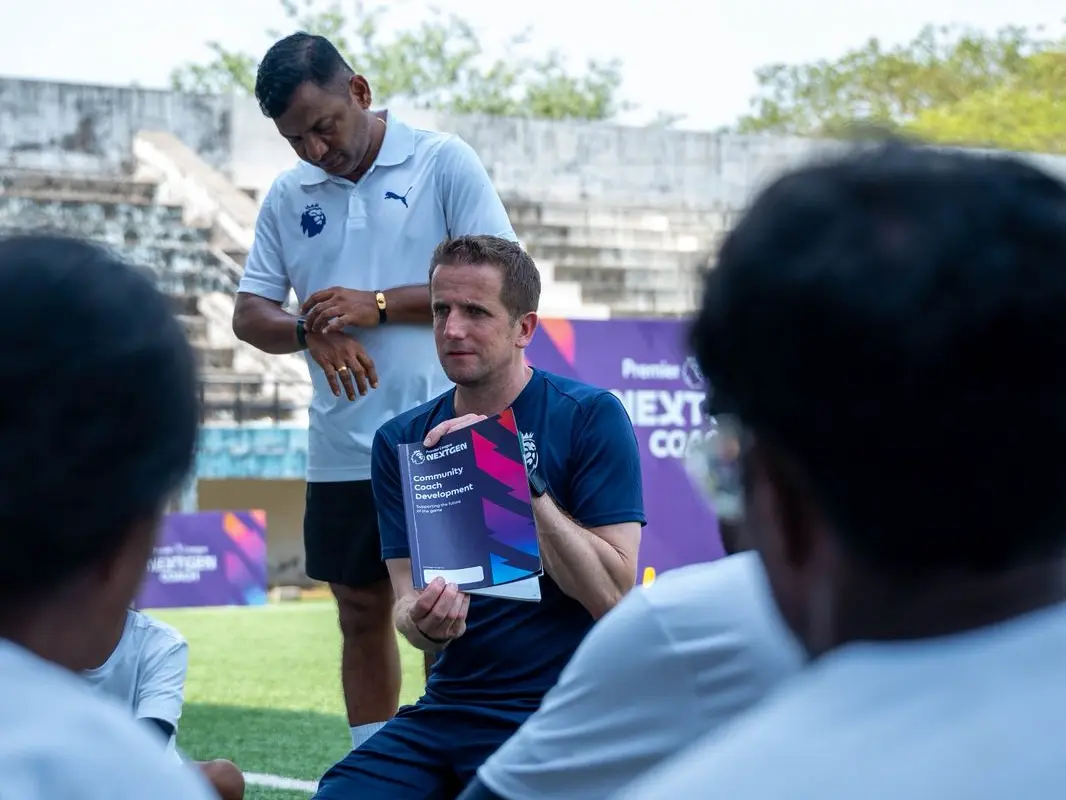
Premier League NextGen coaching campaign, which was held in Goa, invited various experienced professionals from the English league to help Indian coaches understand the nuances to developing children's interest, skill, and game awareness and communication.
Speaking on the campaign's aim, Premier League India Managing Director Hrishikesh Shende said: "The thought process behind this camp is to create long-term impact by investing in grassroots coaches, because they are key to shaping the future of football in India. Through programmes like NEXTGEN Coach and partnerships such as Dream Sports Foundation, we want to share Premier League expertise, build safer and more inclusive football environments, and strengthen coaching infrastructure at scale. Going forward, the focus is on expanding our footprint, deepening local partnerships, and empowering more Indian coaches and young players across the country.”
One of the mentors of the program, Carl Plunkett, who has over 18 years of experience collaborating with senior leadership teams at Premier League Category 1 football academies, spoke to WION in a detailed conversation about the program, what it entails and how it will help promote and develop the game in India.
Q) What inspired you to join this program and what are your ideas that you want to implement or you want to share with the Indian coaches specifically?
Trending Stories
&imwidth=180&imheight=135&format=webp&quality=medium)
Russian woman and Bihar boy's love story goes viral after she reaches India to marry him
&imwidth=180&imheight=135&format=webp&quality=medium)
Anupam Kher joins Ranbir Kapoor's Ramayana as Jatayu, new poster unveiled
&imwidth=180&imheight=135&format=webp&quality=medium)
F1 set to return to Africa for first time since 1993
&imwidth=180&imheight=135&format=webp&quality=medium)
France accuses Musk of ‘online harassment’ of European leaders, warns of poll interference
&imwidth=180&imheight=135&format=webp&quality=medium)
CMs Vijay-Naidu meet in Vijayawada, discuss water sharing, river-linking
&imwidth=180&imheight=135&format=webp&quality=medium)
'Ouch!!! That must hurt': Kangana Ranaut hails Kamal Haasan's sharp reply to Elon Musk over Starlink row
&imwidth=180&imheight=135&format=webp&quality=medium)
Trump accuses Houthis of driving up oil prices before US midterms, warns of consequences
&imwidth=180&imheight=135&format=webp&quality=medium)
'Turn approver, resign, we'll forgive you': Rahul Gandhi claims receiving messages from CEC Gyanesh Kumar
&imwidth=180&imheight=135&format=webp&quality=medium)
'Don't ever mess with nature!': Trump’s tiger attack post triggers social media backlash as victim's family issues heartbreaking tribute
&imwidth=180&imheight=135&format=webp&quality=medium)
‘My president, I mean my husband’: Trump's new press secretary Katie Zacharia's first briefing goes off the rails in 14 minutes
&im=FitAndFill=(700,400)&imwidth=180&imheight=135&format=webp&quality=medium)
New OTT releases this week (October 12-18, 2026): Sacrifice, Koffee with Karan S9, Roadies Rebirth- 6 titles coming on Netflix, JioHotstar and more
&imwidth=180&imheight=135&format=webp&quality=medium)
New Delhi rejects Beijing’s claims and remarks on Ladakh location naming exercise
&imwidth=180&imheight=135&format=webp&quality=medium)
CJP slams 'Coward Sarkar' as Saurav Das, Ashutosh Ranka sent to 5 days' judicial custody over Jantar Mantar protest
&imwidth=180&imheight=135&format=webp&quality=medium)
Girl 'dead' for 8 hours wakes up at her own funeral, dad insists she wasn't breathing
&imwidth=180&imheight=135&format=webp&quality=medium)
Measles kills again: 6 dead in Pennsylvania as America faces its worst outbreak in decades | Gravitas
&imwidth=180&imheight=135&format=webp&quality=medium)
New Cold War: Why is China buying more gold? Explained
&imwidth=180&imheight=135&format=webp&quality=medium)
MI5 chief warns Russia is UK’s ‘aggressor number one’ as Iran and AI threats grow
&imwidth=180&imheight=135&format=webp&quality=medium)
Pakistan to chair UN-backed global Borrowers’ Platform as its own debt burden mounts, triggers sarcastic reactions on social media
&im=FitAndFill=(700,400)&imwidth=180&imheight=135&format=webp&quality=medium)
Navratri 2026: 9 days, 9 forms of Goddess Durga and 9 colours- Check the complete list
&imwidth=180&imheight=135&format=webp&quality=medium)
Netanyahu wants to join Saudi's war on Houthis, but Crown Prince denies: Report
&imwidth=180&imheight=135&format=webp&quality=medium)
China's counter-surveillance industry booms amid heightened espionage fears | Gravitas
&imwidth=180&imheight=135&format=webp&quality=medium)
Cornell University suspends fraternity parties over 2024 gang rape allegations
&imwidth=180&imheight=135&format=webp&quality=medium)
Marco Rubio to visit India next week, focus on energy cooperation and strategic ties
&imwidth=180&imheight=135&format=webp&quality=medium)
1,500 drones illuminate Mumbai sky as Cordelia Cruises unveils second ship, Cordelia Sky
&imwidth=180&imheight=135&format=webp&quality=medium)
US Midterms 2026: In Alaska, cost-of-living anxiety meets strangest ballot in high-stakes Senate race
&imwidth=180&imheight=135&format=webp&quality=medium)
Arijit Singh 9-city India stadium tour to start from January: Check venue and ticket prices
&imwidth=180&imheight=135&format=webp&quality=medium)
Inside Aneet Padda's 24th birthday bash with rumoured boyfriend Ahaan Panday and Alia Bhatt
&imwidth=180&imheight=135&format=webp&quality=medium)
UK school ditches technology, shifts from screen to pen and paper for learning
&imwidth=180&imheight=135&format=webp&quality=medium)
Trump reconsidering calling off Nidal Hasan's execution livestream. Here's why
&imwidth=180&imheight=135&format=webp&quality=medium)
Sidhu Moose Wala’s younger brother wins hearts by recreating late singer’s signature move at Toronto Hologram Show
&imwidth=180&imheight=135&format=webp&quality=medium)
Delhi Police arrest Cockroach Janta Party's Saurav Das, Ashutosh Ranka, Ajinkya Shinde in Jantar Mantar case, to be produced before court
&imwidth=180&imheight=135&format=webp&quality=medium)
Air India Flight from Frankfurt diverted to Jaipur after hijack alert, probe on
&imwidth=180&imheight=135&format=webp&quality=medium)
Durga Puja 2026: Kolkata roads get a splash of colours
&imwidth=180&imheight=135&format=webp&quality=medium)
‘How many people did she illegally bring from Somalia?’ Trump targets Ilhan Omar, questions her net worth
The program has been designed to try and build confidence around the coaches here in India, particularly those that are going to impact in grassroots and working with different children across India. Part of the course is to help them understand with a little bit more knowledge, but a lot of it is about to give them the confidence to create safe and fun environments so that it will be the young people that will benefit from having better coaches. And if you have better coaches, you should have more impactful and fun engaging coaching sessions.
Q) What is your coaching philosophy and what would you like to advise the Indian coaches in the program attending with you? How do they go about their coaching philosophy while trying to step up and develop the football as a game in India at grassroots level and beyond?
The philosophy is really embedded with inside the course. So, there's lots of key features around the course, which are about how you have, like, generate a better connection with young people. So, what is it that you go about and how you go about doing that? Having simple things like listening skills, being able to effectively question and support people's learning. One of the big things on the course is how you utilize the people around you to help you with the coaching.
So, rather than just doing it on your own, are there other support coaches or are there parents who could maybe help you when you're coaching just to be a bit more impactful and fun when you're doing it. The philosophical pieces in here are also about how you make people feel in terms of my coaching manner, in terms of the words I use, in terms of my interaction skills, they're really key to how you want to present yourself as a coach.
Q) One of the topics you shared is effective communication is the key. So, how would you advise the coaches here attending this session with you to deal with the conflicting situations, like sometimes a parent might not be happy with a child's progress or there might be a difference of opinion between the players and the coaches regarding drills or strategy. So, how do you suggest the coaches deal with it?
The course doesn't refer to maybe challenging conversations, but is really dealing with how you create good conversations. So, it would include things such as your body language, how you might be listening to the words the individual is using, and then maybe even playing that back to them in a way that they know that they're being heard.
Ultimately, it doesn't matter where you are in the world, people's skills and interaction skills are all very similar from person to person. And so, when we talk about good conversations with each other, it's really around, if I'm listening to you, do I show interest in my body language? Do I show interest in my eye contact? Do I find ways to ask you to go a little bit deeper with what you're saying, so I can further understand what you're asking? And then that way, you're just showing real interest, which will ultimately develop a better connection between you and the other person.
Q) There's always some sort of divide between talent and skill, like the passion for the game and the skills you have, and some children might not be at the level of other children in terms of passion or skill. So what do you suggest the coaches to back more - passion or skill?
Definitely, yeah, it's a good question. Here on the course, what we're really asking them to do is to make the kids feel more confident and more comfortable with what they're doing. And then as a result of that, you start to build a passion. And if you can build a passion and people more comfortable with what you're doing, you'll end up getting children who probably currently aren't really interested in sport or football or physical activity into a place where they're running around, they're feeling more healthy. And they're in a position where they are enjoying what's happening.
Q) About the coaches that are attending the camp with you, what do you think that their biggest strength as Indian coaches are like, where they can really make an impact in terms of skills or any other attribute of their personality?
My feeling is that there's a real willingness to learn. They really want to listen. They really want to work hard at getting better. And the more we provide them opportunities to speak, connect and interact with each other, we're really developing their confidence and willingness to want to grow. And that's been really important this week because in order to get better at anything in life, you need to be able to reflect, you need to be able to understand where you currently are and then also where you need to head to to get better.
Q) How do you suggest the coaches keep the focus of young children while they're in the drill or while they're in practice because it could be boring for the young children sometime.
Yeah, it's a really good question. So all of the principles that we embed in this program, we offer them eight different games that they can take away with them. We demonstrate them, they get an opportunity to practice. And then within each game, there's a number of progressions which allows them to keep evolving the practice. But you talked about boredom in that example, because these guys are now starting to work out not just what the whole group needs, but maybe where the individuals are at. We talk a lot about differentiation. There's pieces in here that talk about how do you teach to the bottom of the group, but also the top. So if the coach is actively getting around, and they're applying the core principles of this course, you'll probably find that the kids won't get bored.
Q) Have you in your coaching program also talked about the mental aspect of the game, like keeping the players' mental space very, very clean, firm, and focused? And what are the drills or methods that coaches can apply to achieve that?
There are some subtle moments where they've been designed that players won't be just learning about the technical parts of the game. So passing, shooting, or running. There's also ways that they have to work as a team, which generates opportunities to speak with each other, organize each other, and build strategies. So included with inside the practice games, there are ways to develop young people's psychological and the way they think about things. And that's one of the core principles that we have as part of the Premier League program.

