Toronto mayor visits New Delhi to promote Canada's largest city to Indian business, students

Toronto mayor John Tory
John Tory emphasised Toronto as a centre for commerce, culture and multiculturalism in an effort to increase Indo-Canadian ties
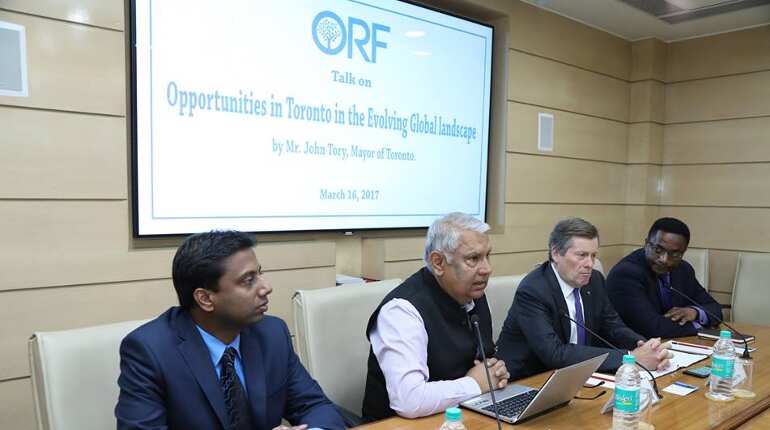
Canada’s second-most internationally beloved politician with the initials JT was inNew Delhi Wednesday to speak to business leaders and politicians“to let the world know Toronto is open for business”.
The twenty-odd minute speech was dubbed, “Opportunities in Toronto in the evolving global landscape”.
Tory insisted he was here as a salesman for Toronto, the first mayor from the city to visit India in 20 years. Premier Kathleen Wynne visited in February 2016, and the chatter before Tory began speaking anticipated a visit to India from Prime Minister Justin Trudeau (the other "JT") later this year or in early 2018.

Mayor Tory’s sell should be easy. Whenever I tell Indians here I myself come from Toronto,they instantly become visibly excited and tell me of their four thousand relatives who live there.
Tory began with facts: Canada is a safe and stable parliamentary democracywith 1.2 million people of Indian-origin living there, good for three per cent of the country'soverall population. One out of every two people in Toronto wasborn outsideCanada.
Tory emphasised that Torontowants Indian students to enroll inits high-qualityschools, and was glad to saythat some graduates would head back to India while some would remain in Canada, toboth country's benefit.
)
Justice eludes Air India 1985 bombing victims as Canada probe goes 'inactive' | Gravitas
)
Trump revives India-Middle East-Europe economic corridor as India emerges central to West Asia’s future: What is it?
)
Erdogan again raises Kashmir issue at UNGA, calls for dialogue under UN Charter
)
Trump signs Greenland security deal with Denmark, paving way for two new US military bases
)
Most Americans want greater federal AI oversight
)
IND vs JPN T20I: How an overturned wide became point of difference between India's win and a tie
)
Trump-Xi summit: From trade to Taiwan, what will the US and Chinese presidents discuss in Washington?
)
Cyclone Arnab: Landfall expected before midnight tomorrow as IMD issues orange alerts across six states
)
ICC plans T20I expansion and fewer ODIs in 2027–2031 FTP cycle: Report
)
US-China tech war: Businesses in the front line
)
'Mumma’s boy from Gwalior who dared to dream': Kartik Aaryan pens long note after first National Award win
)
Gravitas | Boosting NHS productivity could save 20,600 lives in UK annually: Report
)
Nor'easter could batter 13 US states this week. What you should know
)
US and China vie for AI dominance as calls grow for regulation | Gravitas
)
Yemen clashes kill 154 people in two days as cornered Saudi battles Houthi offensive | Gravitas
)
Bomb scare in New York amid UNGA: Suspicious suitcase found near UN headquarters
)
IND vs JPN, one-off T20I: Japan captain Kendel on pushing India to the brink - ‘It was special’
)
Raaka creates history! Allu Arjun’s film secures Guinness World Record ahead of release
)
Mikel Arteta verbally agrees to three-year extension with Arsenal after title-winning Premier League season
)
WION Iconic Tourism Summit and Awards 2026: Key voices to discuss India’s tourism future
)
WION Iconic Tourism Summit and Iconic Awards 2026: India's travel economy leaders gather in Delhi
&im=FitAndFill=(700,400))
New OTT releases this week (September 21-27, 2026): Shaque: Trust No One, Hunkkaar, Don’t Be Shy- 5 new titles coming to Netflix, Prime Video and more
)
81st UN General Assembly: Burnham announces UK-US AI defence tie-up
)
Trump calls on nations to quit ‘rogue’ and ‘out-of-control’ International Criminal Court, rips UN
)
Infections transmitted from pregnant woman linked to autism risk
)
'What kind of confession is this?': Pakistan PM Shehbaz Sharif’s 'terrorists would be roaming New York' remark goes viral, raises alarm online. Watch
)
Elephants hide behind trees, stage surprise attack on poachers targeting rhinos in South Africa
)
IIT Bombay professor Suryanarayana Doolla sent on leave amid Sahil Wakode death probe
&im=FitAndFill=(700,400))
National Film Awards 2026: Kartik Aaryan, Mammootty, Yami Gautam, Randeep Hooda and other key winners
)
‘Strike a deal or drive Iran into hell’: Trump issues fresh warning to Tehran at UNGA
)
Anne Hathaway to run in supporting race for Nolan's epic
)
Over 4,200 books withdrawn from circulation in J&K colleges, 94% from Kashmir
)
From Gaddafi tearing up UN Charter to Trump’s ‘escalatorgate’: Most unforgettable UNGA moments
)
Explainer: Why rare-earth export licences and Board of Trade are US priorities ahead of Trump-Xi summit
)
Asia prepares for record El Nino, food shock
)
Oil slips to $98 as Saudi Arabia restarts East-West oil pipeline
)
Four female students raped during 'Red Zone' at California university. What we know
)
'Taiwan and human rights are red lines': China warns US ahead of Xi-Trump visit
The Toronto film industry got special mention, as cinema could be the heart of the cultural link between the two countries. For decades, many American movieswereactually filmed in Toronto (it can easily be dressed up to look likeAmerican cities, and Canadian taxes greatly lower production costs). It's easy to see why Toronto wants to capturethe growth potential of linking up with Bollywood.
Toronto has historically been pitched as a centre ofcommerce anda haven for multiculturalism,but the cliche for the latter hasreceived anupdate. Even conservatives like Tory pitching Toronto-multiculturalismare too sophisticatednow to sayracism there does not exist, so they add a caveat: We’ve made progress, but we must do more. This was a major theme. While this contains some of the passive smugness the world may not know to detest Canadians for, the cliches Tory invoked is too true to dismiss, especially at a time when the United States and many European countries are closing their borders.
Trump loomed large, but Tory artisticallyavoiding sayinghis name aloud. He repeatedly said he was unwilling to comment on the situation elsewhere, including in Europe, and said that Toronto is simply sharingits positive story that has led to its success.
Tory claimed he is “furiously resisting polarisation”, and that he has categorically denounced racist incidents when they do indeed come up in Toronto, for which he said he is roundly commended by citizens people.
With him was the newly-elected Toronto city councillor Neethan Shan, the city’s first Tamil councillor. Tory referred to Shan as “a breakthrough”, and said it was important for visible minorities to see themselves in the institutions that impact their lives, in order to instil trust.
Tory spoke about bus shelter ads featuring a white and black person with a caption prompting the viewer--whowould you hire? He cited this as evidence that the government is deliberately trying to provoke people into thinking aboutbarriers different people face.
While this comes from a man who during the 2014 mayoral race claimed white privilege does not exist, whether the mayor himself has genuinely evolved on this file or whether he’s speaking for the city broadly, the thrust of his point about the city holds. He was selling Toronto, not him.
Tory framed inclusivity as both something that arises naturally in Torontonians because it’s the decent thing to do, rather than something to merely say out ofrote political correctness, but also framed inclusivity as being a powerful case to drawbusiness.
He pointed to a Toronto-based piracy-detection company that chose to locate there because, surely among other reasons, it was the easiest place to find people who speak so many languages from around the world.
Anecdotally, so manyIndians have told me they would lovetovisit if not move to Canada that Tory’s speech to win them over seems hardly necessary, until you remember he was talking less to individual Indians than to Indian business.
Tory started his trade missionto India at the Delhi-based headquarters for the digital payment companyPaytm,and will meetofficials from Tata, India's largest conglomerate, about "expansion plans".
Tory closed byissuinga personal guarantee that he would “bend over backwards” for “entrepreneurs and risk takers” in order to welcome them and give them access to “smart people there”.
Indians seem to have always hada soft spotforCanada, and maybe particularlyToronto, but inan era of post-demonetisation and PresidentTrump, it's nice to seeToronto make an extra effort to welcomethem, and their money, to the city.
(WION)