Universe's biggest black hole is so monstrous that it can fit 36 billion Suns

&imwidth=600&imheight=450&format=webp&quality=medium "Universe's biggest black hole is so monstrous that it can fit 36 billion Suns")
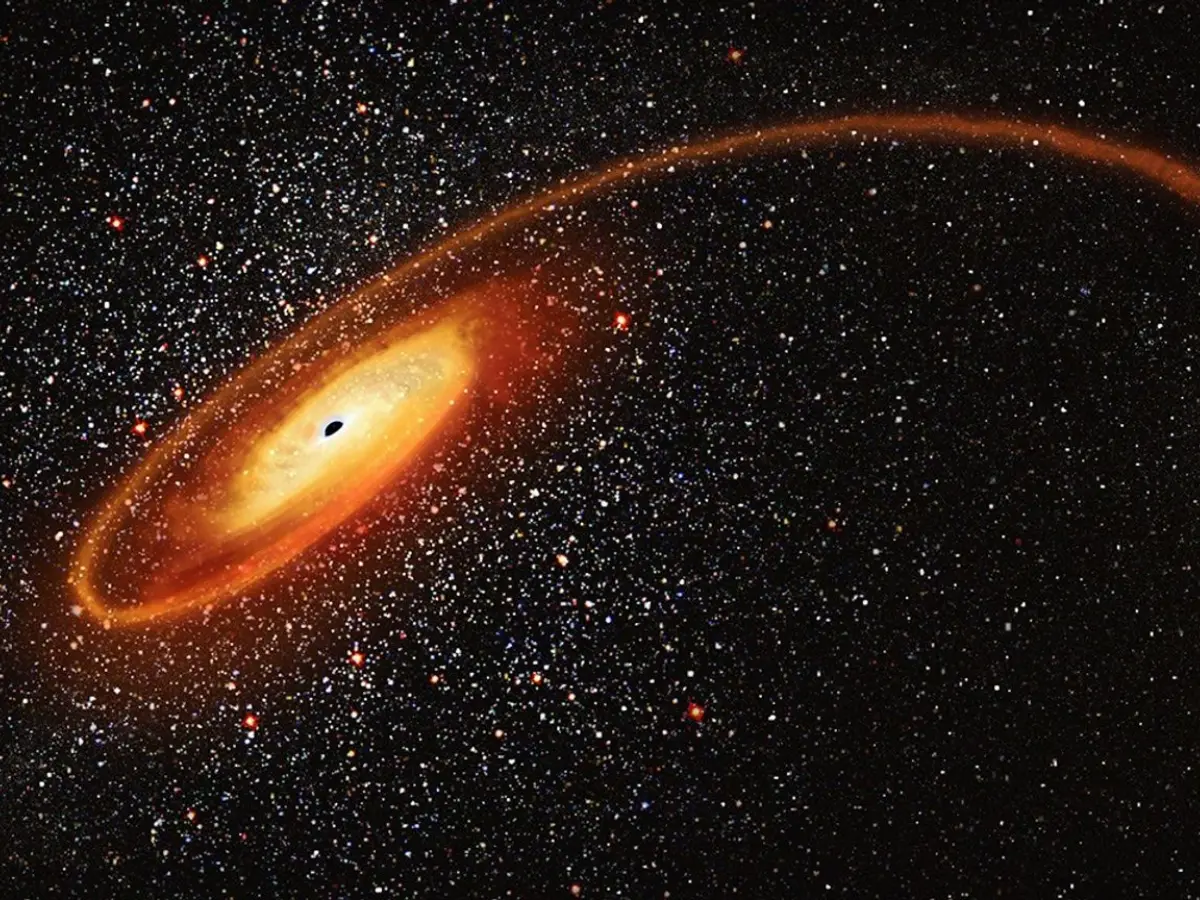
The Cosmic Horseshoe houses the universe's biggest black hole that can fit 36 billion suns. Photograph: (NASA, ESA, and D. Player (STScI))
The biggest black hole in the universe is located 5 billion light years from Earth and can contain 36.3 billion suns inside it. It is completely dormant, but its pull is so strong that stars near it are travelling at a whopping speed of 400 kilometres per second.
The biggest black hole in the universe might have just been found. It sits inside a galaxy whose light is distorted to such an extent by another galaxy in front of it that it appears like a horseshoe. This is because the galaxy in the foreground is hundreds of times heavier than our own galaxy. Because of this bending of spacetime, the background galaxy is known as the Cosmic Horseshoe. The supermassive black hole at the centre of this galaxy has been confirmed to be the biggest one ever seen in the universe in a study. There are millions of galaxies with humongous black holes at their core. They are all estimated to be billions of times the mass of our Sun, although there has never been an exact number to put next to them. But now, with this latest study, scientists have the closest estimate yet. The monstrous black hole in Cosmic Horseshoe is 36.3 billion times the mass of the Sun, with a margin of error of about 6 billion solar masses. "This is amongst the top 10 most massive black holes ever discovered, and quite possibly the most massive,” co-author Professor Thomas Collett, from the University of Portsmouth, said in a statement.
Proof of biggest black hole in the universe
Scientists have been measuring black holes for years, but every other supermassive black hole till now has had quite large uncertainties when measured indirectly. So there has never been a sure-shot contender for the top spot. But the team that carried out this study used a new method to measure this supermassive black hole, and they are almost certain that they have it right. Collett is confident of their findings and much more certain about the measurements. To figure out the size of this dark monster, the researchers looked at how its gravity warped the light passing near it. The stars in the inner region were spotted moving at extreme speeds, touching 400 kilometres per second. The deduction about its size was based on its "immense gravitational pull and the effect it has on its surroundings," the authors wrote in the study published in the Monthly Notices of the Royal Astronomical Society.
Also Read: Can a country barricade the Moon? NASA fears losing out to China because of its own safety zone rule
Trending Stories
)
)
)
)
)
)
)
)
)
)
)
)
)
)
)
)
)
)
)
)
)
)
)
)
)
)
)
)
)
)
)
)
)
)
Ultramassive black hole is 5 billion light-years away
This ultramassive black hole is located 5 billion light-years away. It is completely silent, and so the researchers could not employ the technique that is usually used - determining the size based on the accretion. Carlos Melo of the Universidade Federal do Rio Grande do Sul in Brazil said, "This discovery was made for a 'dormant' black hole – one that isn’t actively accreting material at the time of observation." Also Read: Baba Vanga Predicted Alien Contact In 2025. Is Interstellar 'Mothership' Hurtling Towards Earth Them Reaching Out?
He added that their method can help them discover and measure many more dormant black holes across the universe, even when they are not swallowing and spitting out any matter. Professor Collett has another insight about what could be going on with this black hole. Since the Cosmic Horseshoe galaxy is a Fossil Group galaxy, towards the end of its evolution, it is possible that other black holes in nearby galaxies merged with it, creating this ultramassive black hole.

