This is a photo of the Sun, and it can answer a big question about our star

&imwidth=600&imheight=450&format=webp&quality=medium "This is a photo of the Sun, and it can answer a big question about our star")
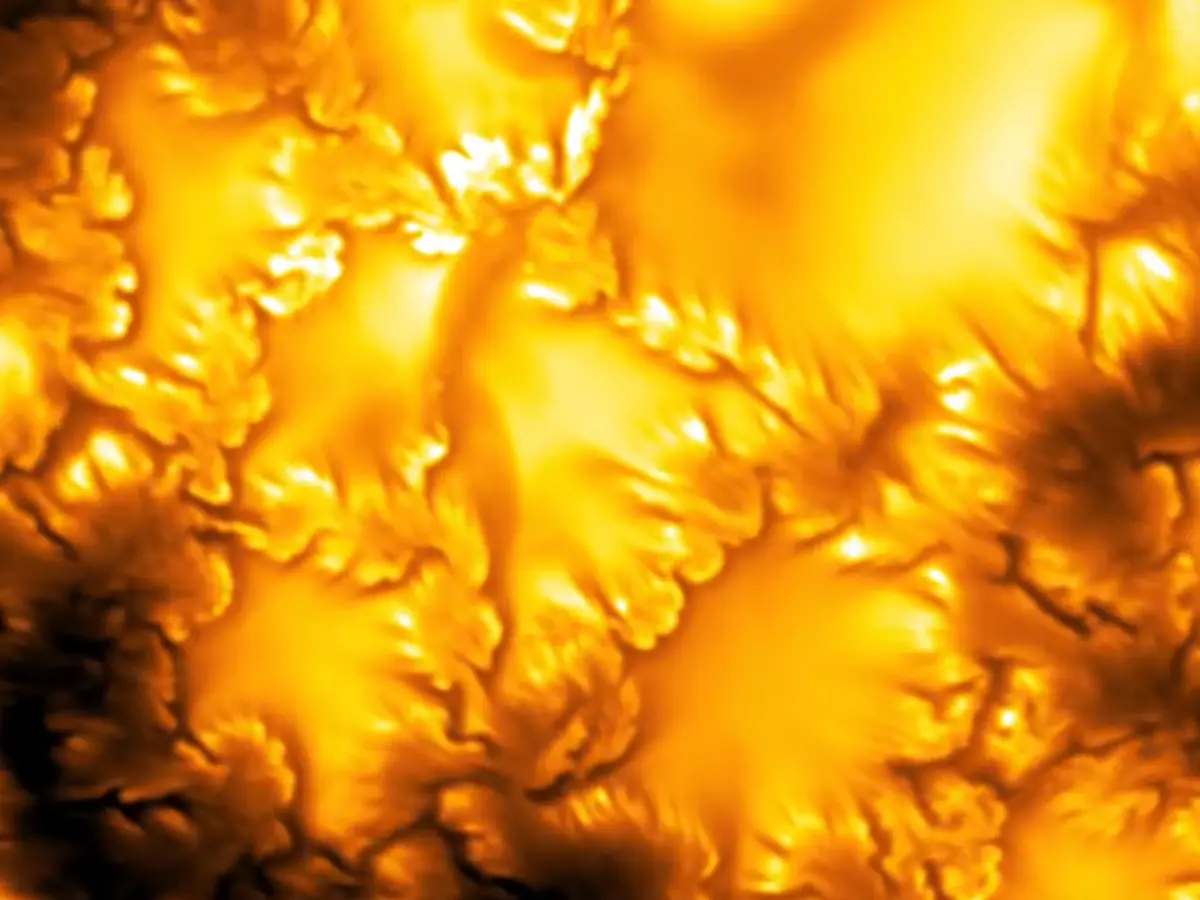
The most detailed photo of the Sun was taken by Inouye Solar Telescope located in Hawaii. Photograph: (US National Solar Observatory/NSF/AURA/MPS)
The most detailed photo ever of our Sun has revealed turbulent whirlpools that form when fast-moving plasma slides past slower-moving fluid. This photo can help solve the question of why the corona is hotter than the surface.
Scientists have learned something new about the Sun. The most powerful solar telescope on Earth, the NSF's Daniel K. Inouye Solar Telescope located in Hawaii, has captured whirlpools that had never been seen before. Huge columns of hot plasma rise from deep within the Sun, spread outward, cool, and sink along the edges of convection cells. Each of them is roughly the size of Texas. Inouye has exposed turbulent whirlpools swirling around the Sun's magnetic boundaries in the highest-resolution photo ever of our star. The findings have been published in Nature.
“These are the highest spatial resolution images of the solar surface ever acquired,” Dr Friedrich Wöger, a senior scientist at the US National Solar Observatory, said. It operates the telescope near the summit of the Haleakalā volcano, on the island of Maui. The new pictures are expected to solve the mystery of why the corona, the Sun’s outer atmosphere, is millions of degrees hotter than its surface.
Also Read: World's largest digital camera captures over 500,000 galaxies, 50,000 stars in one stunning image
These whirlpools are known as Kelvin-Helmholtz instabilities (KHI), which have been theorised to exist in some parts of the Sun. But the latest photo shows that they are not isolated events and are present everywhere on the solar surface. "Seeing how truly omnipresent they are across the magnetic surface was something we really didn't expect at all," solar physicist David Kuridze of the US National Solar Observatory told ScienceAlert.
Kelvin-Helmholtz instabilities have been found on Earth, Jupiter and Saturn
KHI form when fast-moving plasma slides past slower-moving fluid. This contact creates shear at the interface, setting up small disturbances in the Sun’s plasma that grow into spiralling vortices, just like how ocean waves break. They have also been seen on Earth, in clouds, lakes and oceans. They have even been spotted in the atmospheres of Jupiter and Saturn. This is the first time they have been confirmed on the Sun, thanks to Inouye.
Trending Stories
)
)
)
)
)
)
)
)
)
)
)
)
)
)
)
)
)
)
)
)
)
)
)
)
)
)
)
)
)
)
)
)
)
)
&im=FitAndFill=(700,400))
)
)
)
)
The telescope in Hawaii captured the whirlpools on Sun
Scientists have long believed that KHI should be present on the Sun because of its volatile nature. However, none of the instruments was advanced enough to capture these vortices. Then, in April 2025, the telescope was focused at a magnetically active region near a sunspot. The aim was to capture a time-lapse of the solar plasma moving around. When they got back the data and analysed it, they found clear signs of KHI vortices.
Swirling plasma vortices on the Sun likely twist and tangle its magnetic field lines like braided hair. When these tangled lines snap, they suddenly release energy. This could explain how the Sun's outer atmosphere gets millions of degrees hotter than its surface. “This could solve the biggest mystery of the last half a century for solar physics and astrophysics,” said Kuridze.
To know that KHI are actually widespread across the Sun's surface means they could be influencing the flow of energy through the solar atmosphere almost everywhere. The findings will not only help solve the corona problem but also explain the enormous eruptions that sweep the solar system and disrupt communication systems on Earth.

