
&imwidth=800&imheight=600&format=webp&quality=medium "Supercomputers in space: China leads race for AI data hubs in Earth orbit as Musk, Bezos and Pichai also fight it out")
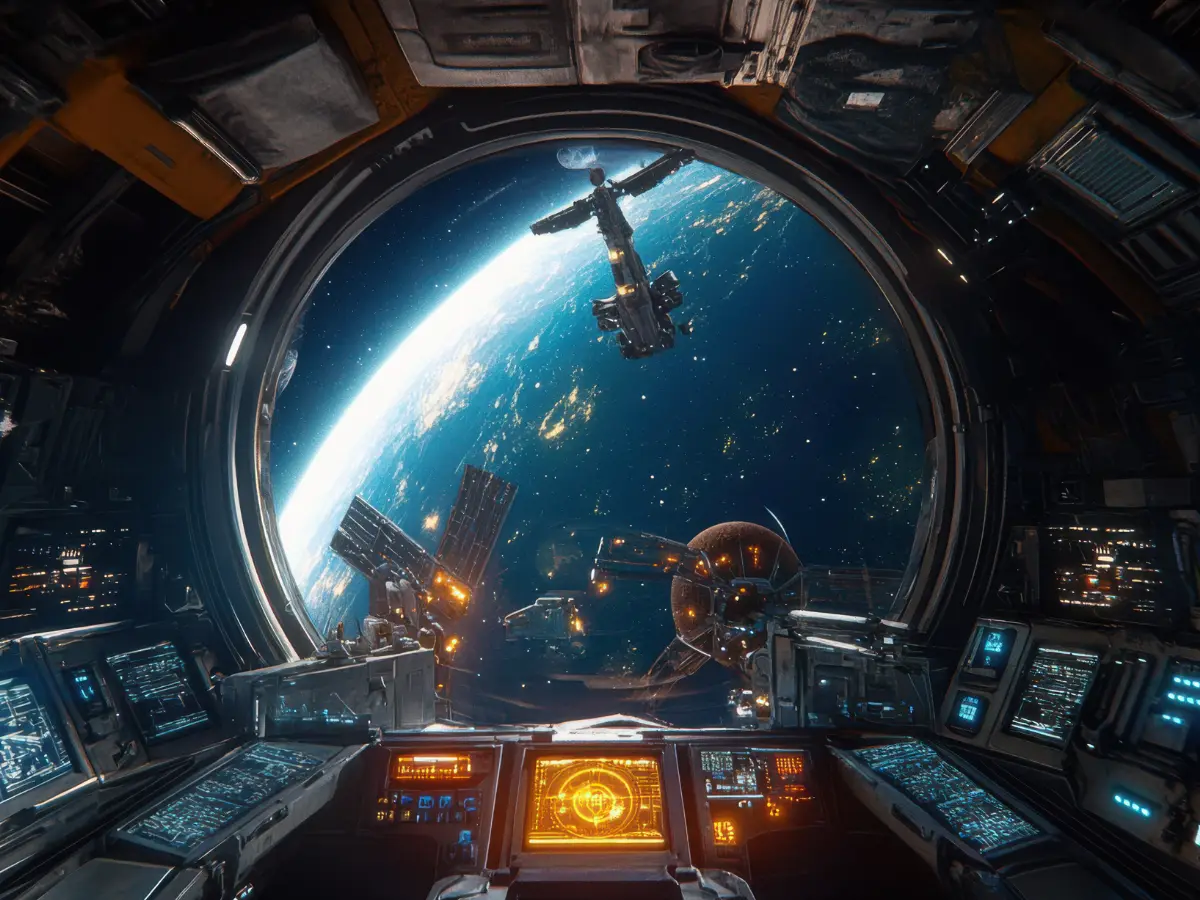
The race to conquer space has now moved to artificial intelligence as countries vie to launch AI infrastructure into low-Earth orbit. China is believed to be leading in this arena and is reportedly working to place space supercomputers above Earth soon. Researchers at the Institute of Computing Technology (ICT) of the Chinese Academy of Sciences in Beijing are preparing to launch an AI data centre. This structure will include 10,000 high-performance computing cards, Popular Mechanics reported. Elon Musk, Jeff Bezos, and Google CEO Sundar Pichai are also developing these cosmic AI hubs, and whoever manages to have the most perfect space centres will lead computing in space.
NVIDIA-backed startup Starcloud is potentially winning this race. Nvidia H100 graphics processing unit managed to get its Starcloud-1 satellite past Earth’s atmosphere last month. It not only launched an 80-gigabyte chip, but also trained the NanoGPT large language model from Terra Firma. While the chip is 100 times more powerful than any chip that has ever been sent to space, NanoGPT is the first AI ever trained in space.
Bezos and Musk plan on having AI data hubs in orbit

Meanwhile, Blue Origin has been working on aI data hub for space for over a year, while Musk plans to upgrade Starlink satellites to handle AI computing payloads. Pichai confirmed Project Suncatcher, which will place micro-racks of machines on board satellites. Having AI infrastructure in space will reduce the huge amounts of energy and water the technology uses and reduce greenhouse gases. In space, it will rely on solar power, which means 10 times less use of electricity by the AI data centres.
Also Read: NASA just saved a precious drill stuck on Mars since 8 months from 212 million kilometres away
China is way ahead in this race and recently placed the first computing constellation in space. Guoxing Aerospace and the research institute Zhejiang Lab together deployed 12 satellites into low-Earth orbit. The constellation could be the foundation for an orbiting supercomputer in the future. Aerospace company Zhongke Tiansuan launched a space supercomputer in 2022, while Zhongke Tiansuan’s satellite is in stable orbit for more than a thousand days. This puts China way ahead of other countries in the quest to have AI hubs and supercomputers in space.
Trending Stories
)
Did India risk its US trade deal despite softer stance at BRICS?
)
First naval drone battle? Ukraine says Sargan 3000 sank Russian unmanned boat
)
Practical Magic 2 breaks Spidey spell over North American box office
)
'Huge destructive power': North Korea calls its latest missile launches 'live-fire drill' even as US dismisses 'immediate threat'
&im=FitAndFill=(700,400))
Meet top 5 batters fastest to 3000 runs in T20Is
)
Delhi’s balancing act: BRICS serves as a stage for West Asia diplomacy
&im=FitAndFill=(700,400))
Why European Meteor missiles use ramjet engines compared to standard US solid rockets
)
'He is popular...': Malaysian PM Anwar Ibrahim's praise for PM Modi during bilateral meeting | WATCH
)
Iran, India agree to deepen humanitarian and political ties, President Pezeshkian says
)
‘Want to reset ties with India, have engagement based on mutual interests,’ says Bangladesh minister
)
Trump says Canada eager to reach a deal, it could come ‘fairly soon’ if Ottawa treats US farmers better
)
Turkish Airlines plane flies through a storm three times, triggering severe turbulence
)
‘Partners, not rivals’: Xi outlines four point plan for stronger India-China ties
&im=FitAndFill=(700,400))
Why Chinese PL-15 air-to-air missiles use dual-pulse motors compared to European interceptors
)
Who is the smiling man beside Modi, Putin and Xi at BRICS Summit 2026?
)
BRICS Summit: New Delhi declaration adopted with full consensus, big diplomatic win for India
)
Russia proposes to build 360 kmph Ivolga FG trains in India: What happened on sidelines of BRICS
)
800 million years old - Scientists discover 'fingerprints' of supercontinent Gondwana in ancient rocks
)
China discovers vast gold and silver 'mine' in the Pacific with unheard-of deposits
)
Russian drone hits Warsaw-bound train near Polish border, Zelensky accuses Moscow of ‘deliberate’ targeting
)
War is making Russia stronger? How Ukraine is shaping Moscow’s next generation of weapons
)
NEET-UG to move to computer-based test soon, NTA DG says ‘CBT is the future’
)
Liam Neeson sparks romance rumours after holding hands with Stella Stocker at TIFF 2026
&im=FitAndFill=(700,400))
New OTT releases this week (September 14-20, 2026): Lust Stories 3, Waiting Hai, Irumudi- 5 new titles coming on Netflix, Prime Video and more
)
9-year-old Chennai prodigy clears Cambridge IGCSE grade 10 exams
)
Indian importers urge Bangladesh to lift export ban on 'Hilsa' fish ahead of Durga Puja
)
Did China give Iran intel before US base strike that killed 3 troops? Trump says, 'You’re right...'
)
Baba Vanga's first prophecy for 2027 is out, and straight out of science fiction
)
US diplomat accused of possessing child abuse images secretly flown out of UK by US Marines
)
Akram, Afridi, Mushtaq tear into PCB after Pakistan’s Test series collapse in UK
&im=FitAndFill=(700,400))
From Rinku Singh to Mayank Yadav, 5 players dropped from India’s squad for Afghanistan T20Is
)
PM Modi and China's Xi offered to help resolve Russia-Ukraine war: Kremlin
)
China thinned Himalayan troop presence in 2025, India defence report says; terms border situation 'stable'
)
Humans may lose control of AI: Anthropic CEO calls for slowdown, Altman, Musk back him
AI data centres in Earth's orbit are the future. The Starcloud team said in a white paper published last year, "Gigawatt-scale orbital data centres are among the most ambitious space projects of all time. We are convinced that orbital data centres are feasible, economically viable, and necessary to realise the potential of AI, the most important technology of the 21st century, in a rapid and sustainable manner."
This endeavour can soon become a reality as experts are sure that an actual supercomputer could be operational in space by the 2030s. However, who will be the first to launch one remains to be seen.

