Hit me baby one more time: Scientists invent new material that toughens up with rapid impacts

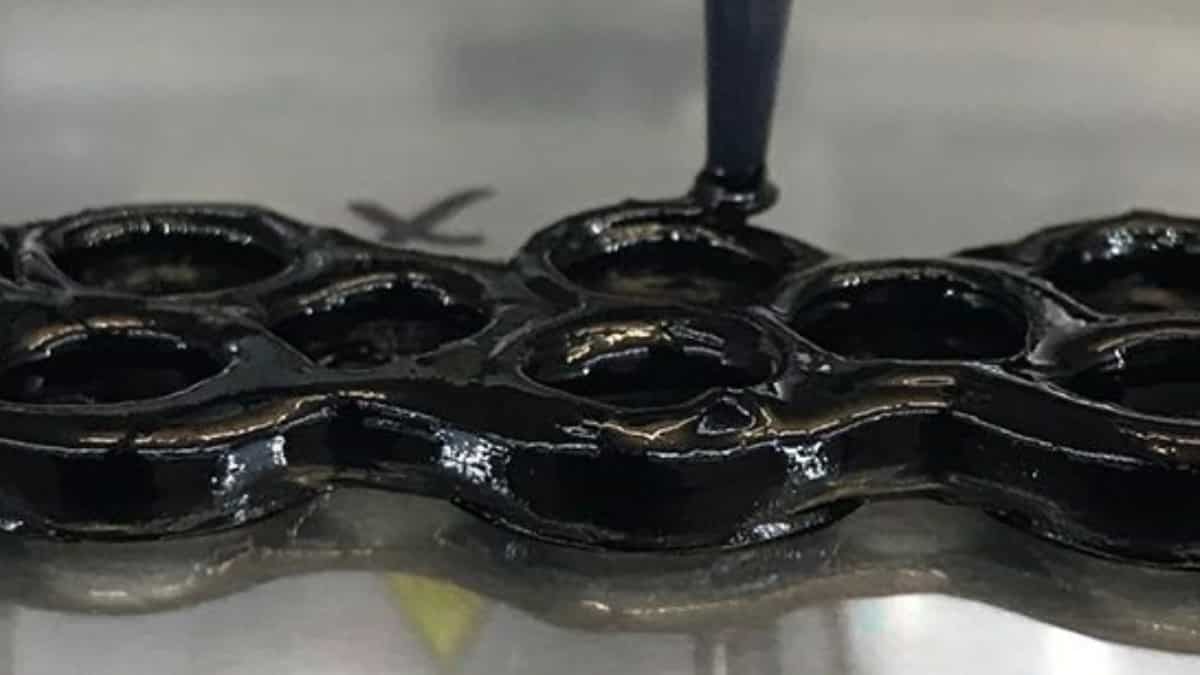
This material has “adaptive durability,” meaning it gets stronger when hit | Yue (Jessica) Wang
Electronic sensors, prosthetic limbs as well as wearables could be made from a special material that toughens up as it is hit or stretched, a property known as 'adaptive durability', research from the University of California has found.
What is this new material like?
The new material is inspired by the corn starch used in cooking, which can be stirred when water is added. The slurry nature of the corn starch acts like a solid when stirred or whenpunched quickly.

Understanding the science of adaptive durability
When you squish cornstarch, the tiny particles or its basic building blocks repel each other due to which they act like a fluid.
But if the surface is hit fast, the friction makes it act like a solid.
)
Three labourers killed as DU student loses control of his car, rams into them on Dwarka Expressway
)
Pentagon revives mandatory testosterone testing for male troops aged 30 and above
)
FACT CHECK: Why did PM Modi ask Xi ‘is it okay’ at BRICS Summit? New video reveals...
)
India seeks to build a full semiconductor supply chain
&im=FitAndFill=(700,400))
From Abhishek Sharma to Sahil Chauhan, 5 batters with fastest T20I hundreds
)
Indian activist-lawyer Prashant Bhushan's post brings focus on ‘conflict of interest’ appointments of ex-govt officials at Reliance, Adani groups
)
US And Denmark reach Greenland deal, Trump announces expanded military presence
)
Former India player Diana Edulji wants Smriti Mandhana to replace Harman as skipper at the earliest
)
China may have gained access to US's classified F-35 jets; parts meant for repairs diverted to Hong Kong, sparking Pentagon inquiry
&im=FitAndFill=(700,400))
Meet top 5 batters in the latest ICC T20I Rankings
)
Godfather of AI Geoffrey Hinton gives US lawmakers a one-year warning on AI
)
Shivakumar attends 79th Kalyana Karnataka Utsav in Kalaburagi
)
Trump signs Russia sanctions law: India faces fresh 100% tariff threat over Russian oil
)
Why Ranveer Singh’s Dhurandhar missed India’s Oscar entry; FFI jury member reveals what happened
)
How did an Australian river with 500 crocodiles pass the Olympic test? Here's how
)
‘Will go to any extent’: Pakistan vows to defend Saudi Arabia amid Houthi attacks
)
'He will always be ahead': India coach Gambhir says Sooryavanshi won't walk into team ahead of Samson
)
The Verdict | When precision fails: US commits war crime in Minab school strike, UN finds
)
Trump signs Russia sanctions bill into law, targets Moscow’s energy sector
&im=FitAndFill=(700,400))
New Friday OTT releases (September 18, 2026): Lust Stories 3, You+Me, Best of the Best- 8 new titles coming on Netflix, Prime Video and more
)
Fast bowler Brydon Carse faces no charges over Derby nightclub incident
)
Flying cars in UAE: Ras Al Khaimah signs deal with Chinese company to test new transport
)
Africa is splitting, and a lot sooner than estimated, giving way to a new ocean
)
'Gangsta' crab shoves knife blade at man and his dog in Florida - Watch
)
Trump bans CNN, MS NOW and Politico from White House over ‘FAKE NEWS’
)
Trump 2.0: Dark days ahead for America’s ‘imperial presidency’
)
Trump's Greenland dream comes true? POTUS announces 'Infinite Life' deal with Denmark, claims permanent US control
)
Laura Wolvaardt sets new world record for most WT20I runs in a year
)
Drone strikes cooling tower at Russia's Kursk Nuclear Plant, IAEA confirms
)
Who is Khalilur Rahman? All you need to know about 81st UN General Assembly President
&im=FitAndFill=(700,400))
Meet top 5 bowlers in latest ICC T20I rankings
)
Ukraine plans record $109 bn defence spending, nearly two thirds of budget amid Russia war
)
Russia holds first parliamentary elections since the beginning of the Ukraine war
&im=FitAndFill=(700,400))
Meet top 5 Indian batters with fastest T20I centuries
Researchers used two positively charged and two negatively charged polymers to create a material with super-small structures like miniature meatballs.
These 'meatballs' do not break apart, and the conductivity of the material is withheld right.
Scientists incorporated long molecules of poly(2-acrylamido-2-methylpropanesulfonic acid), short polyaniline molecules, and a highly efficient conductor – poly(3,4-ethylenedioxythiophene) polystyrene sulfonate (PEDOT:PSS).
Complex names, aren't they?
Well, all you need to know is that this combination created a material that deformed or stretched out when it was hit by rapid impacts.
The faster the impacts, the tougher the material became and added 10 per cent more to the adaptive durability and the conductivity of the material.
There are applications for such material if it can be manufactured at scale.
Researchers have proposed smartwatch bands, wearable sensors and health monitors to be made with such material.
Eventually, artificial limbs could be 3D printed from this material.
Also watch |Chinese scientists develop smart fibre | How does it work?
"There are a number of potential applications, and we're excited to see where this new, unconventional property will take us," materials scientist Yue Wang was quoted as saying by Science Alert.
The research has been presented at the Spring 2024 meeting of the American Chemical Society.
(With inputs from agencies)