NASA to launch drone-like Dragonfly rotorcraft to explore Saturn's moon Titan

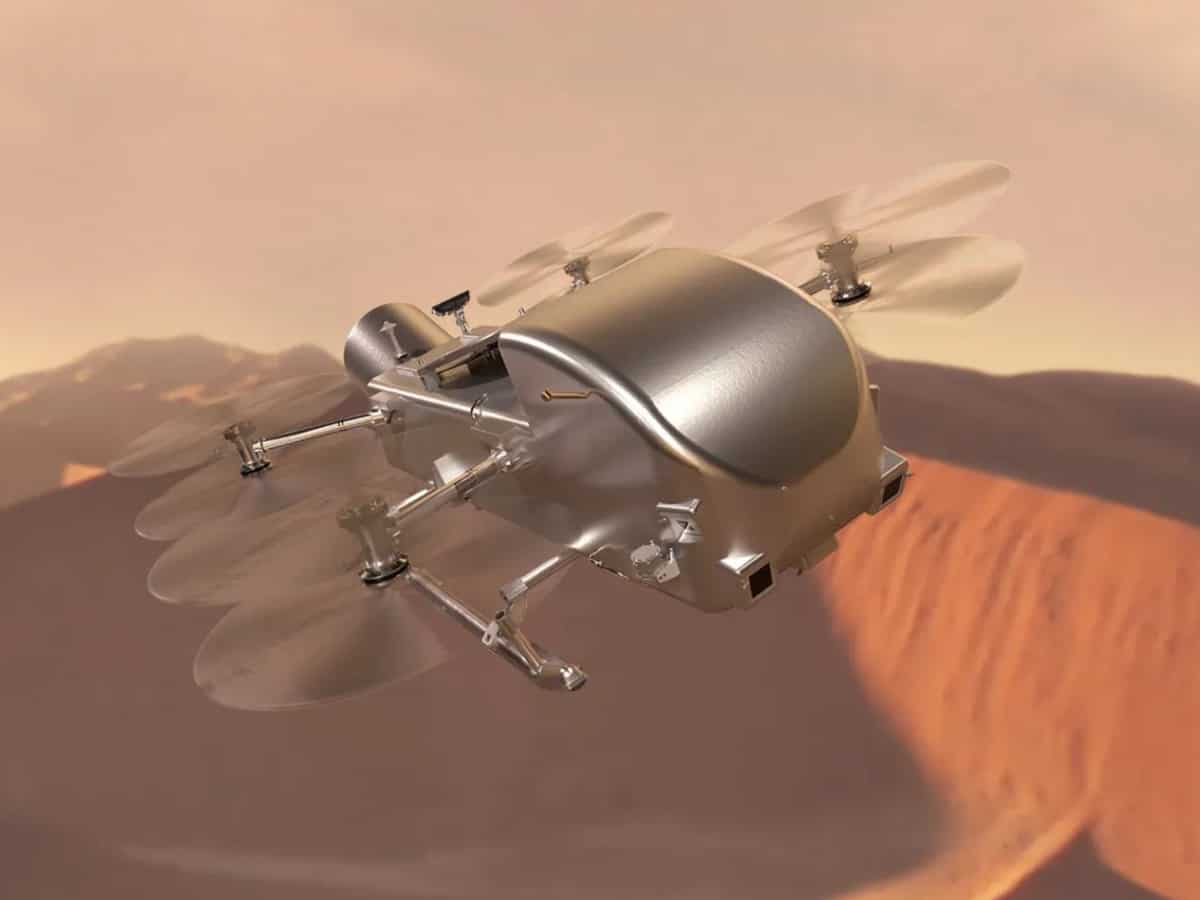
NASA's Dragonfly Rotorcraft mission
NASA is gearing up for the launch of an exploration mission of Saturn’s largest moon, Titan. The Dragonfly Rotorcraft Mission is set to launch in July 2028 to study the “diverse locations to characterise the habitability of Titan’s environment”, said NASA in its newsletter.
Titan is often called one of the most “organic-rich moons” of the ringed planet, and it is also the only moon known to have an atmosphere denser than Earth’s. Exploration of the moon is crucial for the scientific community as it is the only known celestial object other than Earth on which clear evidence of stable bodies of surface liquid has been found.
Also Read |NASA's Ingenuity Mars helicopter sends last message to Earth

“Dragonfly is a spectacular science mission with broad community interest, and we are excited to take the next steps on this mission," said Nicky Fox, associate administrator, of the Science Mission Directorate at NASA Headquarters in Washington.
"Exploring Titan will push the boundaries of what we can do with rotorcraft outside of Earth.”
Dragonfly mission: Cost, duration, objectives and what we know so far
)
The Early Spring is proof not everyone can talk about their real feelings, and it is perfectly OK
)
UN votes to ‘correct the map’ as India backs fairer world view
)
Nigerian Navy discovers 99,000 litres of suspected stolen, illegally refined products as it intensifies anti-crude oil theft operations
)
Who is Aditi Paudel? 17-year-old becomes Japan's first literacy ambassador
)
Bengaluru: Officials find 40 kg expired chilli at chairman's club
)
Jaishankar rejects trade link to ending Ukraine war
)
Israeli strikes on Lebanon kill three, injure 23 despite truce
)
Alpine glacier was covered with sheep wool sheets to prevent melting. It worked
)
South Korea mulls deploying military assets to Strait of Hormuz
)
World's fifth-largest economy, British army can't afford to train
)
Breaking | Vance takes the podium: First White House briefing since Leavitt's exit
)
Taiwan raises 'concerns' over China's missile test
)
BRICS 2026: $1 trillion sovereign capital set to converge in Delhi for first iBRICS Summit
)
What is Iran's Pickaxe Mountain that Trump has again threatened to bomb?
)
UN votes to correct world map that visually shrank Africa for 450 years
)
Former NewJeans member Danielle launches YouTube channel, hints at new solo journey
)
Bangladesh batter Towhid Hridoy creates history with 350 not out in South Africa
)
Brendan Fraser’s transformation fuels The Mummy 4 excitement as fans welcome back Rick O’Connell
&im=FitAndFill=(700,400))
Krishna Janmashtami 2026: From Dhaniya Panjiri to Makhana Kheer- 5 best sweet dishes perfect for celebrating Lord Krishna’s birth
)
Donald Trump plans to travel to Ireland on Qatari-donated jet amid security concerns
)
Nazi-looted art to return to Jewish heirs
)
Eight killed in Kerala’s Thrissur after car rams into lorry parked on highway
&im=FitAndFill=(700,400))
Why Russian fighter jets use bulky, low-pressure tyres compared to US jets
)
FBI-wanted fraud accused arrested in Jalandhar over $600,000 scam
&im=FitAndFill=(700,400))
Why US tanks weigh over 20 tons more than Russian tanks
&im=FitAndFill=(700,400))
New Friday OTT releases (September 4, 2026): GDN, Dhamaal 4, Jagamae Sangeetham- Watch 6 new movies and TV shows on Netflix, Prime Video and more
)
Killing the Himalayas slowly: Human urine is melting a glacier on Mount Everest
NASA said on Tuesday that the total lifecycle of the Dragonfly mission will cost $3.35 billion. The mission will be launched in 2028 and is expected to reach the surface of Titan in 2034 to explore a dozen locations on the moon.
The current cost of the mission is two times more than the original proposed cost and the launch date of the mission is delayed by two years.
Also Read |Scientists believe Uranus and Neptune are 'ice giants,' but a new study hints at something else
During the COVID-19 period, the mission went through multiple overhauls due to constraints in fiscal years 2020 through 2022.
“To compensate for the delayed arrival at Titan, NASA also provided additional funding for a heavy-lift launch vehicle to shorten the mission’s cruise phase,"NASA said in its official statement.
With the Dragonfly mission, the American space agency aimed to look for “prebiotic chemical processes on both Titan and the early Earth”, before life was developed.
"Dragonfly marks the first time NASA will fly a vehicle for science on another planetary body," the government agency said. "The rotorcraft has eight rotors and flies like a large drone."
Dragonfly Rotorcraft is being designed and developed by the Johns Hopkins Applied Physics Laboratory (APL), which also manages the mission for NASA.
(With inputs from agencies)