NASA'S James Webb telescope observes a bizarre lemon-shaped exoplanet with unexplained atmosphere

&imwidth=600&imheight=450&format=webp&quality=medium "NASA'S James Webb telescope observes a bizarre lemon-shaped exoplanet with unexplained atmosphere")
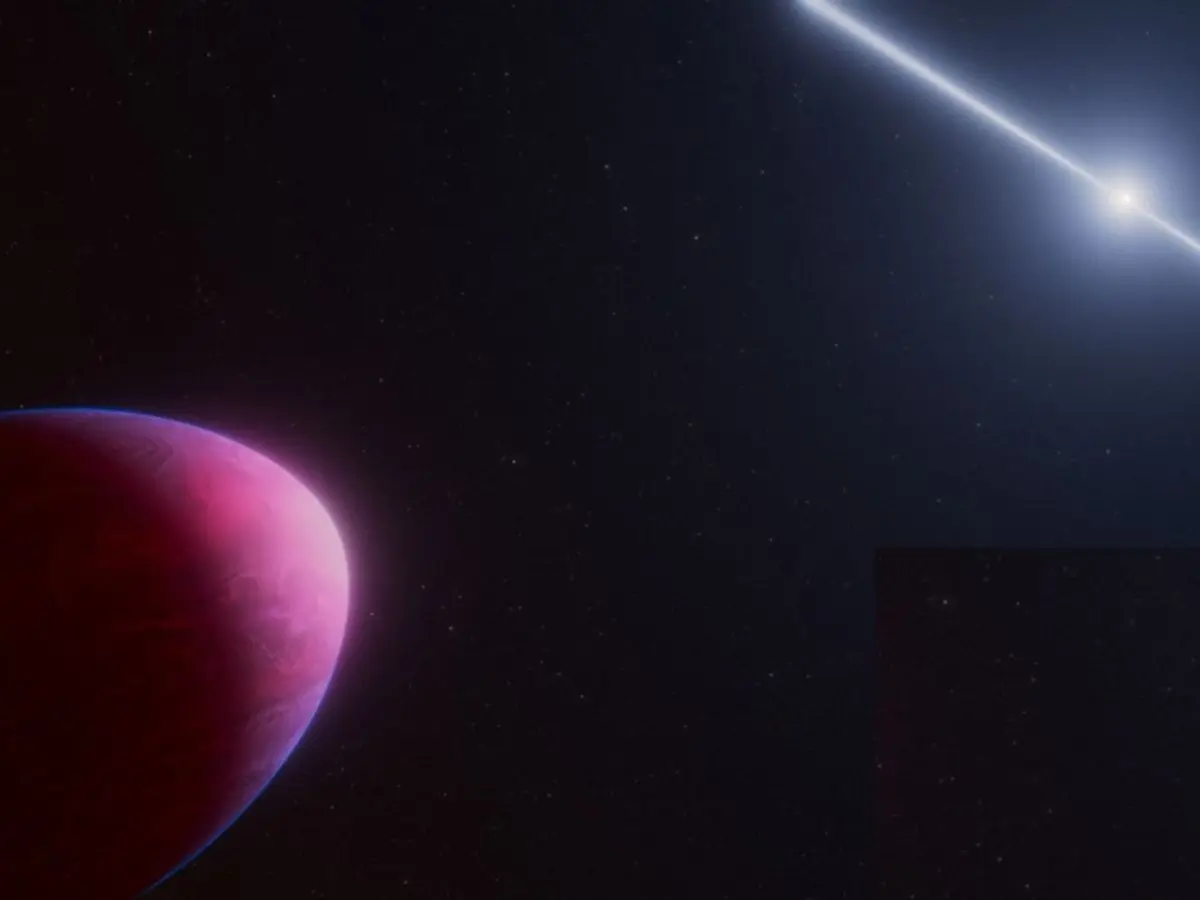
The composition of this exoplanet’s atmosphere challenges current understanding Photograph: (NASA)
Scientists describe the findings as unexpected and puzzling, making this discovery a milestone in exoplanet research.
The James Webb Space Telescope has revealed an exoplanet unlike any previously studied, opening fresh questions about how worlds form and what their atmospheres can contain. Officially named as PSR J2322-2650b, this distant world orbits a pulsar , a rapidly spinning neutron star left over after a massive star’s supernova. Scientists using the James Webb observed through it's infrared instruments that this Jupiter-mass planet is stretched into a lemon-like shape by extreme gravitational forces and has an atmospheric composition that defies existing models. Scientists describe the findings as unexpected and puzzling, making this discovery a milestone in exoplanet research. The paper appeared on Tuesday in The Astrophysical Journal Letters.
A Planet Around an Unusual Host
According to Live Science, PSR J2322-2650b is located some 750 light-years from Earth and completes a full orbit around its star in just 7.8 hours because it lies extremely close to it, only about one million miles. This contrasts sharply with planets in our own Solar System, such as Jupiter, which orbits much farther from the Sun. Earth’s distance from the Sun is about 100 million miles. Gravitational forces from the much heavier pulsar stretch the planet pulling it so much that it resembles a lemon, rather than a near-spherical shape typical of most planets. Webb’s ability to observe the planet without interference from the pulsar’s intense gamma radiation has been key to studying its distinct environment.
An Atmosphere That Defies Expectation
The composition of this exoplanet’s atmosphere challenges current understanding. Unlike many exoplanets, PSR J2322-2650b’s outer layers are dominated by helium and carbon, with little to no oxygen or nitrogen detected. This unusual mix means that common molecules like water, methane or carbon dioxide, typically expected in planetary atmospheres, are absent. Webb’s data suggest soot clouds likely float through the air, and deep within the planet, these carbon clouds can condense and form diamonds.
“The planet orbits a star that's completely bizarre — the mass of the Sun, but the size of a city,” according to the principal investigator on this study, Michael Zhang.
Trending Stories
&imwidth=280&imheight=210&format=webp&quality=medium)
&im=FitAndFill=(700,400)&imwidth=280&imheight=210&format=webp&quality=medium)
&im=FitAndFill=(700,400)&imwidth=280&imheight=210&format=webp&quality=medium)
&imwidth=280&imheight=210&format=webp&quality=medium)
&imwidth=280&imheight=210&format=webp&quality=medium)
&imwidth=280&imheight=210&format=webp&quality=medium)
&imwidth=280&imheight=210&format=webp&quality=medium)
&imwidth=280&imheight=210&format=webp&quality=medium)
&imwidth=280&imheight=210&format=webp&quality=medium)
&imwidth=280&imheight=210&format=webp&quality=medium)
&imwidth=280&imheight=210&format=webp&quality=medium)
&imwidth=280&imheight=210&format=webp&quality=medium)
&imwidth=280&imheight=210&format=webp&quality=medium)
&imwidth=280&imheight=210&format=webp&quality=medium)
&imwidth=280&imheight=210&format=webp&quality=medium)
&imwidth=280&imheight=210&format=webp&quality=medium)
&imwidth=280&imheight=210&format=webp&quality=medium)
&imwidth=280&imheight=210&format=webp&quality=medium)
&imwidth=280&imheight=210&format=webp&quality=medium)
&imwidth=280&imheight=210&format=webp&quality=medium)
&im=FitAndFill=(700,400)&imwidth=280&imheight=210&format=webp&quality=medium)
&imwidth=280&imheight=210&format=webp&quality=medium)
&imwidth=280&imheight=210&format=webp&quality=medium)
&imwidth=280&imheight=210&format=webp&quality=medium)
&imwidth=280&imheight=210&format=webp&quality=medium)
&imwidth=280&imheight=210&format=webp&quality=medium)
&imwidth=280&imheight=210&format=webp&quality=medium)
&imwidth=280&imheight=210&format=webp&quality=medium)
&imwidth=280&imheight=210&format=webp&quality=medium)
&imwidth=280&imheight=210&format=webp&quality=medium)
&imwidth=280&imheight=210&format=webp&quality=medium)
&imwidth=280&imheight=210&format=webp&quality=medium)
&imwidth=280&imheight=210&format=webp&quality=medium)
&imwidth=280&imheight=210&format=webp&quality=medium)
Standard planetary formation theories do not predict a world with such chemistry in this environment, particularly around a pulsar, a host rarely observed with planets at all. Together, the star and exoplanet may be considered a “black widow” system, though not a typical example. In such scenarios, a pulsar strips material from a companion star, but even this model does not fully explain the observed composition and structure. But in this case, the companion is officially considered an exoplanet, not a star. The discovery highlights how Webb’s capabilities are revealing planetary phenomena that were previously invisible, prompting a reevaluation of how diverse planetary systems can be. Of the 6,000 known exoplanets, this is the only one reminiscent of a gas giant (with mass, radius, and temperature similar to a hot Jupiter) orbiting a pulsar.