Explained | ISRO-NASA satellite 'NISAR' gets a feel of space in Bengaluru

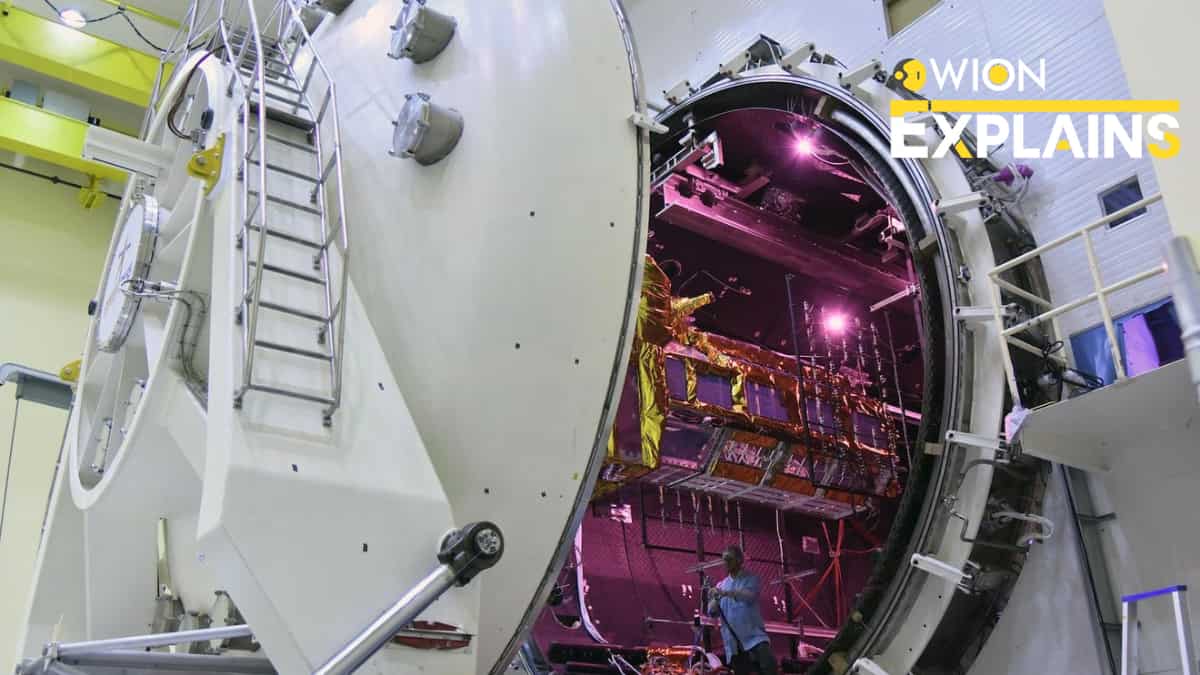
The NISAR satellite enters the thermal vacuum chamber
Space is harsh. Space is unforgiving. Space is not for everyone. So, when you are nearing the final stages of building the most-sophisticated satellite to study the earth, you better get it right. Because you have only one shot. That's what the teams from the Indian Space agency ISRO and America's NASA have been doing in Bengaluru, the city known as India's IT and Aerospace hub.
They have been putting their jointly-built satellite NISAR (NASA-ISRO Synthetic Aperture Radar), through a series of tests, in order to see how well it can withstand the harsh conditions of sitting atop a spacefaring rocket and the brutal conditions of circling the earth at around 28,000 kmph, at an altitude of 747 km above the earth's surface.
Just like how smartphones and other gadgets are tested in factories, for their ability to withstand impact, wear-and-tear, water resistance and heavy usage, satellites are put through tests that simulate the conditions that they would encounter in space.

Satellites comprise a plethora of sophisticated electronic, electrical and optical systems and all of them are rated to work in the harsh environs of space - where temperatures can swing wildly, there's a risk of collision with millimetre-sized space debris, where the pressure is barely a fraction of that at sea-level etc.
The testing processes are meant to validate the functioning of these systems and sub-systems. Remember, once the satellite lifts-off on a rocket, there's no coming back for service and repairs. Therefore, all hardware and related software must be tested as much as possible.
)
Nigerian Navy seizes 10,000 litres of suspected illegal fuel in Rivers State crackdown
)
Did India risk its US trade deal despite softer stance at BRICS?
)
Iran, India agree to deepen humanitarian and political ties, President Pezeshkian says
)
Who is Kalyan Bainsla, accused in the Gurugram hit-and-run case involving woman biker?
)
'She married her brother': Ilhan Omar faces criminal probe over immigration fraud claims
&im=FitAndFill=(700,400))
New OTT releases this week (September 14-20, 2026): Lust Stories 3, Waiting Hai, Irumudi- 5 new titles coming on Netflix, Prime Video and more
)
Extreme warming in Indian Ocean added 695 billion tons of ice to Antarctica ice sheet
)
UK man admits drugging, raping wife for 20 years in shocking abuse case
)
Emmys 2026: Matthew Rhys wins Best Actor twice, sets historic 78-year record
)
Indian-origin woman, Nepali-American friend crushed to death by subway train in New York
)
Plane carrying prominent figure crashes at Libya’s Misrata airport: Report
)
Ecstasy tablets are rage in 'drug haven' Libya | Gravitas
)
Turkish Airlines plane flies through a storm three times, triggering severe turbulence
)
Trump downplays China's alleged 'help' to Iran in strike on Jordan base | Gravitas
)
Legendary costume designer Bob Mackie dies at 87: A look back at his iconic legacy
)
Emmys 2026 In Memoriam: Catherine O’Hara honoured by on-screen children Macaulay Culkin, Annie Murphy, Dan Levy; Dolly Parton, Rob Reiner remembered
)
Pakistan puts Pak Rs 70 lakh bounty on UN terrorist Masood Azhar; move draws skepticism in Delhi
)
Dodgers beat Reds for playoff berth in bid for third consecutive World Series
)
Saudi Arabia discovers 110 million tonnes of Uranium-rich ore in Madinah region
)
BCCI VP Rajeev Shukla says Mohsin Naqvi 'did not object' India refusing trophy from ACC chief
)
'Now Trump is copying us': Shivakumar links US $5,000 plan to Congress guarantees
)
'Huge destructive power': North Korea calls its latest missile launches 'live-fire drill' even as US dismisses 'immediate threat'
)
‘US ensuring global energy supplies’: Trump demands reimbursement for securing Strait of Hormuz
)
Gurugram hit and run case: Police arrest car driver Kalyan Bainsla, book him for attempt to murder
)
Trump loses Supreme Court battle over mail ballots ahead of US midterms: What happened?
)
Sent home midway from UK tour, Pakistan's Salman Agha hits 300* in domestic return
)
Emmy Awards 2026: Widow's Bay and The Pitt win in lead categories- check out the complete list of winners
&im=FitAndFill=(700,400))
Why Chinese PL-15 air-to-air missiles use dual-pulse motors compared to European interceptors
)
Emmys 2026: Michael J Fox honoured with Bob Hope Humanitarian Award for Parkinson’s advocacy
)
What is Hyrox, in news for athlete who soiled herself, but kept running and using common equipment?
&im=FitAndFill=(700,400))
Emmys 2026 Red Carpet: Zendaya, Nicole Kidman and Julia Garner lead the glamour peak
)
Ukraine strikes Syzran Oil Refinery deep inside Russia, fires erupt
)
Former Pak PM Imran Khan's ex-wife Jemima Goldsmith marries Australian financier: Who is Cameron O'Reilly
)
3 Italians fly from Delhi to Munich without immigration clearance; Air India gets notice on major security lapse
)
UPI payments up to Rs 2,000 to stays free, but bigger transactions may soon cost you: Govt
)
China thinned Himalayan troop presence in 2025, India defence report says; terms border situation 'stable'
)
Russia proposes to build 360 kmph Ivolga FG trains in India: What happened on sidelines of BRICS
)
Video of Pakistani lawmaker struggling to read English tribute to Jinnah goes viral - WATCH
)
Delhi govt to roll out ₹13,820 crore development projects under Seva Sankalp Abhiyan: CM Rekha Gupta
)
800 million years old - Scientists discover 'fingerprints' of supercontinent Gondwana in ancient rocks
The SUV-sized NISAR comprises two radar imaging systems - an S-band radar that was built at the Space Applications Centre in Ahmedabad, India and the L-band radar built at the Jet Propulsion Laboratory in California. Both of them have been fixed to form a barrel-like structure.
Also watch |Indian space agency successfully launches next-gen satellite
The satellite's main body, or bus, includes components and systems developed by both ISRO and JPL. The bus will provide power, navigation, pointing control, and communications aspect of the mission.
While NASA is providing the radar reflector antenna, the deployable boom, a high-rate communication subsystem for science data, GPS receivers, a solid-state recorder, and payload data subsystem, ISRO is providing the spacecraft bus, the S-band SAR electronics, the launch vehicle, and associated launch services and satellite mission operations.
According to NASA's Jet Propulsion Laboratory, this week, the NISAR satellite passed a major milestone, as it emerged successfully from a 21-day test. These tests were aimed at evaluating the satellite's ability to function in the extreme temperatures and the vacuum of space. NISAR is the first space hardware collaboration between NASA and the Indian Space Research Organisation, or ISRO, on an Earth-observing mission.
Scheduled to launch in the first quarter of 2024, the satellite will scan nearly all the planet’s land and ice twice every 12 days, monitoring the motion of those surfaces down to fractions of an inch. It will be able to observe movements from earthquakes, landslides, and volcanic activity and track dynamic changes in forests, wetlands, and agricultural lands.
Integrated at ISRO's UR Rao Satellite Centre in Bengaluru, the satellite underwent tests at ISRO's Satellite Integration and Test Establishment. It’s one of a battery of tests the satellite will face leading to launch. Other tests will ensure it can withstand the shaking, vibration, and jostling that it will encounter during launch.
"NISAR, partially covered in gold-hued thermal blanketing, entered the vacuum chamber on October 19th. Over the following week, engineers and technicians lowered the pressure to an infinitesimal fraction of the normal pressure at sea level. They also subjected the satellite to an 80-hour 'cold soak' at 14 degrees Fahrenheit (minus 10 degrees Celsius), followed by an equally lengthy 'hot soak' at up to 122ºF (50 C)."
"This simulates the temperature swings the spacecraft will experience as it is exposed to sunlight and darkness in orbit," said NASA's Jet Propulsion Laboratory. During the three-week test period, ISRO and JPL teams worked around the clock, testing the performance of the satellite’s thermal systems and its two primary science instrument systems – the L-band and S-band radars – under the most extreme temperature conditions they will experience in space.
According to JPL, this latest round of testing followed 20 days of testing in September in which engineers used ISRO’s compact antenna test facility to evaluate whether the radio signals from the two radar systems’ antennas passed requirements. In the antenna test facility, a lining of foam spikes are placed on the walls, floor and ceiling, in order to prevent radio waves from bouncing around the room and interfering with measurement.
With thermal vacuum and compact antenna tests successfully done, NISAR will soon be fitted with its solar panels and its nearly 40-foot (12-metre) radar antenna reflector, which resembles a snare drum and will unfold in space at the end of a 30-foot (9-metre) boom extending from the spacecraft.
After more tests, the satellite would finally be wheeled away to the Indian Spaceport, Satish Dhawan Space Centre, in Sriharikota, Andhra Pradesh.
Satellites are always transported in specialised containers where temperature, moisture, vibration etc are within very controlled limits. For safety and security purposes, these specialized containers always travel in a convoy that clears the path for them. The road journey from Bengaluru to Sriharikota is around 350 kms.
Once at the spaceport, the satellite would be taken to a clean room to undergo its final health checks, fuel-filling and integration within the rocket's nose cone. Owing to the sensitive electronics and space-grade components on-board, the satellite is always placed in a clean room and transported in such conditions.
A clean room is a specialised facility where the pressure, temperature and humidity are kept constant regardless of the weather outside. Clean rooms also have negligible amounts of dust particles per cubic metre of air.
Finally, it would be mounted atop the rocket. In this case, it would be the Indian Geosynchronous Satellite Launch Vehicle(GSLV) rocket, formerly known as the GSLV Mk2.
