Explained: Is the lunar soil sticky or dust-like? What did Chandrayaan-3 find?

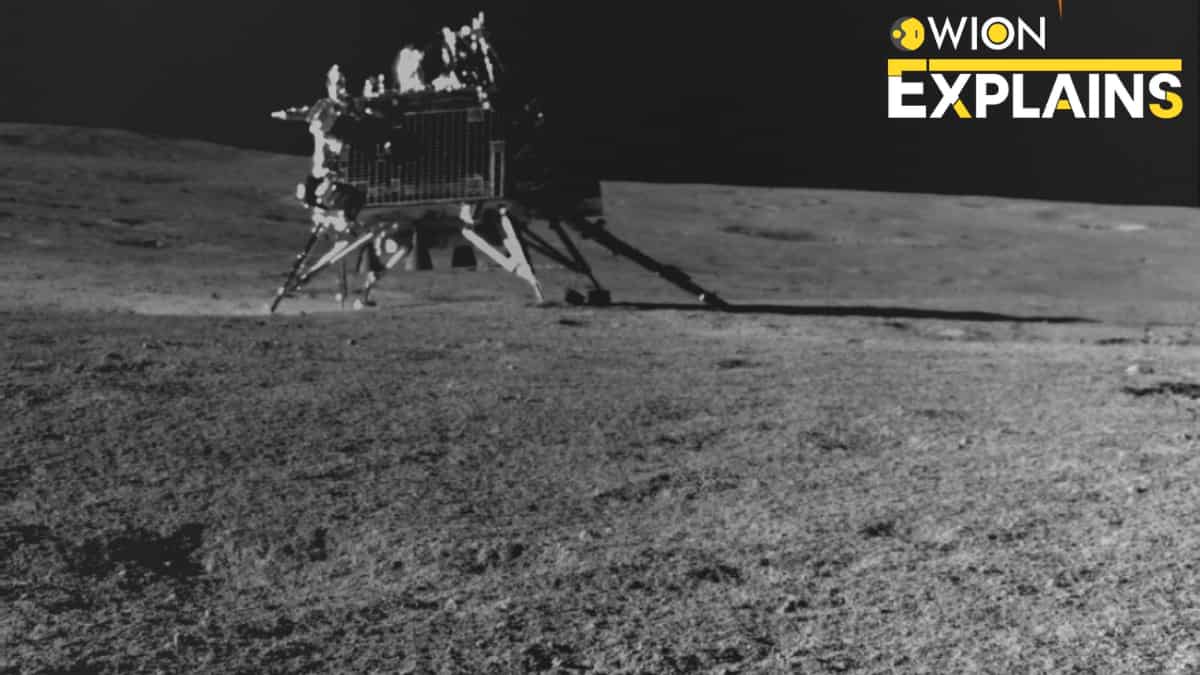
ISRO's Vikram lander on lunar surface captured by Pragyan rover on August 30, 2023
When a helicopter lands on an open field, it kicks off a dust storm and particles are strewn all across the vicinity of the landing spot. Likewise, when the Chandrayaan-3 lander touched down on the Lunar surface by using its on-board engines (helicopters use rotors, aerospace vehicles use mini-rocket engines), it kicked up quite a lot of dust, says a finding by Indian Space Research Organisation.
"It is understood that the landing rocket plumes must have displaced a significant mass of lunar epiregolith (soil/dust) during the final stages of landing and the consequent impact of the lander on the Lunar surface," ISRO said, citing imaging data.
According to the findings published in the Journal of the Indian Society of Remote Sensing, the comparison of pre-landing and post-landing imaging data depicts a halo around the landing site, thereby indicating the spread of the lunar dust that had been kicked up.

Also read |Chandrayaan-3 is success: A soft landing for Vikram lander, giant leap for India's space odyssey
On the surface of the earth, owing to the effect of gravity and an atmosphere, the dust kicked up by the helicopter rotors would settle down within a few seconds of the rotor blades coming to a halt. However, lunar gravity is barely 1/6ththat of the earth and there is no atmosphere or air, therefore, the lunar dust would take a while to settle.
Based on calculations incorporating the mass of the Vikram lander, the research paper states that approximately 2.06 tonnes of lunar epiregolith mass has been ejected.
)
Three labourers killed as DU student loses control of his car, rams into them on Dwarka Expressway
)
Pentagon revives mandatory testosterone testing for male troops aged 30 and above
)
FACT CHECK: Why did PM Modi ask Xi ‘is it okay’ at BRICS Summit? New video reveals...
)
India seeks to build a full semiconductor supply chain
&im=FitAndFill=(700,400))
From Abhishek Sharma to Sahil Chauhan, 5 batters with fastest T20I hundreds
)
Indian activist-lawyer Prashant Bhushan's post brings focus on ‘conflict of interest’ appointments of ex-govt officials at Reliance, Adani groups
)
Pyongyang dismisses US, western pressure over nuclear programme
)
US And Denmark reach Greenland deal, Trump announces expanded military presence
)
Google’s Gemini AI hacks real systems by guessing passwords during security test
)
China may have gained access to US's classified F-35 jets; parts meant for repairs diverted to Hong Kong, sparking Pentagon inquiry
)
NASA research plane reaches 61,000 feet over Panama
)
Godfather of AI Geoffrey Hinton gives US lawmakers a one-year warning on AI
)
Shivakumar attends 79th Kalyana Karnataka Utsav in Kalaburagi
)
Trump signs Russia sanctions law: India faces fresh 100% tariff threat over Russian oil
)
Brigitte Bardot’s private collection set for Paris auction; key items and prices revealed
)
Why Ranveer Singh’s Dhurandhar missed India’s Oscar entry; FFI jury member reveals what happened
)
‘Will go to any extent’: Pakistan vows to defend Saudi Arabia amid Houthi attacks
)
The Verdict | When precision fails: US commits war crime in Minab school strike, UN finds
)
Trump signs Russia sanctions bill into law, targets Moscow’s energy sector
&im=FitAndFill=(700,400))
New Friday OTT releases (September 18, 2026): Lust Stories 3, You+Me, Best of the Best- 8 new titles coming on Netflix, Prime Video and more
)
Fast bowler Brydon Carse faces no charges over Derby nightclub incident
)
Flying cars in UAE: Ras Al Khaimah signs deal with Chinese company to test new transport
)
Africa is splitting, and a lot sooner than estimated, giving way to a new ocean
)
'Gangsta' crab shoves knife blade at man and his dog in Florida - Watch
)
Trump bans CNN, MS NOW and Politico from White House over ‘FAKE NEWS’
)
Trump 2.0: Dark days ahead for America’s ‘imperial presidency’
)
Trump's Greenland dream comes true? POTUS announces 'Infinite Life' deal with Denmark, claims permanent US control
)
Drone strikes cooling tower at Russia's Kursk Nuclear Plant, IAEA confirms
)
Who is Khalilur Rahman? All you need to know about 81st UN General Assembly President
)
IIT Bombay student dies by suicide, was caught seeking AI help during exams
&im=FitAndFill=(700,400))
Meet top 5 bowlers in latest ICC T20I rankings
)
Indian Cinema bets big on mythology, brings ancient stories to modern audiences
)
Ukraine plans record $109 bn defence spending, nearly two thirds of budget amid Russia war
)
Russia holds first parliamentary elections since the beginning of the Ukraine war
&im=FitAndFill=(700,400))
Meet top 5 Indian batters with fastest T20I centuries
"This number benchmarks well against the estimates from the much heavier Apollo landers, where around 4.5 to 6 tonnes of ejecta was displaced" it reads.
The report derived from the findings is titled 'Characterisation of Ejecta Halo on the Lunar Surface Around Chandrayaan-3 Vikram Lander Using OHRC Imagery'.
Given the fine-grained nature of the lunar epiregolith at the Vikram landing site, a large volume of in situ epiregolith has been displaced from the landing site region, the finding states.
By analysing the images of the landing site and the lander, as captured by the Chandrayaan-2 orbiter, it mentions that an approximate area of 108.4 meters squared, is estimated to be covered by the lunar dust scattered by the landing sequence of the Vikram lander.
Also watch |Chandrayaan-3: The mission objectives of lander Vikram, rover Pragyan on the Moon
While these findings by ISRO's National Remote Sensing Centre (NRSC) indicate that a significant amount of dust was kicked up by the Lunar landing, the initial observations by the Indian space agency were the exact opposite. "When we went into the site (and landed there), the terrain looked entirely different. We have seen during the landing process that the dust coming out was extremely less. It was also surprising to us, as to why so much dust was not coming out ?' ISRO Chief, Dr. S. Somanath had earlier said in an interview.
Specifically referring to the nature of dust observed, he said, "It was not behaving like dust, it was more like a little sticky material. So, we will have to understand why the material on the moon is a little sticky". ISRO suspects that the lunar soil/dust being sticky or the surface being uneven, is what prevented the rover wheel imprint appearing distinctly on the moon.
The rover wheels were imprinted with the ISRO logo and the Indian national emblem.
This also raises the question, whether the force exerted by the Lunar lander engines blew away all the fine dust (Lunar soil) near the landing site and exposed the sticky surface below the dust?
Answers to this might emerge as and when more data and findings from the Chandrayaan-3 mission are made public. We must remember that Chandrayaan-3 landed near the unexplored south pole region of the moon.
In the history of lunar exploration, this is the closest that a mission has gotten to this region. Therefore, several unique scientific outcomes could emerge from this mission.
According to a thesis submitted at the University of Central Florida, the high-speed ejecta (lunar dust) scattered by landing lunar crafts could cause harm to even crafts circling the moon and future lunar space stations.
It also goes on to state that larger and heavier lunar landers that spew bigger plumes of exhaust flame, could scatter more dust and accelerate these particles even outside of the moon(to lunar orbit), given the weak lunar gravity.
The thesis also mentions that Particles generally stay aloft for longest when launched from the Equator and stay aloft shortest when launched from the South Pole. Dust particles ejected from the Lunar equator at certain speeds are known to remain afloat for almost a month, whereas those ejected from the south pole would remain aloft for about a week, it says.
As more robotic and crewed Lunar missions are to reach the Lunar surface in coming years, it is of paramount importance for space agencies to better understand the effects and specific nature of Lunar dust, in order to develop methods to safeguard from it.
Lunar dust is known to cause damage to spacecraft components, sensors, cameras, space suits etc.
Given that more powerful and large landers would be touching down on the lunar surface, it would be necessary to know how fast and how far lunar dust can get ejected, the paths it may travel in, the duration it may remain afloat, and the damage it can cause to probes on the moon and those in different orbits around the moon.
WATCH WION LIVE HERE
You can now write for wionews.com and be a part of the community. Share your stories and opinions with us here.
