The Verdict | Trump, Putin and Xi: A superpower triangle that could reshape global diplomacy

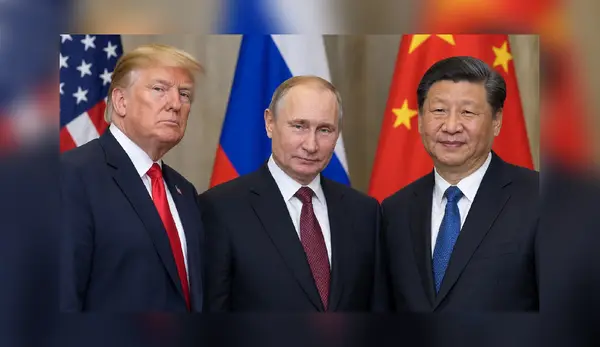
US President Donald Trump, Russian President Vladimir Putin and Chinese President Xi Jinping Photograph: (AI-generated)
For the global community, the proposed meeting raises questions extending beyond Ukraine. Supporters of renewed great-power dialogue see an opportunity to reduce confrontation. But critics fear that negotiations conducted without directly affected countries could undermine their sovereignty.
Three leaders, three competing priorities and one proposed summit that could have far-reaching consequences for global security.
The possibility of an unprecedented meeting between US President Donald Trump, Russian President Vladimir Putin and Chinese President Xi Jinping has triggered fresh debate over the future of international diplomacy.
The Kremlin has acknowledged discussions about a potential trilateral meeting on the sidelines of the Asia-Pacific Economic Cooperation summit in Shenzhen, China, on November 18 and 19.
Trump has expressed willingness to participate, but no formal agreement has been reached.
And already, the three powers appear to have different priorities.
According to reports, Putin has proposed using the meeting to explore a settlement to the war in Ukraine. Trump, however, has suggested that nuclear disarmament would be a principal objective, alongside possible discussions on trade.
Trending Stories


Beijing has not confirmed the proposed gathering.
The most immediate controversy concerns Ukraine.
Ukrainian officials have strongly criticised the prospect of negotiations about their country's future without Kyiv's participation.
Foreign Minister Andrii Sybiha warned that a meeting involving Washington, Moscow and Beijing could encourage Russia to continue the war rather than accelerate peace.
The diplomatic developments also come amid fresh Russian attacks on Ukrainian energy infrastructure, leaving hundreds of thousands of households without electricity.
Meanwhile, Trump's recent decision to ease certain sanctions on Moscow and his criticism of Ukrainian President Volodymyr Zelensky have intensified disagreements between Washington and Kyiv.
China faces a different calculation.
Beijing maintains close strategic ties with Moscow while simultaneously seeking economic stability in its relations with Washington and Europe.
It has also questioned proposals for trilateral nuclear disarmament talks, arguing that its nuclear arsenal remains considerably smaller than those of Russia and the United States.
For the wider international community, the proposed meeting raises questions extending beyond Ukraine.
Could three competing powers negotiate meaningful arms-control agreements? Would their diplomatic engagement reduce geopolitical tensions? And what role would smaller countries and established alliances play in decisions affecting their security?
Supporters of renewed great-power dialogue may see an opportunity to reduce confrontation. Critics fear that negotiations conducted without directly affected countries could undermine their sovereignty and confidence in international diplomacy.
For now, the summit remains hypothetical.
But the debate surrounding it has already exposed a central tension in contemporary geopolitics: the difference between negotiating with powerful states and negotiating on behalf of those whose futures are at stake.
Three superpowers may eventually sit at one table. The question is whether their discussions will produce a more stable international order — and whose voices will help shape it.