The democratic adaptation gap: Can democracies respond before the streets take over?

&imwidth=600&imheight=450&format=webp&quality=medium "The democratic adaptation gap: Can democracies respond before the streets take over?")
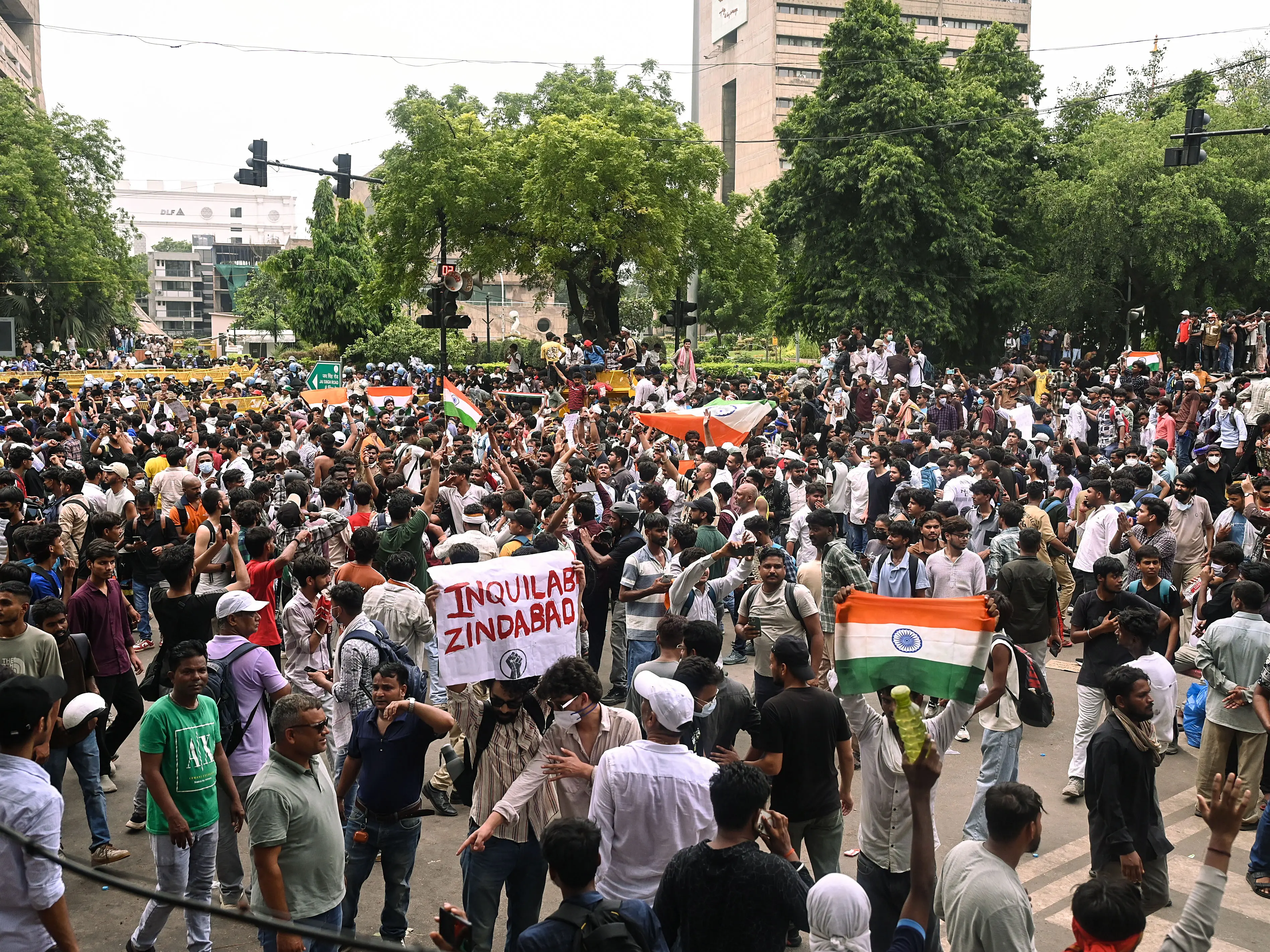
Why young people are taking to the streets across the world Photograph: (ANI)
India’s recent youth protests should therefore be viewed within this broader global context. They are not simply about one policy or one government. They are symptomatic of a larger transformation affecting democracies everywhere.
As the United States commemorates the 250th anniversary of its Declaration of Independence, another story is unfolding across much of the democratic world. From recent youth-led protests in India to the upheavals witnessed in Sri Lanka, Bangladesh and Nepal, and before them the Arab Spring, an increasingly frustrated generation is taking its grievances to the streets.
The question is no longer why such protests erupt. It is whether representative democracy can adapt quickly enough to respond before public frustration spills beyond the institutions designed to contain it.
Different countries have experienced different triggers. Yet the underlying forces are remarkably similar: growing economic insecurity, declining confidence in traditional political institutions, and a pervasive belief among many young people that the future offers fewer opportunities than the past. Technology has transformed these anxieties into political force.
Social media has democratised communication in unprecedented ways, giving ordinary citizens a voice that previous generations could scarcely imagine. Yet it has also rewarded outrage over reason, speed over reflection, and confrontation over compromise. Algorithms amplify emotion, enabling anger to spread far more quickly than consensus can be built.
Representative democracy, however, was never designed to function at the speed of a smartphone.
Trending Stories
)
)
)
)
)
)
)
)
)
)
)
)
)
)
)
)
)
)
)
)
)
)
)
)
)
)
)
)
)
)
)
)
)
)
)
)
)
The framers of the American Constitution understood that democracy required more than simply reflecting public passions. John Adams warned against societies where “noise” overwhelms “sense” and where ignorance prevails over learning. Their constitutional architecture sought to temper immediate passions through institutions that encouraged deliberation, compromise and long-term thinking.
Those principles remain as relevant today as they were in the eighteenth century. The challenge is that the environment in which democracies operate has changed beyond recognition.
This is what might be called the democratic adaptation gap. Institutions designed for the age of the printing press now struggle to govern societies shaped by algorithms, artificial intelligence and instantaneous communication. Citizens compare governments not with other governments, but with technology platforms capable of responding within seconds. Political systems cannot—and should not—operate at that speed, but they can no longer ignore the expectations it has created.
Ironically, the American Republic itself emerged through protest. The Boston Tea Party and the unrest that followed demonstrated that when people lose confidence in institutions, politics inevitably moves into the streets. But history also teaches another lesson. Winning a revolution is often easier than building a stable political order afterwards.
South Asia offers timely reminders of this reality.
Sri Lanka’s Aragalaya, Nepal’s repeated political upheavals and Bangladesh’s cycles of protest all reflected genuine public grievances. Yet none should be romanticised. Lives were lost. Institutions were weakened. Political polarisation deepened. In each case, years of national progress in important areas were also put at risk.
Public protest can be an essential democratic corrective. But it can also produce unintended consequences. Reform should strengthen institutions rather than destroy them. The baby should not be thrown out with the bathwater.
India’s recent youth protests should therefore be viewed within this broader global context. They are not simply about one policy or one government. They are symptomatic of a larger transformation affecting democracies everywhere.
The economic context explains much of this anxiety. Across South Asia and much of the Global South, millions of educated young people struggle to find meaningful employment despite years of investment in education. Expectations have risen faster than opportunities. For many graduates, the promise that education alone would secure upward mobility no longer appears credible.
Now artificial intelligence is adding another layer of uncertainty.
For policymakers, AI promises remarkable gains in productivity, innovation and economic growth. For many young people, however, it appears as a force that could eliminate the very entry-level jobs they hoped would provide economic security. Whether those fears ultimately prove justified is less important than the fact that they are widely shared.
Combined with social media, this creates a powerful political dynamic. Digital platforms no longer merely communicate frustration; they organise it, accelerate it and, at times, radicalise it. A local grievance can become a national movement within hours.
This is not simply a crisis of democracy. It is a crisis of democratic adaptation.
Democracies cannot abandon deliberation in favour of the speed and volatility of social media. Checks and balances, constitutional safeguards and the rule of law remain indispensable. But they must develop new ways of engaging citizens more continuously than through periodic elections alone. They need institutions capable of listening earlier, responding faster and incorporating younger voices before frustration reaches a breaking point.
This requires nothing less than a new democratic social contract for the age of artificial intelligence.
Governments alone cannot build it. Business leaders must create pathways to meaningful employment in rapidly changing economies. Universities must prepare students for occupations that may not yet exist rather than those that are disappearing. Technology companies must recognise that maximising engagement is not always compatible with strengthening democratic discourse. Civil society, educators, faith leaders and the media all have vital roles in rebuilding trust.
Perhaps the greatest challenge is restoring hope.
When young people believe institutions remain capable of renewal, they invest in reform. When they conclude that institutions are incapable of change, they seek change outside them.
India is uniquely placed to initiate a global conversation on this challenge. As the world’s largest democracy, a leading voice of the Global South and one of the world’s foremost digital societies, it possesses both the credibility and the convening power to bring together governments, technology companies, academics, youth representatives and civil society.
A high-level international conference examining democracy, technology, artificial intelligence and generational aspirations could begin developing a shared framework for democratic adaptation in the twenty-first century. The objective would not be to discourage peaceful protest, which remains an essential democratic right, but to reduce the conditions that make protest appear to be the only avenue for meaningful change.
As America marks 250 years of constitutional democracy, perhaps the greatest lesson from its own history is that enduring institutions survive not because they resist change, but because they adapt while remaining faithful to their founding principles.
The defining challenge of the twenty-first century may not be whether democracies survive, but whether they can adapt faster than the technologies reshaping their societies. If they fail to do so, the streets—rather than representative institutions—may increasingly become the first arena of politics instead of the last.
DISCLAIMER: The opinions expressed in this article are solely those of the author and do not necessarily reflect the views of WION.
