Coronavirus outbreak: What should be India's lockdown exit strategy?

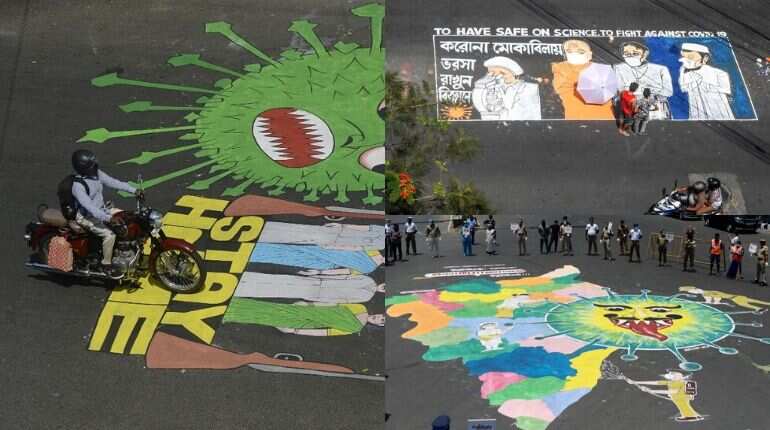
Indian graffiti artists and police take to roads to spread awareness!
Government of India has correctly stated that the decision to relax or totally lift the lockdown has to be taken by balancing the compulsive need of two factors namely lives and livelihood. Obviously, this view implies that while lives are very important, the economic factors reflecting on the livelihood are no less important.
Lifting of Lockdown Necessary :
While no one is able to predict as to when the COVID 19 crisis would end, the ground reality is that the lockdown cannot be prolonged indefinitely, as the continued lockdown is bound to upset the economy of the country to an unacceptable level, with job losses in massive scale and other disastrous consequences.

In such circumstances, selective lifting of lockdownhas become an absolute necessity and an inevitable measure.
Present Situation:
It has been only partial lockdown in India so far, with the agricultural operations being allowed to continue. For supply-side management, the government has permitted transportation of essential and non-essential goods, thus ensuring that the day to day life of the people would not be disrupted.
Further, groceries, ration and medical shops apart from the distribution of newspapers, milk etc. have been allowed to operate
Several pharmaceutical units, detergent units etc and the raw material units supplying inputs for such industries, which are needed for fighting against COVID 19 crisis, have been operating partially.
Ships carrying crude oil have been allowed to dock at the port and the transportation of crude oil to the destination is taking place.
A significant achievement, so far, in controlling the virus spread has happened in the lockdown period, which is only partial and not total.
Limitation of Lockdown :
The realisation is gradually setting in that while lockdown is a very important and necessary measure, it cannot be the be-all and end-all for solving the COVID 19 crisis. The ultimate solution for the crisis can come only by developing an appropriate vaccine, which is at least a few months away.
Governments have done their level best to implement the lockdown measures and it appears that it cannot be more strict and effective in future than at the present time.
It appears that the benefits of lockdown have already reached an optimum level, as far as, social distancing is concerned.
Need for Cost-Benefit Decision:
The decision on relaxation/lifting of lockdown based on lives and livelihood concept is essentially a cost-benefit decision.
The advocates of full lockdown say that lifting lockdown is calculated risk, while those who advocate lifting lockdown term it as necessary. The moderates may call it as a necessary evil.
Obviously, the government is hesitant to fully open the economy, as it fears that the situation may go out of control. Such fear of the government appears to be a case of overreaction.
A large section of the population is now well aware of the dangerous consequences of COVID 19 and importance of social distancing and hygiene, particularly since every human being has the instinct to protect himself or herself from dangerous conditions.
In India’s population of around 1300 million, only microscopic number of people have violated the lockdown restrictions in the last few weeks in isolated spots.
Government, by continuing the strict enforcement measures and with public and media support, should be able to control such rogue elements to ensure social distancing and other safety measures to prevent spread of the virus
If the government would continue with the enforcement of social distancing measures, then the violation after lifting the lockdown is likely to be only as much as it is happening now with the lockdown in force.
Steps Needed :
While some hotspots of virus spread have been identified, the present lockdown restrictions should continue in such hotspots, which should be sealed until the situation would improve.
To prevent further spread of the virus, it is essential that some sectors such as railways, public transport, cinema theatres, public parks, malls, places of worship should not be allowed to operate and activities such as mass meetings and social gatherings should be banned till the situation would improve to a desirable level, as their operations would certainly make the social distancing impossible.
The manufacturing and services activities should be allowed to resume as early as possible to ensure that the state of the national economy would be sustained and economic slow down would be prevented.
The main issue in resuming such economic activities relates to the transportation sector. While interstate truck transportation is already in operation, in the absence of a mass transportation facility, most workers and employees will not be able to attend work spots
To overcome the transportation issue to some extent, the taxis and private cars should be allowed to ply with a maximum of two passengers in the rear and two-wheelers without pillion rider should be permitted. Domestic airlines should be allowed to operate at 50 per centcapacity to maintain social distance and each traveller being asked to produce a health certificate.
These measures would not entirely solve the mass transportation issue but this would only be a temporary arrangement until the overall situation would improve and has to be put up with.
While permitting the economic activities to resume, the government should insist that the individuals and organisations would maintain social distancing and observe hygiene conditions. Employers and employees should ensure this and any violation should be punished.
A Pragmatic View :
Lifting lockdown and at the same time ensuring that social distancing and hygienic conditions would be maintained, is the ideal way out in the present.
(Disclaimer: The opinions expressed above are the personal views of the author and do not reflect the views of ZMCL)