

&imwidth=800&imheight=600&format=webp&quality=medium "Walls as battleground: Jadavpur University's graffiti war turns into test of 'us vs them'")
By Sunday night, paintbrushes were out again on the Jadavpur University campus. A day after authorities whitewashed slogans the state government had branded "anti-national," students from Left-leaning student groups were already back on the walls- reclaiming, repainting, and daring the administration to erase them a second time.
At the centre of the standoff is chief minister Suvendu Adhikari, whose intervention has turned a routine campus dispute over graffiti into a sharply drawn battle line between the state and its most politically restive university.
The Spark
Addressing a gathering outside JU on Friday, Adhikari singled out specific wall writings- including a tribute to Maoist leader Kishenji and messages supporting Palestine-and demanded they be removed. He framed the graffiti almost entirely through the lens of national loyalty, contrasting slogans about Palestine with the more "acceptable" cause of Pakistan-Occupied Kashmir, and questioning why students would honour a figure linked to insurgent violence while he remained responsible for law and order in the state.
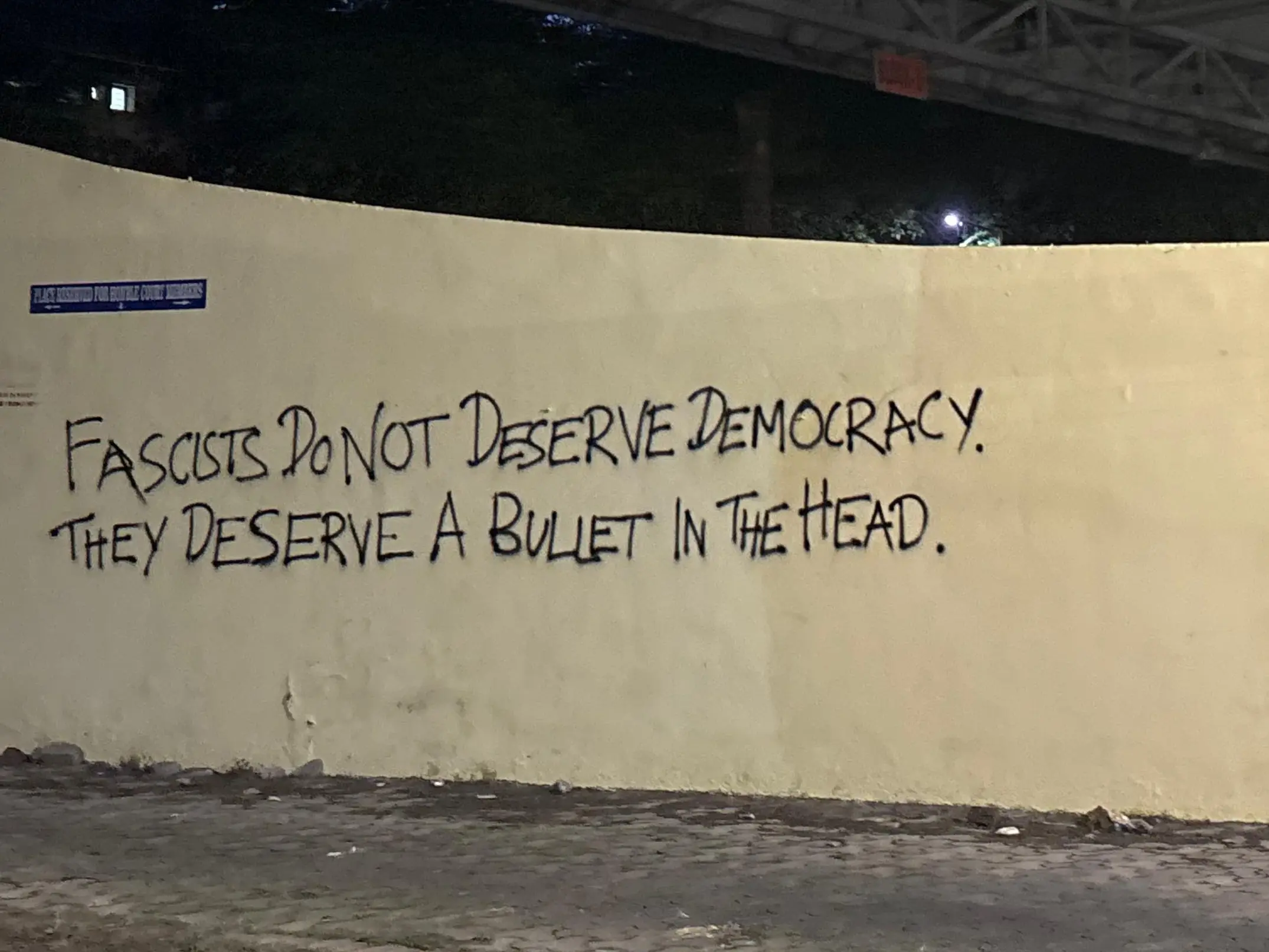
Days earlier, on August 24, Adhikari had posted a video objecting to other graffiti- including one reading that fascists deserve "a bullet in the head"- amplifying pressure on the university to act. By Saturday, the administration had complied, whitewashing several contested slogans. Higher education minister Jagannath Chattopadhyay backed the move bluntly, dismissing the graffiti as "garbage" and warning that if the university didn't act, the government would step in itself.
The "Us vs Them" Framing
Trending Stories
&imwidth=180&imheight=135&format=webp&quality=medium)
US sanctions Cuban state-owned bank BICSA over alleged financial links to Iran
&imwidth=180&imheight=135&format=webp&quality=medium)
US considering use of ‘mother of all bombs’ in its war with Iran: Report
&imwidth=180&imheight=135&format=webp&quality=medium)
Russian woman and Bihar boy's love story goes viral after she reaches India to marry him
&imwidth=180&imheight=135&format=webp&quality=medium)
Arijit Singh 9-city India stadium tour to start from January: Check venue and ticket prices
&imwidth=180&imheight=135&format=webp&quality=medium)
'Don't ever mess with nature!': Trump’s tiger attack post triggers social media backlash as victim's family issues heartbreaking tribute
&imwidth=180&imheight=135&format=webp&quality=medium)
88 days apart, twice: Mystery signal detected coming from empty region of space
&imwidth=180&imheight=135&format=webp&quality=medium)
Saudi Arabia executes two Bangladeshi nationals over ‘immoral acts’ inside Mecca mosque
&imwidth=180&imheight=135&format=webp&quality=medium)
Mumbai gears up for Marco Rubio’s visit as US Secretary of State prepares for India trip
&imwidth=180&imheight=135&format=webp&quality=medium)
Turkey Floods: Heavy rains flood homes and submerge vehicles in Istanbul
&imwidth=180&imheight=135&format=webp&quality=medium)
Leap second could go by 2027. What it means, as timekeepers gather in Versailles
&imwidth=180&imheight=135&format=webp&quality=medium)
Women who eat meat have a higher chance of living to 100: Study
&imwidth=180&imheight=135&format=webp&quality=medium)
Katie Zacharia, White House Press Secretary admits she never passed bar exam amid credentials controversy
&imwidth=180&imheight=135&format=webp&quality=medium)
Ukraine blinded: Musk deflects blame on Trump, Putin sharpens attack | Gravitas
&imwidth=180&imheight=135&format=webp&quality=medium)
Oregon school shooting: At least four killed, including three children; suspected shooter dead
&imwidth=180&imheight=135&format=webp&quality=medium)
‘False accusations’: Maduro, wife plead not guilty to new US torture charges
&imwidth=180&imheight=135&format=webp&quality=medium)
Who is Abu Dhabi royal Mahrah Al Nahyan, found unconscious on London street with toddler after cocaine use
&imwidth=180&imheight=135&format=webp&quality=medium)
Ukraine running out of patriot missiles as Russian ballistic attacks intensify: Report
&imwidth=180&imheight=135&format=webp&quality=medium)
Iranian woman, 23, handed death sentence for ‘blasphemy’ in social media post; appeals for help
&imwidth=180&imheight=135&format=webp&quality=medium)
Australian woman charged for adding snail poison to lover's curry at work
&imwidth=180&imheight=135&format=webp&quality=medium)
Central Park in Delhi shut on October 16, 17 amid CJP's protest call
&im=FitAndFill=(700,400)&imwidth=180&imheight=135&format=webp&quality=medium)
Inside the Peshawar school tragedy: 34 dead, building's condition under scrutiny and owner arrested. Here's what all happened
&imwidth=180&imheight=135&format=webp&quality=medium)
‘My president, I mean my husband’: Trump's new press secretary Katie Zacharia's first briefing goes off the rails in 14 minutes
&imwidth=180&imheight=135&format=webp&quality=medium)
IND-W vs ZIM-W, 1st T20I: When and where to watch live streaming in India?
&imwidth=180&imheight=135&format=webp&quality=medium)
NASA captures strange structure with tentacle-like formation from space
&im=FitAndFill=(700,400)&imwidth=180&imheight=135&format=webp&quality=medium)
World's 7 most innovative countries in 2026 REVEALED: Did India make the list? | In Pics
&imwidth=180&imheight=135&format=webp&quality=medium)
Trump's tariff strategy faces new test: India wants preferential access and tariff stability
&imwidth=180&imheight=135&format=webp&quality=medium)
Girl 'dead' for 8 hours wakes up at her own funeral, dad insists she wasn't breathing
&imwidth=180&imheight=135&format=webp&quality=medium)
US midterms 2026: FBI investigates suspicious mailings containing 'unknown substance' sent to election offices
&imwidth=180&imheight=135&format=webp&quality=medium)
The war premium, in rupees: How the Iran conflict could hit India’s import bill as US midterms near
&imwidth=180&imheight=135&format=webp&quality=medium)
US business activity grows in June, but tariffs and inflation cloud outlook
&imwidth=180&imheight=135&format=webp&quality=medium)
Yemen’s govt says PM, cabinet survived Houthi missile attack on presidential palace in Aden
&imwidth=180&imheight=135&format=webp&quality=medium)
Abhishek Sharma sets all-time record for most T20I sixes in a year
&imwidth=180&imheight=135&format=webp&quality=medium)
India’s naval priorities: Ex-Navy Chief calls for third aircraft carrier, more warships and submarines
&imwidth=180&imheight=135&format=webp&quality=medium)
Netanyahu defies Trump, blocks Gaza military base for Board of Peace | Gravitas
&imwidth=180&imheight=135&format=webp&quality=medium)
India to overtake Japan, become 4th-largest economy by 2027? What IMF’s latest projection reveals
&imwidth=180&imheight=135&format=webp&quality=medium)
'White supremacist' terror plot against Illinois Hindu temple foiled by jammed gun: Who is Alexandros Paporakis?
What has struck students and observers alike is how explicitly the conflict has been cast in binary terms- nationalist versus anti-national, order versus disorder, "we" the state versus "they" the campus radicals. Adhikari's own words leaned into this framing directly, invoking a serious terror attack and a deadly ambush on security personnel from 2010 to argue that celebrating Kishenji amounted to endorsing violence against the state.
Student groups pushed back hard against that logic. Indranuj Ray of the Revolutionary Students' Front argued that when a government publicly labels slogans against fascism or in solidarity with Palestine as anti-national, it is effectively admitting to fascist rule itself. He described the freshly whitewashed walls as symbols of what he called an undeclared emergency, vowing that new messages would reappear within days.
The Left student body SFI struck a similarly defiant note. Its JU unit secretary said the walls would be "taken back" and repainted with resistance messaging, while SFI leader Gaurav Barman confirmed plans to restore both the Palestinian flag and the "Free Palestine" slogan by Monday — a call, he said, against what SFI describes as genocide in Gaza.
As a symbolic first move, SFI members marked several walls on Sunday with the organisation's name and the date "28.02.2027" — effectively staking a claim over the surface until that date, ahead of repainting the full slogans.
A poster released by SFI's local committee carried a defiant Hindi couplet, roughly translated as a warning that suppressing dissent on the ground would only see revolution written across the sky — a line drawn from Aamir Aziz's protest poem *Sab Yaad Rakha Jayega*.
The University Caught in the Middle
Jadavpur University's administration has tried, with limited success, to stay above the political crossfire. Vice-chancellor Chiranjib Bhattacharjee declined to say whether repainted graffiti would be erased again, saying only that he could not comment on the matter. Registrar Selim Box Mandal took a more definitive line, stating that a campus should not host controversial graffiti at all.
That ambiguity has left the university exposed to pressure from both sides. The Akhil Bharatiya Vidyarthi Parishad (ABVP), the RSS-affiliated student body whose complaints appear to have helped trigger Adhikari's intervention, welcomed the whitewashing but said the job was incomplete. ABVP's JU spokesperson, Subhajit Saha, said several "obscene and vulgar" graffiti remained and had no place in an educational institution, singling out slogans calling for the CPI (Maoist) ban to be lifted and one praising Maoist commander Madvi Hidma.
Beyond Politics: A Fight Over What Counts as "Obscene"
Not all of the contested art is overtly political. ABVP has also objected to a menstrual-destigmatisation mural declaring solidarity with women who "bleed proudly," positioned near a quote from Mao Zedong on women holding up half the sky, and to a painting of a kissing couple beside a portrait of artist Chittaprosad Bhattacharya. Saha said ABVP has no objection to Chittaprosad's portrait itself and claimed to welcome creative expression — but drew the line at what he called Maoist advocacy and "anti-national activities."
Students rejected that distinction as inconsistent. Sociology student Anubhab Gupta questioned how the same painter's imagery could be embraced in one context and condemned as obscene in another, suggesting the real discomfort was with depictions of intimacy rather than any coherent principle. History student Rijupalika Mukherjee went further, arguing that treating open conversation about menstrual health as obscene reflected an anti-woman mindset rather than any real concern for campus decorum.
Even faculty pushed back gently against a blanket approach. A senior professor at the university noted that many of the wall artworks carry genuine social messages and that controversy over some content shouldn't be used to condemn all of it indiscriminately.
What Comes Next
Art Against Oppression, a JU student cultural collective, has called on students to bring their brushes back to campus on Monday and Tuesday, framing the repainting as both artistic expression and political resistance. Member Udita Bedajna described the walls as a democratic space that the university's political opponents fear precisely because they cannot control it, vowing that students would not be intimidated.
With SFI, RSF, and allied groups all promising to repaint the erased slogans this week, and the state government showing no sign of softening its stance, Jadavpur University's walls look set to become the site of a prolonged tug-of-war- one where every fresh coat of whitewash is likely to be met, within days, by another coat of paint.
