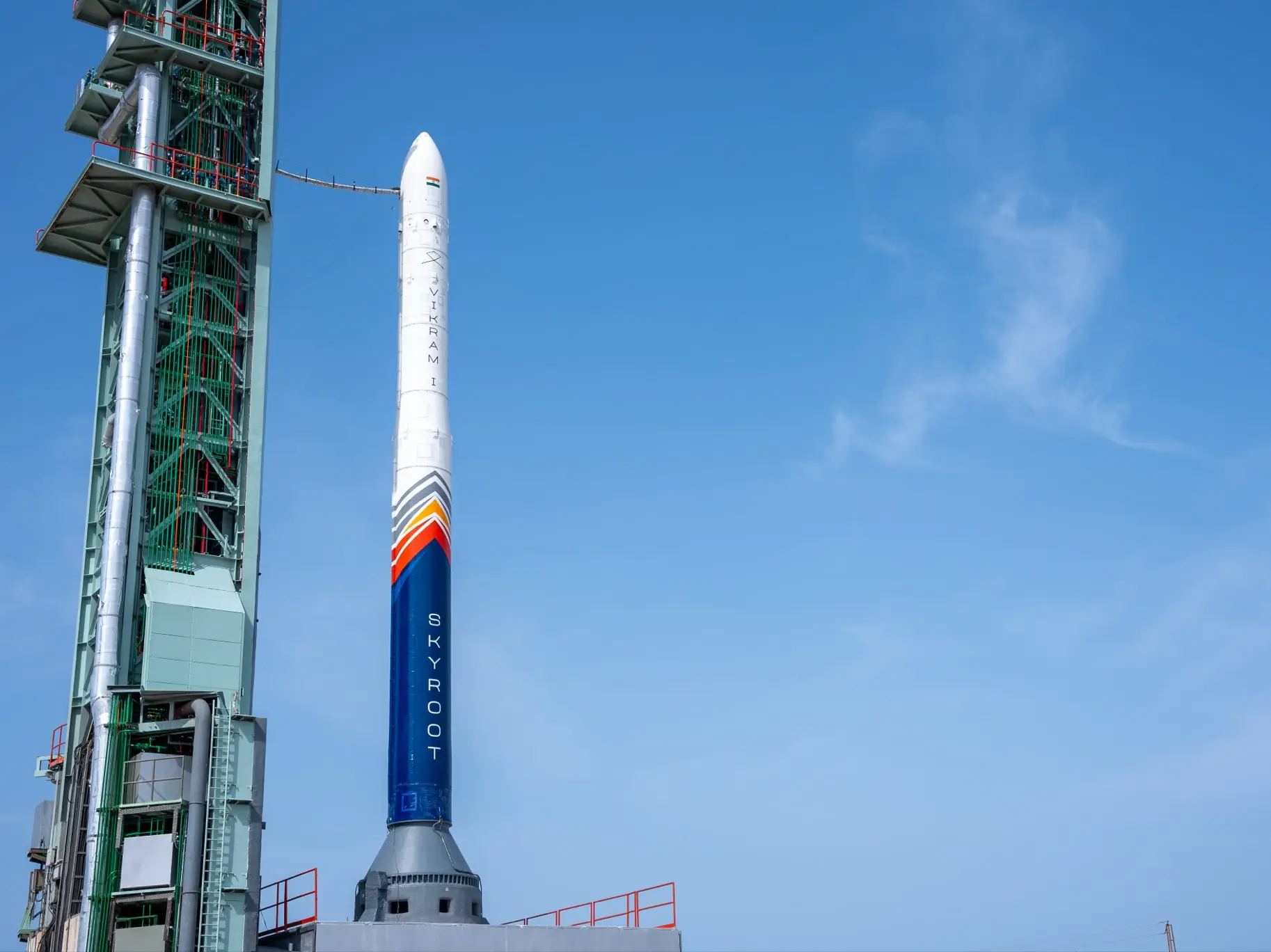
Vikram-1: India's first privately designed & built spacefaring rocket to liftoff on July 18

&imwidth=600&imheight=450&format=webp&quality=medium "Vikram-1: India's first privately designed & built spacefaring rocket to liftoff on July 18")
Vikram-1: India's first privately designed & built spacefaring rocket to liftoff on July 18 Photograph: (WION)
Vikram-1, will carry technology demonstration payloads from Grahaa Space, Cosmoserve, DCubed and Skyroot's own SCOPE, along with Cosmos Diamonds' artwork "Cosmic Bloom" and a micro-art piece.
India's first privately designed and built spacefaring rocket 'Vikram-1' is scheduled to launch at 11:30am IST, 18th July, Saturday. Since the start of this month, the Hyderabad-based firm Skyroot Aerospace's seven-storeys-tall 'Vikram 1' rocket has been fully integrated and stacked at the lone Indian spaceport, Satish Dhawan Space Centre(SDSC) in Sriharikota, Andhra Pradesh. This will be the first time that a private spacefaring rocket is lifting off from the first launchpad of the Government-run Indian Space Research Organization (ISRO). So far, only rockets designed and developed by ISRO have been launched from the first and second launchpads at SDSC, Sriharikota.
Concerned authorities have issued the necessary airspace and maritime notices, formally designating the restricted zones along Vikram-1's ascent and impact corridor for launch day, Skyroot said about the launch readiness.
“We have done everything that could be done to test Vikram-1 on ground. On 18th July, we are eager to see how Vikram-1 performs in a real flight environment for the first time. This is our first test flight, and we will be getting valuable data from it. This will be foundational to Skyroot's aspirations of establishing launch cadence. We are excited to see this through," said Pawan Kumar Chandana, Co-founder & CEO, Skyroot Aerospace.
Also read | Rs 5 lakh for NEET questions: CBI uncovers conspiracy behind paper leak
Vikram-1 will carry technology demonstration payloads from Grahaa Space, Cosmoserve, DCubed and Skyroot's own SCOPE, along with Cosmos Diamonds' artwork "Cosmic Bloom" and a micro-art piece.
Dubbed 'Mission Aagaman', meaning “the arrival”, the launch mission of Vikram-1 marks Skyroot’s second mission following the successful suborbital flight of Vikram-S, a rocket that was meant to fly to the edge of space and not deploy satellites. The November 2022 launch of Vikram-S was the first attempt of that sort by an Indian private firm.
"What we are aiming to do on 18 July is bigger than a single launch. It represents the hopes and hard work of around 1,000 people, the contributions of over 400 suppliers, and nearly 3,000 days of resolve to build a global offering from India. This test flight will show us how every technology we have developed over the years performs in real-world conditions. With the in-flight data gathered from this mission, we will return to the shop floor to learn, improve, and build further. This test flight is the first step towards creating a reliable, on-demand launch company for the world from India."
— Naga Bharath Daka, Co-founder & COO, Skyroot Aerospace
About the Vikram-1 rocket
Vikram-1 is a seven-storey-tall, multi-stage orbital launch vehicle built with an all-carbon composite structure and powered by in-house developed propulsion systems, including 3D-printed engines and high-thrust solid-fuel rocket boosters. Designed to carry small satellites weighing up to 350 kg to Low Earth Orbit (LEO), Vikram-1's maiden mission will target an orbit at an altitude of 450 km with a 60-degree orbital inclination.
Orbital inclination is the tilt of a satellite's path with respect to the Earth's equator. For context, a satellite that circles along the Earth's equator will have a 0-degree inclination; a satellite that circles from pole to pole will have a 90-degree inclination. Therefore, a 60-degree inclination in a Low Earth Orbit (LEO) means the satellite circles the planet tilted at a 60-degree angle to the equator. It traces a path that flies over populated regions between 60° North and 60° South latitude. It leaves the extreme polar regions unobserved but covers nearly all inhabited areas.
Trending Stories
&imwidth=280&imheight=210&format=webp&quality=medium)
&imwidth=280&imheight=210&format=webp&quality=medium)
&imwidth=280&imheight=210&format=webp&quality=medium)
&imwidth=280&imheight=210&format=webp&quality=medium)
&imwidth=280&imheight=210&format=webp&quality=medium)
&imwidth=280&imheight=210&format=webp&quality=medium)
&imwidth=280&imheight=210&format=webp&quality=medium)
&imwidth=280&imheight=210&format=webp&quality=medium)
&imwidth=280&imheight=210&format=webp&quality=medium)
&imwidth=280&imheight=210&format=webp&quality=medium)
&imwidth=280&imheight=210&format=webp&quality=medium)
&imwidth=280&imheight=210&format=webp&quality=medium)
&imwidth=280&imheight=210&format=webp&quality=medium)
&imwidth=280&imheight=210&format=webp&quality=medium)
&imwidth=280&imheight=210&format=webp&quality=medium)
&imwidth=280&imheight=210&format=webp&quality=medium)
&imwidth=280&imheight=210&format=webp&quality=medium)
&imwidth=280&imheight=210&format=webp&quality=medium)
&imwidth=280&imheight=210&format=webp&quality=medium)
&imwidth=280&imheight=210&format=webp&quality=medium)
&im=FitAndFill=(700,400)&imwidth=280&imheight=210&format=webp&quality=medium)
&imwidth=280&imheight=210&format=webp&quality=medium)
&imwidth=280&imheight=210&format=webp&quality=medium)
&imwidth=280&imheight=210&format=webp&quality=medium)
&im=FitAndFill=(700,400)&imwidth=280&imheight=210&format=webp&quality=medium)
&imwidth=280&imheight=210&format=webp&quality=medium)
&imwidth=280&imheight=210&format=webp&quality=medium)
&imwidth=280&imheight=210&format=webp&quality=medium)
&imwidth=280&imheight=210&format=webp&quality=medium)
&imwidth=280&imheight=210&format=webp&quality=medium)
&imwidth=280&imheight=210&format=webp&quality=medium)
&imwidth=280&imheight=210&format=webp&quality=medium)
&imwidth=280&imheight=210&format=webp&quality=medium)
&imwidth=280&imheight=210&format=webp&quality=medium)
&imwidth=280&imheight=210&format=webp&quality=medium)
&imwidth=280&imheight=210&format=webp&quality=medium)
Vikram-1's first launch mission will help Skyroot gather critical data across propulsion, stage separation, guidance, navigation, control and overall vehicle performance, supporting the evolution of Skyroot into a commercially operational launch company. Typically, spacefaring rocket makers regard the first three launches of a rocket as developmental or demonstration flights. It is based on the outcomes of the first three missions and their learnings that the firm would declare the rocket operational. Skyroot says that it will commence full commercial launches after one or two successful demonstration launches to orbit.
Watch | ISRO genius preparing India's future minds | Vijay govt's big move
