Indian space agency ISRO starts 2024 with successful launch of PSLV C58/XPoSat

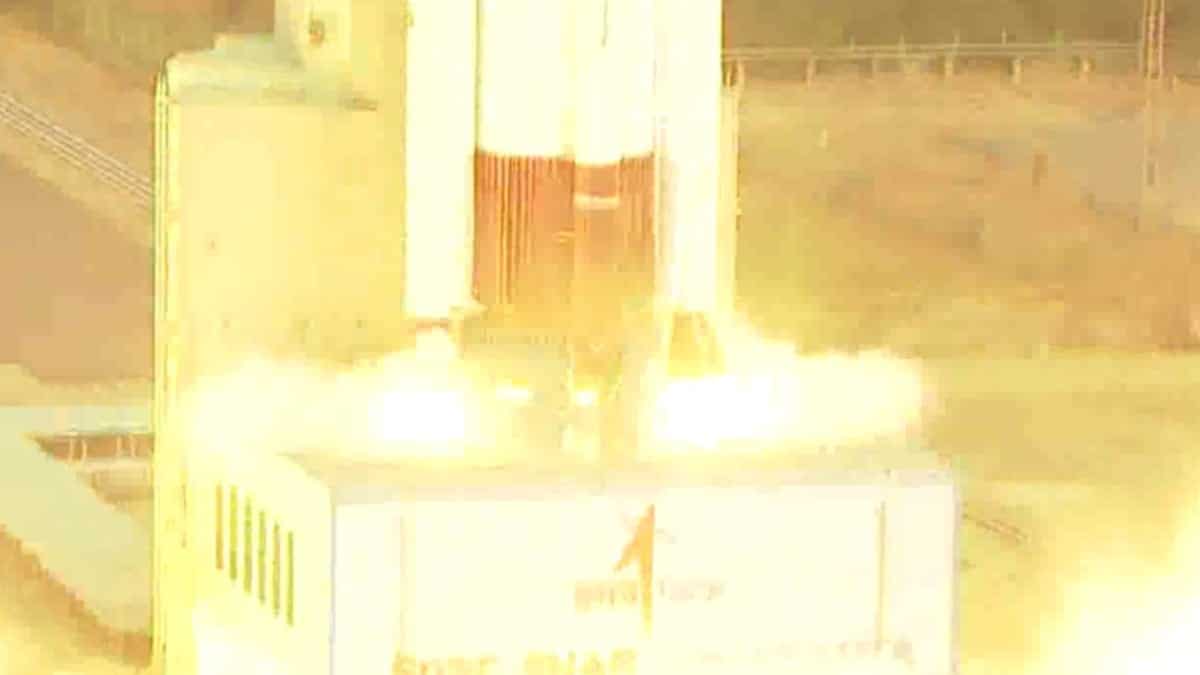
XPoSat
ISRO's 44-meter tall Polar Satellite Launch Vehicle (PSLV) lifted off majestically at 9:10am IST, on the first day of the New Year 2024. As the world welcomed the New Year, the Indian space agency set out to explore the mysteries of the universe and its phenomena, using an X-ray polarimetry Satellite (XPoSat). This is the 60th flight of ISRO's PSLV rocket, which has thus far placed more than 300 Indian and foreign satellites in their respective orbits. By operating its sensors to study X-rays that originate from space, the XPoSat satellite would offer a wealth of information for academicsand astronomers. As expected, the XPoSat satellite was placed into its designated orbit (650 kms above the earth's surface) at 9:32am IST.
X-rays are a form of high-energy light. In space, X-rays originate from places where matter is under extreme conditions - violent collisions, enormous explosions, 10-million-degree temperatures, strong magnetic fields etc. These X-rays that travel far and wide in space, carry detailed information about the powerful phenomena that produce them. However, the Earth's atmosphere blocks out these X-rays arriving from space. So, one of the best options to study these X-rays is by placing a satellite in space, where X-rays travel unhindered.
In the post-launch address, ISRO Chairman, Dr S Somanath congratulated the team for the successful mission and said that exciting times lay ahead in the New Year.

"There are a host of new technologies being tested in this mission - fuel cell, silicon-based high-energy battery, a payload designed and developed exclusively by women" said the PSLV-C58/XPoSat Mission Director, Dr M Jayakumar.
He added that the multiple experimental payloads being carried on the PSLV's 4th stage platform (PSLV Orbital Experimental Module) are a testimony to India's space sector reforms that have boosted participation of startups and industries in space-faring activities.
"Since last evening (New Year's Eve), people around the world have been celebrating New Year and fired rockets (fireworks) in celebration. We have launched a big (44-m) tall 'rocket firework' and except India it is not possible to work like this on New Year's Day and execute a mission like this" said M. Sankaran, the Director of ISRO's UR Rao Satellite Centre.
&imwidth=180&imheight=135&format=webp&quality=medium)
Pakistan to head IMF, World Bank boards after 74 years amid persistent economic crisis
&imwidth=180&imheight=135&format=webp&quality=medium)
IND-W vs ZIM-W, 1st T20I: Deepti Sharma, Niki Prasad shine as India beat Zimbabwe by four wickets
&imwidth=180&imheight=135&format=webp&quality=medium)
US midterms 2026: Ken Paxton may have Elon Musk to thank if he wins the Texas Senate race. Here's why
&imwidth=180&imheight=135&format=webp&quality=medium)
Trump invokes national interest to waive new Russia sanctions, tariffs; India gets relief from 100% tariff threat
&imwidth=180&imheight=135&format=webp&quality=medium)
Ankita Bhandari murder case: Parents meet CBI, seek impartial investigation
&imwidth=180&imheight=135&format=webp&quality=medium)
Lizard people? Ex-US Army sniper claims soldier killed by 'reptilian beings' in battle near Area 51
&imwidth=180&imheight=135&format=webp&quality=medium)
Gravitas | Iran threatens to hit key bridges in 7 countries if US resumes strikes
&imwidth=180&imheight=135&format=webp&quality=medium)
Ukraine drone strike disrupts 22 Russian airports, over 200 flights

Not Khan but Pal: Why did Imran Khan choose his mother's surname over his father's? Family tree explained
&imwidth=180&imheight=135&format=webp&quality=medium)
A secret code, a midnight escape and 300 deaths: The Russian officer who turned on Putin
&imwidth=180&imheight=135&format=webp&quality=medium)
'Reason UN has lost credibility': Amid SIR protests India hits out at report alleging 'youth repression'
&imwidth=180&imheight=135&format=webp&quality=medium)
Oregon school shooting: 16-year-old shooter identified, used shotgun bought by mother; Trump praises bystander who shot gunman as 'great hero'
&imwidth=180&imheight=135&format=webp&quality=medium)
China tells Israel to stop West Bank settlements, calls Palestine issue ‘historic injustice’
&imwidth=180&imheight=135&format=webp&quality=medium)
‘My president, I mean my husband’: Trump's new press secretary Katie Zacharia's first briefing goes off the rails in 14 minutes
&imwidth=180&imheight=135&format=webp&quality=medium)
China responds to Trump's Press Secretary Katie Zacharia after toilet remark: 'Visit China more often'
&im=FitAndFill=(700,400)&imwidth=180&imheight=135&format=webp&quality=medium)
Who left the White House podium the fastest? Press secretaries with the shortest stints
&imwidth=180&imheight=135&format=webp&quality=medium)
Vijay Deverakonda and Rashmika Mandanna's Ranabaali X Review: Netizens call it history-rich but overstuffed
&imwidth=180&imheight=135&format=webp&quality=medium)
Ramayana Part 1: Sai Pallavi's warrior avatar as Sita steals the spotlight in new BTS footage
&imwidth=180&imheight=135&format=webp&quality=medium)
Israel examines Russia's Shahed-type drones sent by Ukraine to combat Iran | Gravitas
&imwidth=180&imheight=135&format=webp&quality=medium)
US midterms 2026: Alexandria Ocasio-Cortez donates $1 million to Abdul El-Sayed’s as Michigan race heats up
&imwidth=180&imheight=135&format=webp&quality=medium)
Here’s who is eyeing the White House press secretary role after Katie Zacharia’s exit
&imwidth=180&imheight=135&format=webp&quality=medium)
Infiltration bid foiled in Kupwara’s Keran sector, search operation underway
&imwidth=180&imheight=135&format=webp&quality=medium)
Sean ‘Diddy’ Combs transferred to new prison amid reports of special privileges
&imwidth=180&imheight=135&format=webp&quality=medium)
Abhishek Sharma sets all-time record for most T20I sixes in a year
&imwidth=180&imheight=135&format=webp&quality=medium)
No Ravindra Jadeja, Yashasvi Jaiswal in India’s 2027 ODI World Cup plans: Report
&im=FitAndFill=(700,400)&imwidth=180&imheight=135&format=webp&quality=medium)
Inside Tesla's Roadster: 10 features of Elon Musk's 'flying car' that push the limits of electric vehicles | In Pics
&imwidth=180&imheight=135&format=webp&quality=medium)
India’s naval priorities: Ex-Navy Chief calls for third aircraft carrier, more warships and submarines
&imwidth=180&imheight=135&format=webp&quality=medium)
Starlink says 'ready to connect India with high-speed internet' amid Reliance row
&im=FitAndFill=(700,400)&imwidth=180&imheight=135&format=webp&quality=medium)
New Friday OTT releases (October 16, 2026): DC, Sacrifice, Aasha- 6 new movies and TV shows coming on Netflix, Zee 5, Prime Video and more
&imwidth=180&imheight=135&format=webp&quality=medium)
One species, two lineages: Why Sri Lanka’s spectacled cobra differs genetically from Indian variant
&imwidth=180&imheight=135&format=webp&quality=medium)
Oil tanker carrying over 2M barrels of crude hits mine in Strait of Hormuz, catches fire, says Iran
&imwidth=180&imheight=135&format=webp&quality=medium)
Selma Blair’s team responds to flight incident, says actress ‘did not intend to harm anyone’

US ends automatic work permit extensions; Indian workers lose 540-day safety net: What it means
&imwidth=180&imheight=135&format=webp&quality=medium)
US lawmaker Pramila Jaypal writes to Rubio, urges to raise handling of CJP protest with India
The XPoSat spacecraft comprises two scientific payloads- the primary payload POLIX (Polarimeter Instrument in X-rays) will measure the polarimetry parameters (degree and angle of polarization) in medium X-ray energy range of 8-30 keV photons of astronomical origin. The XSPECT (X-ray Spectroscopy and Timing) payload will give spectroscopic information in the energy range of 0.8-15 keV.
"XPoSat is the first dedicated satellite for polarization measurements in the medium X-Ray range and this is going to find something very interesting about blackholes and their ability to eat into other stars. Once black holes take raw material from adjacent stars, there will be X-Ray radiation. If you are able to measure the polarization nature of the X-ray emission, you can quantify the material ejection, such is the theory" explained Dr S Somanath, Chairman, ISRO.
"The emissions from celestial objects such as black holes, neutron stars and other energetic events arise from intricate events and provide a formidable challenge to understand. To surmount this challenge, ISRO is gearing up to launch India's first polarimetry and spectroscopy satellite. The life of the mission is expected to be five years" ISRO said before the launch
After placing the satellite in the intended orbit of 650 kms, the final stage of the PSLV rocket (PS4) would be brought down to a lower orbit of 350 kms, by re-starting the engines on two instances. Once in the 350 kmorbit, the fuels and hazardous chemicals stored within the upper stage tanks would be passivised. Passivisation is a step that prevents any possible explosions or break-up of the stored chemicals. It is a step aimed at ensuring sustainable use of space.
Also Read | NASA’s Parker Solar Probe plans to ‘touch the Sun’ in 2024
Post passivisation, the PS4 stage of the PSLV rocket would be used as a stabilised orbiting platform, that would carry a handful of experiments and technology demonstrators from ISRO Centres, academia and startups. In contrast, launching a dedicated satellite for testing each of these experiments would be very expensive. Simply put, ISRO is re-purposing a spent rocket stage as an orbiting platform.
WATCH | Moon landings, giant leap on Mars, and more... NASA reveals its 2024 plans
This launch is the 60th flight of India's workhorse rocket, the Polar Satellite Launch Vehicle (PSLV).The vehicle is the most-flown rocket in the Indianfleet. Flying since 1993, the rocket has an enviable success rate of more than 98 per cent. PSLV has been usedto put into orbitmost of India's own satellites. It has also been used to launch customer satellites. It has the reputation of having completedhigh-profile missions including Chandrayaan-1, the Mars Orbiter Mission andAditya-L1.
Notably, XPoSat mission marked the third scientific missionlaunched by ISRO, in six months. On July 14,2023, ISRO successfully launched the Chandrayaan-3 mission which achievedmuch more than what was initially expected and planned. On September 2, 2023, ISRO successfully launched the Aditya-L1 spacecraft, the country's first solar observatory. The Aditya craft is expected to reach its destination in the first week of January 2024. In the first quarter of this year, India's GSLV (formerly GSLV Mark 2) rocket willl launchthe NASA-ISRO Synthetic Aperture Radar (NISAR) Earth observation satellite. The satelliteis meant to help study Earth's natural phenomena, climate change, landmass, icecaps, forest cover, oceans etc.
