
&imwidth=800&imheight=600&format=webp&quality=medium "India sits on a critical mineral goldmine buried in 54mn tonnes of e-waste")
New Delhi is staring at what could be either its biggest resource security liability or its most consequential strategic opportunity of the clean energy decade. A new white paper by The Energy and Resources Institute and Messe Frankfurt India, released this week at WasteTech India's sixth edition in New Delhi, lays out the numbers with uncomfortable clarity.
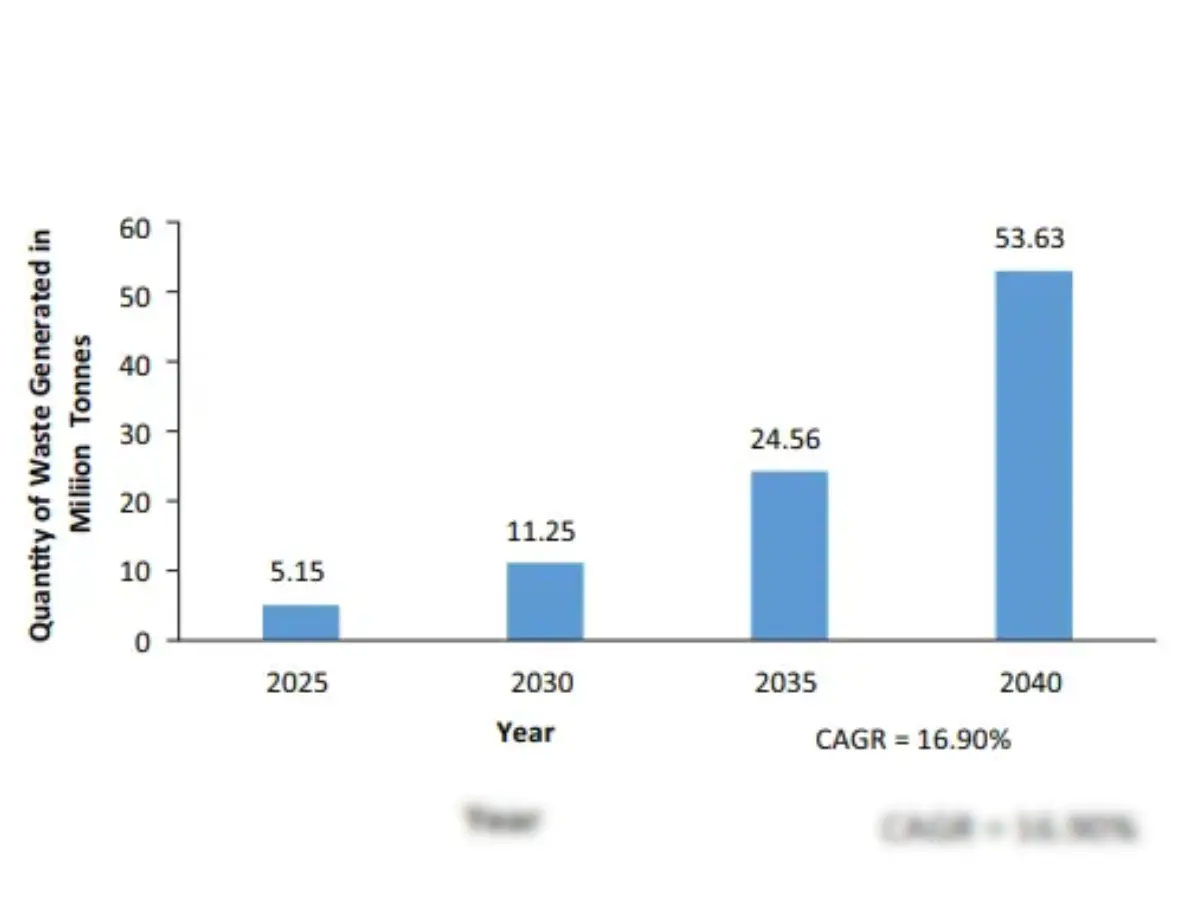
By 2040, India is projected to generate approximately 54 million metric tonnes of electronic waste annually, growing at a compound rate of 16.9% per year, from roughly 6.19 million metric tonnes estimated in 2026. For a country that is 100% import-dependent on lithium, cobalt, nickel, rare earth elements, gallium, indium, tungsten, and over a dozen other minerals critical to its clean energy ambitions, what gets thrown away is increasingly as strategically important as what gets mined.
THE MINERAL DEBT INDIA CANNOT AFFORD TO IGNORE

India's dependence on foreign mineral supply chains is not a distant policy concern, it is a present and growing liability. According to projections cited in the report from NITI Aayog's 2026 assessment, India's cumulative mineral demand through 2070 will reach 5.4 million metric tonnes of lithium, 11 MMT of nickel, 1.4 MMT of cobalt, and 46.4 MMT of graphite, all essential inputs for electric vehicles, energy storage systems, solar photovoltaics, and the broader digital economy.
The supply side of this equation is where geopolitics becomes dangerous. China refines 63% of the world's rare earth elements and has already imposed export licensing restrictions on several of them. The Democratic Republic of Congo holds 48% of global cobalt reserves and produces 72% of world supply, while itself restricting cobalt exports. Australia controls 55% of global lithium output. India buys from all of these markets and controls none of them.
For an economy guided by the principle of Atmanirbharta, self-reliance, this structural dependency represents a fundamental contradiction at the heart of its clean energy transition strategy.
Trending Stories
)
‘Kill all in the name of...’: FBI arrests 21-year-old over alleged ISIS-inspired mass-casualty attack plot
)
Space mines, lasers & robotic arms: Lt Gen Pannu decodes US disclosure of weapons in space
)
Bitter Zelensky snubs Trump for playing politics with Ukraine war | Gravitas
)
Passengers scream as Iran flight suffers mid-air scare: Boeing 737 shakes violently after take-off | VIDEO
)
US fires up to 70 interceptors against Iran attack on Jordan, putting supplies under pressure
)
India’s imports from Russia jump 57% in five months; China remains top import source
)
‘US military task force aiding Saudi Arabia forces with intel, planning support’: Official
)
OpenAI boss Sam Altman repeats AI 'slow down' call, says world 'right to be afraid'
)
Top military commanders from US, Israel, and 7 Arab nations held secret meeting on Iran War
)
Sydney Sweeney defends provocative ad choice, the internet is still not impressed
)
'Definitely feel bad for yourself': Kuldeep Yadav opens up on India Test snubs
)
Ex-India all-rounder Yuvraj Singh wants India to avoid 'massive changes' before ODI World Cup 2027
)
Ed Sheeran’s US tour loses all support acts after Macklemore’s removal | Controversy explained
)
China's property crisis deepens as investment plunges nearly 20%
)
Messi set to play in farewell match on October 6 in Argentina vs Benin friendly
)
2,200 people donate Rs 1.5 crore for 'docile' Georgia donkey 'HeeHaw' shot dead by police officer
)
Putin-linked Russian oligarch, Melania links: Why Trump skipped his son’s Bahamas wedding bash?
)
800 million years old - Scientists discover 'fingerprints' of supercontinent Gondwana in ancient rocks
)
Trump's name cannot return to Kennedy Center, US judge rules
)
Water equivalent to two Pacific Oceans could be stashed 2,900 km inside Earth
)
1,200 Indian and US troops begin high-altitude and desert drills
)
Ex-CIA officer caught with gold bars worth $40 million seeks plea deal | Gravitas
&im=FitAndFill=(700,400))
New OTT releases this week (September 14-20, 2026): Lust Stories 3, Waiting Hai, Irumudi- 5 new titles coming on Netflix, Prime Video and more
)
Trump's Iran war faces fresh House rebuke; 7 Republicans join Democrats in push to end conflict ahead of midterms
)
US Treasury yields cross 5% as Scott Bessent warns of ‘global issues’ impacting bonds
)
Who is Kalyan Bainsla, accused in the Gurugram hit-and-run case involving woman biker?
)
Saudi Arabia discovers 110 million tonnes of Uranium-rich ore in Madinah region
)
'Now Trump is copying us': Shivakumar links US $5,000 plan to Congress guarantees
)
Elephants hide behind trees, stage surprise attack on poachers targeting rhinos in South Africa
)
Los Angeles helicopter crash: At least three dead, several injured; NTSB to investigate
)
West Bengal IPS officer Bushra Bano transferred after objections to ‘Assalamualaikum’, ‘Inshallah’
)
India summons top Pakistan diplomat after Pak Navy ship collides with Indian warship at high seas
)
Spanish officer sent home from NATO base over affair with 'Russian spy' | Gravitas
)
Saudi Arabia accuses Houthis of drone attack on Mecca, first-ever red alert in Islam's holiest site sparks panic
)
'Like a thug you are using agency to go after..': Kash Patel grilled by Senate Democrats over FBI firings, journalist investigations and hiring policy
THE SECONDARY RESOURCE HIDING IN PLAIN SIGHT
This is precisely where India's mounting E-Waste problem reframes itself as an opportunity. Electronic devices contain over 60 elements, with metals comprising roughly one-third of their total composition. Batteries, in particular, are among the most resource-dense components in the E-Waste stream.
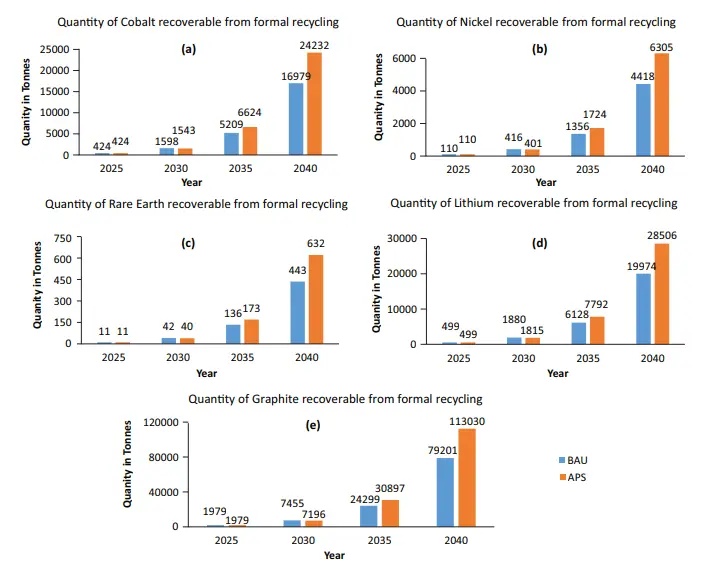
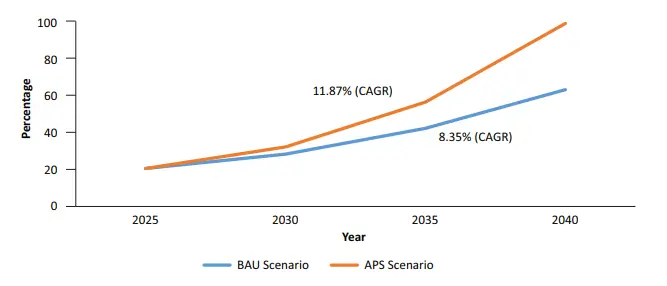
The report models two scenarios for India's formal E-Waste recycling sector. Under a business-as-usual trajectory, formal recycling capacity grows at 8.35% annually, recovering 1.9 kilotonnes of lithium, 1.6 kT of cobalt, 4.4 kT of nickel, and 7.9 kT of graphite annually from E-Waste by 2035-40. Under an Accelerated Policy Support scenario, where informal recyclers are progressively integrated into the formal ecosystem and policy support is aggressive, those numbers transform sharply. Lithium recovery could rise to 28 kT annually by 2035-40, cobalt to 24 kT, graphite to 113 kT, and nickel to 6 kT.
The lithium-ion battery recycling stream tells an equally compelling story. Driven primarily by end-of-life electric vehicles, formal LIB recycling could yield 56 kT of lithium, 42 kT of cobalt, 99 kT of nickel, and 205 kT of graphite annually by the 2036-40 period. These are not negligible quantities, they represent a meaningful secondary supply buffer against the geopolitical volatility of primary mineral markets.
THE TECHNOLOGY GAP THAT IS BLEEDING VALUE
The problem is that India, right now, lacks the tools to capture most of this value. The white paper identifies a structural technology deficit at the core of the country's recycling ecosystem that is actively costing it mineral wealth.
The informal sector, which processes approximately 78% of India's total E-Waste and employs an estimated 500,000 workers, lacks the capability to refine beyond what the industry calls black mass. This dark, granular powder, produced when lithium-ion batteries are mechanically shredded, contains concentrated graphite, lithium, cobalt, nickel, and manganese. Unable to process further, informal recyclers export this intermediate product overseas for hydrometallurgical refining, a practice the report describes as a massive leakage of critical mineral resource out of the country.
The formal sector is better equipped, but thinly spread. A small group of high-capacity formal recyclers accounts for approximately 48% of total formal processing capacity, while 75% of registered recyclers collectively account for just 15% of capacity. The government's technology transfer program through the Centre for Materials for Electronics Technology has succeeded in transferring advanced recycling technology to just 27 recyclers over two years, a number that bears no proportion to the scale of the challenge ahead.
India's E-Waste management framework currently tracks only four metals through the Extended Producer Responsibility system: copper, aluminium, iron, and gold. This was a pragmatic choice at the time of drafting the E-Waste Management Rules, calibrated to the sector's then-limited capabilities. But the landscape has moved on, and the policy has not.
WHAT THE REPORT PRESCRIBES
The white paper does not stop at diagnosis. It proposes a layered set of interventions across government, industry, and civil society, several of which carry direct market implications.
On policy reform, the report calls for expanding the scope of the EPR framework to include a wider range of critical and high-value metals beyond the current four-metal configuration. It specifically recommends developing a chemistry-specific EPR pricing framework for Lithium Ferro-Phosphate batteries, whose low content of valuable minerals makes recycling currently unprofitable, a structural problem that will worsen as LFP becomes the dominant battery chemistry for mass-market EVs.
On technology and infrastructure, the report calls for establishing Common Facility Centres giving smaller and informal recyclers shared access to advanced processing equipment, and for scaling domestic hydrometallurgical refining capacity so that black mass is processed within India, not exported as a semi-processed intermediate.
On market architecture, the paper recommends replacing the current floor-and-ceiling pricing mechanism for EPR certificates with market-based price discovery, strengthening digital traceability through integration with existing government systems, and introducing recycled content mandates in manufacturing to create a stable domestic demand signal for secondary minerals.
The report also identifies a significant financial opportunity in carbon markets, noting that recycled minerals generate approximately 80% fewer greenhouse gas emissions than primary extraction. This, it argues, makes recycled mineral production in India a natural candidate for carbon credit generation, a potential new stream of climate finance that remains largely untapped.
Crucially, the paper argues that the informal sector, far from being simply an enforcement problem, must be integrated before it can be regulated. Any formalisation strategy that ignores the livelihoods of half a million workers, the report warns, will fail on both economic and political grounds.
THE WINDOW IS OPEN, BUT NOT FOR LONG
India has moved. The National Critical Minerals Mission, launched in January 2025, has earmarked INR 1,500 crores for a recycling incentive scheme, with INR 700 crore directed at lithium-ion battery recycling and INR 650 crore at E-Waste more broadly. The Mines and Minerals (Development and Regulation) Amendment Act of 2025 has opened pathways for mineral recovery from mine tailings and overburden. The architecture is taking shape, but the report's projections carry an implicit warning: the accelerated scenario's benefits, those 28 kilotonnes of recovered lithium, the 113 kT of graphite, only materialise if policy support is aggressive, consistent, and technologically serious. The business-as-usual path recovers a fraction of what is possible, and the mineral that flows out of India as black mass does not come back.
India's E-Waste mountain is rising. Whether it becomes a resource liability or a strategic asset will depend, in large part, on decisions being made, or deferred, right now.
