&imwidth=800&imheight=600&format=webp&quality=medium "Global turbulence and BRICS 2026: Can intra-BRICS trade replace the West?")
Rarely has a BRICS Chairmanship arrived amid so much simultaneous turbulence. As India prepares to host the 18th BRICS Summit at Bharat Mandapam on 12-13 September 2026, under the theme ‘Building for Resilience, Innovation, Cooperation and Sustainability’, the grouping finds itself navigating a Russia-Ukraine war that refuses to end, an Iran-Israel-US crisis that has already claimed the life of Iran’s Supreme Leader, a US Congress moving to weaponise tariffs against Russian oil buyers, a Sino-Indian relationship only cautiously thawing after years of border tension and outcome of SCO 2026. Global turbulence, in other words, is not merely the backdrop to BRICS 2026; it has become the agenda.
A sequence not of India's choosing, but to India's advantage: Impact of SCO 2026
The 26th SCO Summit at Bishkek, held barely ten days before Bharat Mandapam, has effectively become a dress rehearsal for BRICS. The Bishkek Declaration condemned the US-Israel strikes on Iran, mourned the assassination of Iranian Supreme Leader Ali Khamenei, backed a just settlement on Palestine, and reaffirmed a “representative, democratic and equitable multipolar world order.” Iranian President Masoud Pezeshkian personally asked Prime Minister Modi, in his capacity as incoming BRICS Chair, to help build a common position against US-Israeli military action.
Since BRICS contains Iran alongside the more US-aligned UAE and Saudi Arabia, the same fault line that surfaced at Bishkek will resurface, in sharper form, at the BRICS table. Yet the sequencing works in India’s favour rather than against it. Having already co-signed Bishkek’s language on multipolarity and non-discriminatory trade, New Delhi arrives at its own Summit with a tested template for balancing Global South solidarity against its own strategic autonomy vis-à-vis Washington. Over 350 preparatory meetings across 25-plus cities this year testify to a chairmanship that has been methodical rather than reactive, the diplomatic equivalent of India’s subtraction and addition strategy: subtracting friction points before they harden into disputes, while adding areas of convergence the grouping can act upon together.
The tariff weapon and the limits of collective retaliation
The most immediate turbulence is economic. The Lindsey O Graham Sanctioning Russia and Iran Act, passed by the US Senate, authorises tariffs of up to 100 per cent on the largest importers of Russian oil and gas, a measure that would strike directly at India, China and, depending on final designation, Brazil. It is legislation dressed as Ukraine policy but built, as several US analysts have noted, to double as general-purpose tariff leverage against precisely the economies BRICS represents.
Trending Stories
&imwidth=180&imheight=135&format=webp&quality=medium)
'This is humiliation': Vijay Deverakonda under fire over controversial marriage proposal remark on Koffee With Karan 9
&imwidth=180&imheight=135&format=webp&quality=medium)
Shikhar Mohan earns maiden India A call-up, replaces KL Rahul
&imwidth=180&imheight=135&format=webp&quality=medium)
AI slop or smart strategy? South African author Coral Hart defends Her 370 AI- assisted books in 20 months
&imwidth=180&imheight=135&format=webp&quality=medium)
Two BrahMos missiles on Tejas, triple the range and 100% indigenisation, says former BrahMos CEO
&imwidth=180&imheight=135&format=webp&quality=medium)
India-China face-off continues near Arunachal’s Taksing, reveals ITBP chief in first official confirmation of tensions
&imwidth=180&imheight=135&format=webp&quality=medium)
Ilhan Omar breaks silence over alleged marriage to her brother; Trump thinks it's 'really good answer'
&imwidth=180&imheight=135&format=webp&quality=medium)
WATCH: Trump demands Ilhan Omar removal from Congress for 'using fake name to be sworn in'. So what is her real name?
&imwidth=180&imheight=135&format=webp&quality=medium)
Netanyahu dials PM Modi, invites him and Capt Smit Machchhar to light torch on Israel’s Independence Day
&imwidth=180&imheight=135&format=webp&quality=medium)
Pakistan airline PIA unveils new crew uniforms, faces online criticism
&imwidth=180&imheight=135&format=webp&quality=medium)
Christa Pike's failed execution: Tennessee team struggled to insert IV lines, lawyer says
&imwidth=180&imheight=135&format=webp&quality=medium)
Did Neha Bora call for Bangladesh-like GenZ protest, 'anarchy' in India? WION Fact-checks viral claim
&imwidth=180&imheight=135&format=webp&quality=medium)
US midterms 2026: US Supreme Court allows New Hampshire to restrict student IDs for voting
&imwidth=180&imheight=135&format=webp&quality=medium)
A secret code, a midnight escape and 300 deaths: The Russian officer who turned on Putin
&imwidth=180&imheight=135&format=webp&quality=medium)
India’s 2022 CWG silver medallist Sabbhineni Meghana announces international retirement
&imwidth=180&imheight=135&format=webp&quality=medium)
Trump ordered to answer questions under oath in BBC defamation lawsuit by December 11
&imwidth=180&imheight=135&format=webp&quality=medium)
Putin says Russia is ready to resume Ukraine-US peace talks but rejects 'short ceasefire' amid deadly attacks
&imwidth=180&imheight=135&format=webp&quality=medium)
Horrific video shows the moment 18-year-old fell to her death from Mexico amusement park ride
&imwidth=180&imheight=135&format=webp&quality=medium)
'It's a crime not to see this scene': Tehran puts Trump 'behind bars'
&imwidth=180&imheight=135&format=webp&quality=medium)
IND-W vs ZIM-W, 1st ODI: Rawal, Charani star in India’s nine-wicket win over Zimbabwe
&imwidth=180&imheight=135&format=webp&quality=medium)
Meghan Markle’s father Thomas under investigation over alleged child abuse images: Report
&imwidth=180&imheight=135&format=webp&quality=medium)
SA vs AUS 2nd Test: Temba Bavuma reveals 'Tendulkar inspiration' behind career-best 179
&imwidth=180&imheight=135&format=webp&quality=medium)
China's dancing robot turns violent bodyguard, lifts cars and fights intruders - Watch
&imwidth=180&imheight=135&format=webp&quality=medium)
Watch: India rejects ‘imprecise and unsupported’ references in UN migrant rights report
&imwidth=180&imheight=135&format=webp&quality=medium)
US to get 850 F-35 stealth fighter jets under 10-year Pentagon-Lockheed deal
&imwidth=180&imheight=135&format=webp&quality=medium)
GRAVITAS | Putin fires nuclear-capable hypersonic missiles, Zelensky ready to surrender 25% territory
&im=FitAndFill=(700,400)&imwidth=180&imheight=135&format=webp&quality=medium)
New Friday OTT releases (October 23, 2026): Gajab Raat, Dorothy, Chaar Yaar- Watch these 6 new movies and TV shows on Netflix, Prime Video and more
&im=FitAndFill=(700,400)&imwidth=180&imheight=135&format=webp&quality=medium)
Serbia elections: Nearly 150,000 people take to streets in massive rally against Aleksandar Vucic | In pics
&imwidth=180&imheight=135&format=webp&quality=medium)
BCCI’s CoE cautious over Hardik Pandya’s fitness, sets expected comeback timeline
&imwidth=180&imheight=135&format=webp&quality=medium)
First Lady Melania Trump secures ceasefire between Russia, Ukraine in Oleshky: White House
&imwidth=180&imheight=135&format=webp&quality=medium)
Finance influencer dies by suicide in Chennai; father accuses tech CEO, who denies charge
&imwidth=180&imheight=135&format=webp&quality=medium)
'Vivek should keep it up': Trump defends Ramaswamy's controversial campaign ad targeting Amy Acton
&imwidth=180&imheight=135&format=webp&quality=medium)
One man, 8 months of work, and a river dirty again: Why Bittu Tabahi may quit
&imwidth=180&imheight=135&format=webp&quality=medium)
450 villagers in UP rush to take anti-rabies shots after consuming 'charnamrit'
&imwidth=180&imheight=135&format=webp&quality=medium)
US midterms 2026: Elon Musk’s political spending hits $445 million as Republicans battle to retain Senate control
&imwidth=180&imheight=135&format=webp&quality=medium)
ENG vs SL: Harry Brook breaks Shubman Gill’s record for fastest ODI double century
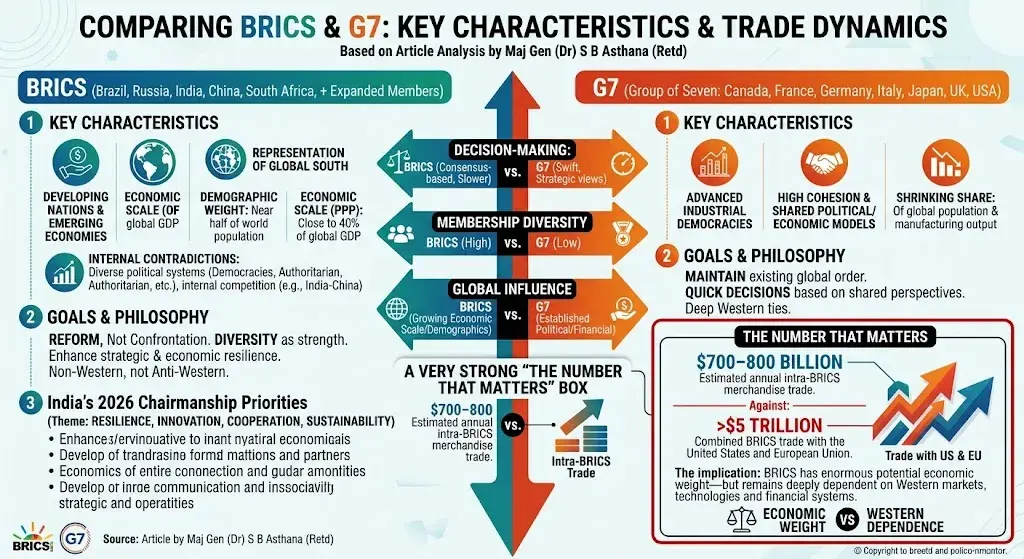
Can BRICS respond as a bloc? The economics counsel caution. Intra-BRICS merchandise trade runs at roughly USD 700-800 billion annually, against combined BRICS trade with the US and EU exceeding USD 5 trillion. No BRICS economy, including China’s, is prepared to sacrifice Western market access for bloc solidarity. What the tariff threat can do, paradoxically, is accelerate what internal diplomacy has struggled to achieve: greater coordination on payment systems, supply chains and financial cooperation, precisely because external coercion, when it targets multiple members simultaneously, narrows the space for free-riding. The lesson for BRICS is unambiguous, intra-BRICS trade must expand substantially if the grouping is to develop genuine resilience against an economic hegemon acting alone.
Xi's possible visit and the China variable
Adding to the turbulence is the prospect of Xi Jinping’s first visit to India since 2019, pre-dating the deadly Galwan clash of 2020. A delegation of some 400 officials is reportedly being readied, even as reports of a fresh border friction point complicate the atmospherics and India’s top security official has been in Beijing for talks. If the visit materialises, it will be read globally as a signal that the India-China relationship is entering a phase of competitive coexistence rather than open confrontation, correct diplomacy for both capitals, given that neither benefits from a permanently frozen bilateral track feeding into a wider “Cold War 2.0” narrative that neither India nor China wishes to be boxed into.
This matters for BRICS because the China-India contradiction remains, as I have argued elsewhere, the grouping’s most consequential internal tension. Beijing increasingly treats BRICS as a pillar of an alternative architecture reducing Western influence; New Delhi insists on a genuinely multipolar Asia rather than a China-centric one, and on BRICS as a reform platform rather than an anti-Western instrument. A cordial Modi-Xi meeting at the margins of Bharat Mandapam would not resolve that contradiction, but it would demonstrate that BRICS’s consensus-based model can still accommodate rival visions without capsizing, itself a form of concirclement, in which India manages competing power centres around it rather than being encircled by their rivalries.
Energy security: The silent common thread
Running beneath the geopolitics is a shared, less discussed vulnerability – energy security. Any escalation that threatens the Strait of Hormuz strikes directly at India’s oil import bill and inflation, and at similar exposures across China, and much of the Global South that BRICS claims to represent. The Bishkek statements on energy cooperation and India’s own MoUs on climate and connectivity are not separate from this turbulence; they are hedges against it. Chabahar Port, discussed in Prime Minister Modi’s sideline meeting with Iran’s President, and India’s continued, calibrated purchase of discounted Russian crude despite tariff threats, both reflect the same underlying calculus: energy security first, ideological alignment a distant second.
Calibrated activism as the only viable course
None of this turbulence is likely to derail the Summit’s declared, deliberately non-controversial themes of resilience, innovation, cooperation and sustainability. The harder question is whether members will stay within those bounds once they are in the room together, given how many of them arrive carrying grievances, Iran’s demand for solidarity against the US and Israel, Russia’s search for sanctions relief, and China’s institutional ambitions for BRICS as counterweight to the West all sit uneasily against India’s preference for a reform-not-confrontation agenda. India’s answer has to be calibrated activism: firm enough to hold the chair’s agenda together, restrained enough not to let BRICS be captured by any single member’s confrontation with the West. This is consistent with New Delhi’s parallel engagement with the G20, the Quad and the SCO, competitive coexistence with all major poles rather than exclusive alignment with any one of them.
Conclusion
BRICS at twenty was already navigating internal contradictions of size, ideology and economic asymmetry. BRICS in 2026 must do so while absorbing external shocks, war, assassination, tariff coercion and great-power rivalry, arriving almost simultaneously. That the grouping’s chair this year is a nation practised in balancing exactly these pressures, and that its Summit follows so closely on the SCO’s own test of the same balancing act, is more opportunity than accident. Whether Bharat Mandapam converts turbulence into cohesion, or merely papers over it for another year, will depend on India’s ability to keep BRICS anchored to its founding purpose: reform of an unrepresentative global order, not participation in a new bloc confrontation. That, ultimately, is the measure by which this Chairmanship, and this Summit, should be judged.