BRICS Summit 2026 | Inside Delhi’s BRICS security fortress: VVIP routes, anti-drone systems and over 25,000 cops

&imwidth=600&imheight=450&format=webp&quality=medium "BRICS Summit 2026 | Inside Delhi’s BRICS security fortress: VVIP routes, anti-drone systems and over 25,000 cops")
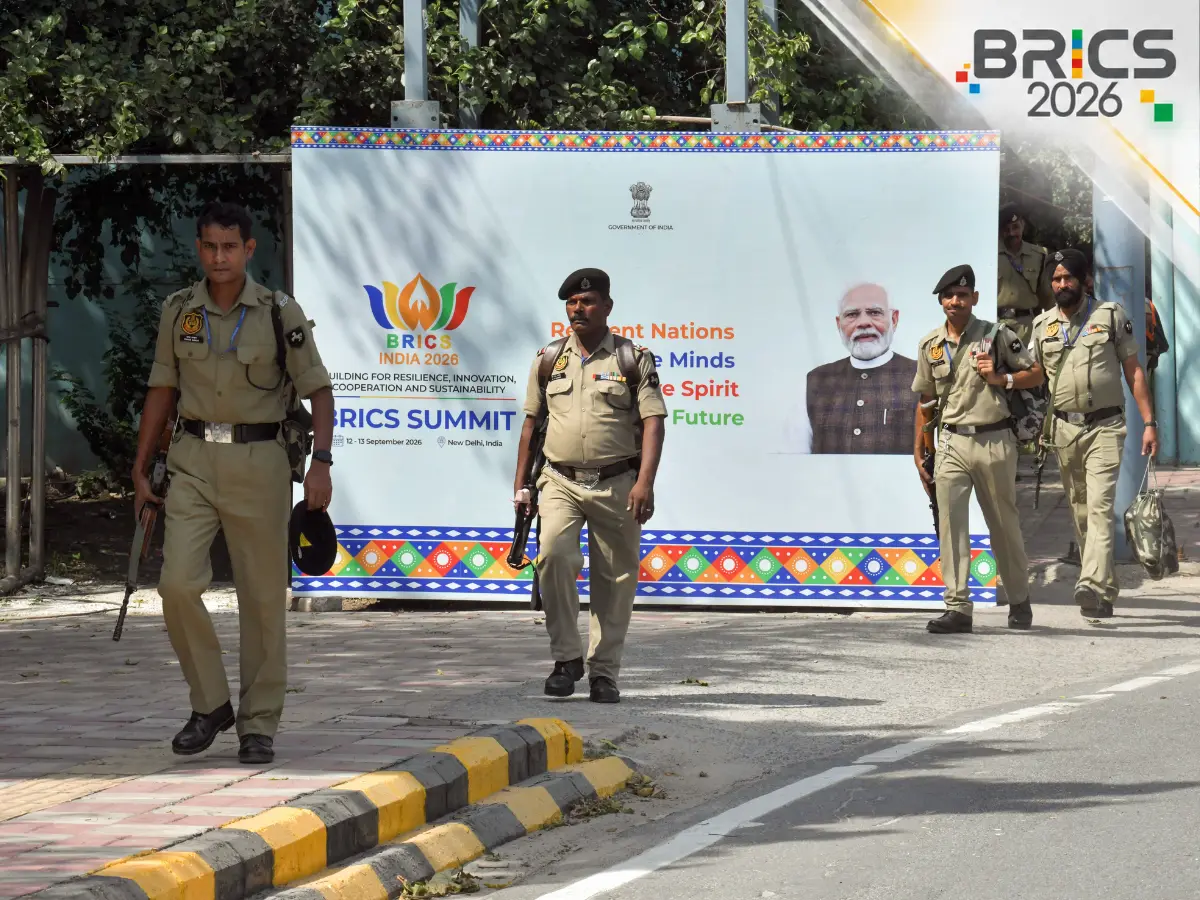
BRICS Summit 2026 | Inside Delhi’s BRICS security fortress: VVIP routes, anti-drone systems and over 25,000 cops Photograph: (ANI)
New Delhi turns into a high-security citadel for the BRICS Summit as thousands of personnel, anti-drone systems and VVIP routes secure world leaders
For a few days, Delhi is no longer just the seat of government, it is becoming a carefully choreographed security zone. As world leaders and senior delegations descend on the capital for the 18th BRICS Summit, the city is operating under a multilayered security architecture covering airports, hotels, roads, the summit venue, airspace and even the borders connecting Delhi with neighbouring Uttar Pradesh and Haryana. The summit, being held at Bharat Mandapam, brings together leaders and delegations from BRICS member countries and partner nations. The scale of the event has triggered a security operation comparable to the arrangements seen during the 2023 G20 Summit. For ordinary Delhi residents, that security operation will be visible in the form of traffic restrictions, diversions, heightened police presence and tighter surveillance. For the security agencies, however, the operation goes much deeper.
A security grid stretching across the Capital
The BRICS security plan is not confined to Bharat Mandapam. The security footprint stretches from Indira Gandhi International Airport to the hotels hosting foreign leaders and delegations, and onwards to the summit venue at Pragati Maidan. Around 25,000 personnel, including more than 100 NSG commandos, have been reported as part of the broader security deployment, while newer reports put the overall deployment closer to 30,000 personnel when Delhi Police and paramilitary forces covering airports, hotels and the summit venue are counted. The city has also been divided into security sectors, with senior police officers placed in charge of individual zones to enable faster coordination during VVIP movements.
From airport to hotel: The first layer of the fortress
The security operation begins even before foreign leaders leave their aircraft. With special aircraft and additional delegation flights arriving in Delhi, airport operations have been placed under heightened coordination. Reports indicate that Delhi is preparing for a significant increase in special and charter flights around the summit period. The airport-to-hotel corridors are being treated as critical VVIP routes, with police and security agencies preparing for convoy movements and temporary traffic regulation. The objective is to ensure that a leader's journey from the aircraft to the hotel, and later from the hotel to Bharat Mandapam, happens with minimum exposure and maximum control.
Hotels become temporary security bubbles
Trending Stories
)
)
)
)
)
)
)
)
)
)
)
)
)
)
)
)
)
)
&im=FitAndFill=(700,400))
)
)
)
&im=FitAndFill=(700,400))
)
&im=FitAndFill=(700,400))
&im=FitAndFill=(700,400))
)
The Capital's luxury hotels are another crucial component of the security architecture. Several prominent hotels in areas such as Chanakyapuri and central and south Delhi are hosting foreign leaders and delegations. Security checks have been intensified, with hotel employees subjected to verification and security personnel deployed around the buildings. In some cases, entire floors have been reserved for individual leaders and their delegations. But the hotels are not merely accommodation. They are also becoming temporary diplomatic and communications hubs, with dedicated spaces being prepared for secure communication with governments back home. That turns each hotel hosting a world leader into a mini high-security zone.
Also Read: BRICS Summit is a ‘large logistical exercise’, 1300 Journalists expected, MEA official says
The anti-drone shield
One of the most important changes in modern VVIP security is happening above ground. Delhi's security architecture includes anti-drone measures and aerial surveillance, reflecting the growing threat posed by unmanned aerial systems around high-profile international events. The aerial restrictions extend beyond Delhi itself. The Directorate General of Civil Aviation has temporarily restricted flying-training operations in seven states during the summit period, while restrictions have also been placed on several categories of aircraft and unmanned aerial vehicles within specified radii around Delhi. In other words, the security perimeter is not simply a line drawn around Bharat Mandapam. It extends into the sky.
35 roads controlled, 22 diversion points
For Delhi residents, the most visible impact will be on the roads. Traffic authorities have identified more than 35 roads for controlled movement and 22 diversion points as part of the BRICS traffic plan. Major stretches in central, south and southwest Delhi are expected to see restrictions or diversions, particularly during VVIP convoy movements.
Routes around Bharat Mandapam, Dhaula Kuan, Mahipalpur, Sardar Patel Marg, Akbar Road, Teen Murti Marg, Janpath, Shanti Path, Mathura Road and several other key corridors are among those likely to experience heightened regulation. The important point for commuters is that a “controlled road” does not necessarily mean a road will remain permanently closed. Traffic decisions can change in real time depending on the movement of VVIP convoys.
Why Delhi metro becomes the safer bet
With traffic restrictions expected across several important corridors, authorities have advised commuters to plan journeys in advance and use public transport where possible. For airport and railway-station passengers, additional travel time is particularly important because VVIP movements can temporarily affect road traffic. The Delhi Metro, meanwhile, is expected to remain a comparatively reliable option because the main restrictions are focused on road movement. For residents, the message is straightforward: if you have an important journey during the summit, do not rely on your usual travel time.
Intelligence sharing across Delhi-NCR
The security operation also extends beyond Delhi Police jurisdiction. Delhi Police has held coordination meetings with police and traffic authorities in neighbouring Ghaziabad and Noida, focusing on border vigilance, intelligence sharing, suspicious activity, aerial surveillance, emergency response and movement management. This is significant because a high-profile diplomatic event cannot be secured by looking only at what happens inside the New Delhi district. The security perimeter has to account for Delhi-NCR as one interconnected operational space.

