
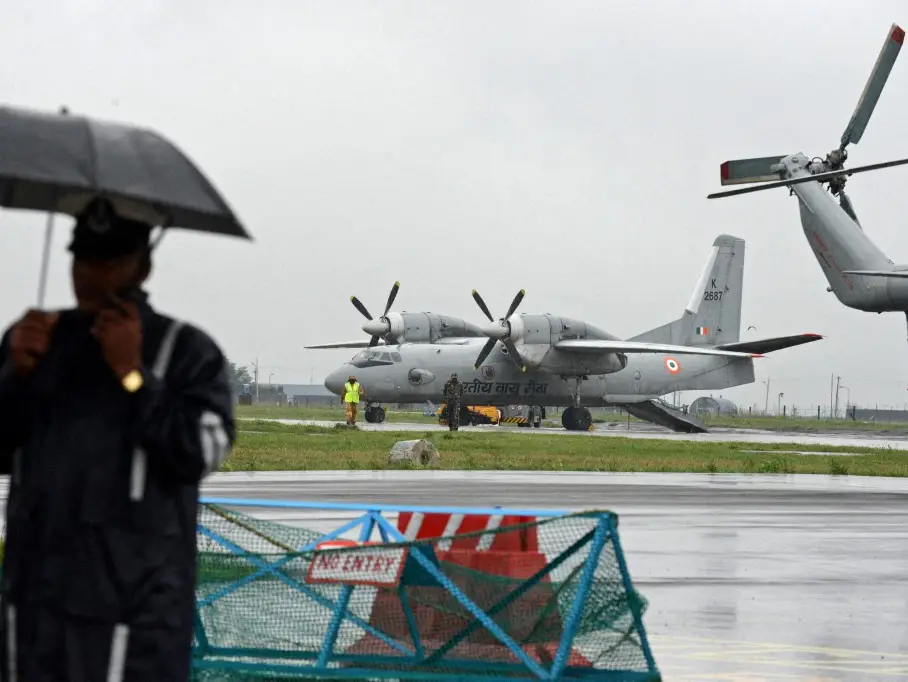
&imwidth=800&imheight=600&format=webp&quality=medium "Antonov An-32: Rugged backbone of the Indian Air Force’s transport fleet")
The Antonov An-32, a Soviet-origin twin-engine turboprop tactical transport aircraft, has served as a primary workhorse for the Indian Air Force (IAF) since its formal induction in 1984. Originally designed to meet India's unique requirement for an aircraft capable of operating under demanding "hot and high" conditions, the An-32 remains an indispensable element of the nation's military logistics network, linking remote border outposts to the mainland.
The aircraft’s design was driven by the specific geographical challenges of the Indian subcontinent, which span from scorching deserts to freezing, high-altitude mountain ranges. To achieve the performance required for these environments, engineers mated the rugged airframe of the Antonov An-26 with significantly more powerful Ivchenko Progress AI-20 turboprop engines. These modifications gave the An-32 a high thrust-to-weight ratio, allowing it to take off from short runways and operate out of critical Advanced Landing Grounds (ALGs) across the Himalayas in Ladakh and Arunachal Pradesh.

Operational roles and fleet modernisation
The An-32 is a multi-role platform with broad operational capabilities. It is designed to carry up to 7.5 tons of cargo, transport 50 passengers, or accommodate 42 paratroopers. Beyond standard troop and supply movements, the fleet regularly executes critical humanitarian assistance and disaster relief (HADR) missions, including medical evacuations and civilian airlifts during natural disasters. The aircraft has also played a pioneering role in the IAF’s transition toward sustainable aviation, successfully conducting multiple flights utilising home-grown bio-jet fuel blends.
Trending Stories
)
India ‘deeply concerned’ as Houthi strikes hit Saudi civilian & energy sites
)
Three labourers killed as DU student loses control of his car, rams into them on Dwarka Expressway
)
Pentagon revives mandatory testosterone testing for male troops aged 30 and above
)
FACT CHECK: Why did PM Modi ask Xi ‘is it okay’ at BRICS Summit? New video reveals...
)
India seeks to build a full semiconductor supply chain
)
North Korea's last nuclear test in 2017 set off 1,399 earthquakes over 8 years, each stronger than previous
&im=FitAndFill=(700,400))
From Abhishek Sharma to Sahil Chauhan, 5 batters with fastest T20I hundreds
)
Indian activist-lawyer Prashant Bhushan's post brings focus on ‘conflict of interest’ appointments of ex-govt officials at Reliance, Adani groups
)
Former India player Diana Edulji wants Smriti Mandhana to replace Harman as skipper at the earliest
&im=FitAndFill=(700,400))
Meet top 5 batters in the latest ICC T20I Rankings
)
UNGA 2026 theme explained: What does ‘Restoring trust, managing transformation: A United Nations that delivers for all’ mean?
)
Godfather of AI Geoffrey Hinton gives US lawmakers a one-year warning on AI
)
US F-16 fighter jet crashes in Michigan during training mission, pilot ejects safely
)
A first in 100 years: New cat species discovered in Bolivia is incredibly tiny
)
Shivakumar attends 79th Kalyana Karnataka Utsav in Kalaburagi
)
Xi-Trump summit may boost military links
)
Hong Kong extends newborn cash support scheme by three years
)
‘Will go to any extent’: Pakistan vows to defend Saudi Arabia amid Houthi attacks
)
'He will always be ahead': India coach Gambhir says Sooryavanshi won't walk into team ahead of Samson
)
The Verdict | When precision fails: US commits war crime in Minab school strike, UN finds
&im=FitAndFill=(700,400))
New Friday OTT releases (September 18, 2026): Lust Stories 3, You+Me, Best of the Best- 8 new titles coming on Netflix, Prime Video and more
&im=FitAndFill=(700,400))
Which country has the most F-35s outside America?
)
Africa is splitting, and a lot sooner than estimated, giving way to a new ocean
)
'Gangsta' crab shoves knife blade at man and his dog in Florida - Watch
)
Trump bans CNN, MS NOW and Politico from White House over ‘FAKE NEWS’
)
Drone strikes cooling tower at Russia's Kursk Nuclear Plant, IAEA confirms
)
Who is Khalilur Rahman? All you need to know about 81st UN General Assembly President
&im=FitAndFill=(700,400))
Meet top 5 bowlers in latest ICC T20I rankings
)
Ukraine plans record $109 bn defence spending, nearly two thirds of budget amid Russia war
&im=FitAndFill=(700,400))
Suriya and Jyothika say ‘I do’ again after 20 years! See their dreamy wedding pics
)
Cristiano Ronaldo returns to Portugal squad for Nations League under new coach
)
Laura Wolvaardt sets new world record for most WT20I runs in a year
)
Asian Games 2026: Shafali stars as India thump Japan by 8 wickets to book semis berth
&im=FitAndFill=(700,400))
Meet top 5 Indian batters with fastest T20I centuries
To preserve this capability, the IAF initiated a comprehensive $400 million modernisation programme. The upgrade project, executed partly in Ukraine and partly at the IAF's 1 Base Repair Depot (BRD) in Kanpur, aimed to modernise the aircraft’s avionics, navigation suites, and radar systems. This program extended the airframe's operational life, ensuring the An-32 remains flightworthy and relevant in modern airspace while improving cockpit ergonomics and cabin conditions for the crew.
History of strategic challenges
Operating a massive transport fleet across some of the world's most unforgiving terrain carries inherent operational risks, and the An-32's four-decade service record includes notable losses. In June 2009, an IAF An-32 crashed into Rinchi Hill near Mechuka in Arunachal Pradesh, resulting in the deaths of all 13 defence personnel on board.
On July 22, 2016, another An-32, carrying 29 personnel, disappeared over the Bay of Bengal after taking off from Tambaram Air Force Station near Chennai on a routine flight to Port Blair in the Andaman and Nicobar Islands. While the disappearance remained an unresolved mystery for years, a breakthrough came when a deep-sea exploration vehicle operated by the National Institute of Ocean Technology located the wreckage on the seabed at a depth of 3,400 meters. The Ministry of Defence officially confirmed the discovery, bringing closure to India's largest maritime search operation.
The risks of operating in India’s frontier regions affect the broader air fleet as well. On March 5, 2026, an IAF Sukhoi Su-30MKI fighter jet crashed in the Karbi Anglong district of Assam during a routine training mission, resulting in the tragic loss of both pilots on board. Despite these high costs, the An-32 fleet continues to serve as an irreplaceable pillar of India's forward defence posture, maintaining the supply lines that secure the nation’s mountainous borders.

