

&imwidth=800&imheight=600&format=webp&quality=medium "3 years after its debut, India’s SSLV rocket doesn’t have a market?")
Let’s say that a popular automobile company introduces a new type of small, cost-efficient car. This car is meant to be built and operated in large numbers, and over the years it is projected to ferry a significant number of passengers and bring in big bucks. However, after doing three mandatory development rides in three years, this car has never been started again; it isn’t even being talked about much in the relevant global market, while its competition does very well. The aforementioned car analogy refers to the Small Satellite Launch Vehicle (SSLV), an ISRO-built rocket funded by the Indian taxpayer.
What is the SSLV rocket?
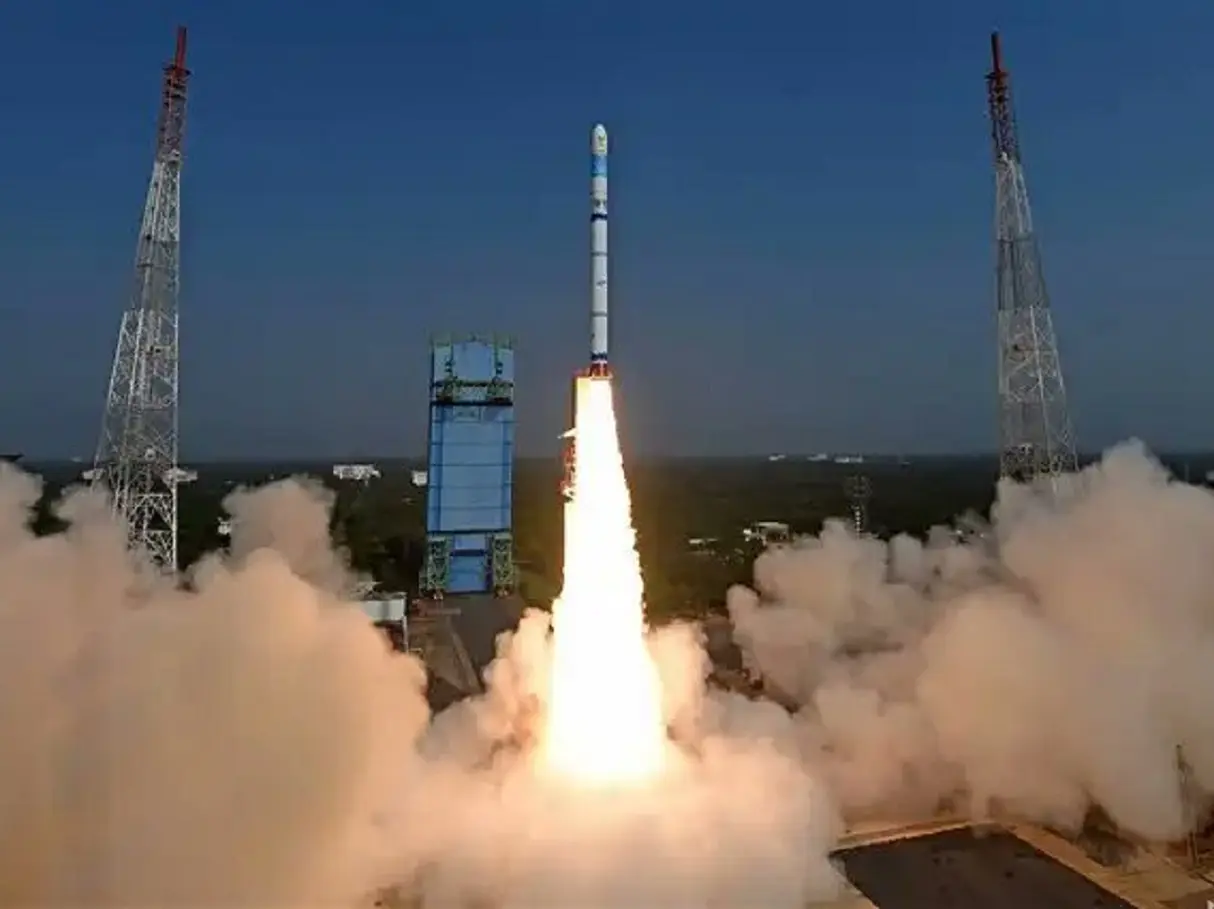
Launched for the first time on August 7th, 2022, SSLV was meant to be a new addition to India’s fleet of PSLV, GSLV, and LVM3 mainstay rockets. In the Indian context, think of the PSLV as a hatchback, GSLV as a crossover, and LVM3 as an SUV. The SSLV can be thought of as a two-seater car. Many rockets in the global market can be compared to large vans and buses; Indian rockets do not come close in size or capability.
According to ISRO, SSLV is capable of launching a 500 kg satellite in a 500 km planar orbit from the Indian spaceport in Sriharikota. The features of SSLV are easy-to-manufacture, low-cost, can accommodate multiple satellites, launch-on-demand feasibility, minimal launch infrastructure requirements, etc. It has been said SSLV could be assembled and readied for launch in less than a week and could be launched multiple times in a month.
Typical ISRO rockets like PSLV and GSLV require more than a month to assemble and be readied for launch. SSLV was touted as a rocket that could be readied for launch on short notice, based on customer orders. SSLV was also seen as a strategic spacefaring capability that would help India launch small satellites during emergency scenarios or crises.
Based on such features, the SSLV was projected as a rocket that could earn revenue for the Indian government. Together, India’s PSLV and LVM3 rockets have launched more than 400 foreign-origin satellites and brought in millions of dollars to the Indian exchequer. SSLV was expected to do the same and increase India’s share in a billion-dollar market where there are only a handful of government agencies and private firms competing consistently. Estimates say that India’s share in the $20 billion global space launch market is barely 2-3%.
Trending Stories
&imwidth=180&imheight=135&format=webp&quality=medium)
Other Mommy leads North American box Office as Verity, Resident Evil round out top four
&im=FitAndFill=(700,400)&imwidth=180&imheight=135&format=webp&quality=medium)
Navratri 2026: 9 days, 9 forms of Goddess Durga and 9 colours- Check the complete list
&im=FitAndFill=(700,400)&imwidth=180&imheight=135&format=webp&quality=medium)
Is sending robots to Mars easier than sending humans?
&imwidth=180&imheight=135&format=webp&quality=medium)
A watchdog rated 'ChatGPT for Teens' an unacceptable risk and says keep under-18s off it
&imwidth=180&imheight=135&format=webp&quality=medium)
1,500 drones illuminate Mumbai sky as Cordelia Cruises unveils second ship, Cordelia Sky
&imwidth=180&imheight=135&format=webp&quality=medium)
'Just coincidence': Police mistakes protester as AISA chief Neha Bora, arrests her from site
&imwidth=180&imheight=135&format=webp&quality=medium)
Anthropic's AI invented a murder witness and sent the fake tip to Philadelphia police
&imwidth=180&imheight=135&format=webp&quality=medium)
CJI Surya Kant declines INDIA bloc leaders’ request for meeting ahead of march to SC, asks them to file petition
&imwidth=180&imheight=135&format=webp&quality=medium)
Aamir Khan's niece, actress Zayn Marie shares injury pictures after being detained with Imran Khan at Mumbai protest
&imwidth=180&imheight=135&format=webp&quality=medium)
One Indian killed in Riyadh airport attack; 11 others injured : MEA
&imwidth=180&imheight=135&format=webp&quality=medium)
Imran Khan released hours after Mumbai Police detain him during CJP protest
&imwidth=180&imheight=135&format=webp&quality=medium)
Nathan Lyon completes 1,000 Test runs at No. 10 to script rare cricket feat
&imwidth=180&imheight=135&format=webp&quality=medium)
Top AI models flunked a test of inventing new AI research, so much for self-improving AI
&imwidth=180&imheight=135&format=webp&quality=medium)
Wasim Jaffer blames Ajit Agarkar-led selection panel for Virat Kohli’s Test retirement
&imwidth=180&imheight=135&format=webp&quality=medium)
'Ouch!!! That must hurt': Kangana Ranaut hails Kamal Haasan's sharp reply to Elon Musk over Starlink row
&imwidth=180&imheight=135&format=webp&quality=medium)
Sidhu Moose Wala’s younger brother wins hearts by recreating late singer’s signature move at Toronto Hologram Show
&imwidth=180&imheight=135&format=webp&quality=medium)
Meta's Muse AI could be a security nightmare for India's billion-plus users
&imwidth=180&imheight=135&format=webp&quality=medium)
UK school ditches technology, shifts from screen to pen and paper for learning
&imwidth=180&imheight=135&format=webp&quality=medium)
IND vs WI, 3rd T20I: Abhishek Sharma smashes 18-ball fifty, sets record for fastest to 2,000 T20I runs
&imwidth=180&imheight=135&format=webp&quality=medium)
Houthis claim Riyadh airport attacks, Aramco strikes; issue fresh warning to airlines, travellers and workers
&imwidth=180&imheight=135&format=webp&quality=medium)
Portugal Federation confirms Cristiano Ronaldo’s return to national team despite suspension
&im=FitAndFill=(700,400)&imwidth=180&imheight=135&format=webp&quality=medium)
New OTT releases this week (October 12-18, 2026): Sacrifice, Koffee with Karan S9, Roadies Rebirth- 6 titles coming on Netflix, JioHotstar and more
&imwidth=180&imheight=135&format=webp&quality=medium)
Microsoft's Nadella says treat every AI model as already hacked, and build an 'emergency brake'
&imwidth=180&imheight=135&format=webp&quality=medium)
Delhi protest: CJI Surya Kant declines to meet India Bloc leaders
&imwidth=180&imheight=135&format=webp&quality=medium)
Are Gold and Silver poised for a rebound soon?
&imwidth=180&imheight=135&format=webp&quality=medium)
China imposes first-ever sanctions on ministers from Taiwan allies: What this means
&imwidth=180&imheight=135&format=webp&quality=medium)
McSweeney reveals how studying Virat Kohli’s YouTube clips helped Australia A conquer India
&imwidth=180&imheight=135&format=webp&quality=medium)
Maharashtra appoints FDA commissioner Tukaram Mundhe as secretary of committee for MPSC overhaul amid stir
&imwidth=180&imheight=135&format=webp&quality=medium)
Iran: US accepted some conditions, Clarity needed on others
&imwidth=180&imheight=135&format=webp&quality=medium)
Nana Patekar's cause of death confirmed; here's what his postmortem report says
&imwidth=180&imheight=135&format=webp&quality=medium)
iPhone Duo price index: Tracking Apple’s latest pricing trends
&imwidth=180&imheight=135&format=webp&quality=medium)
'Say no to Muse': Meta has no control over its own moderation AI while it forces a security nightmare on everyone
&imwidth=180&imheight=135&format=webp&quality=medium)
Delhi wakes up to heavy rain, thunderstorms; yellow alert in place; temperature drops
In 3 flights, SSLV failed once, succeeded twice
The first three flights of a rocket are known as developmental flights, these are opportunities to launch the rocket and test, validate all its systems. Which is why there is a high chance of failure or unexpected errors. Shortly after reaching space, SSLV failed on its first launch that took place on 7th August 2022. Both satellites were lost due to the rocket failure in the final moments.
ISRO rectified the errors identified in the maiden mission, and SSLV’s second launch was successfully carried out on February 10th, 2023. SSLV’s third launch was successfully carried out on August 16th, 2024. Overall, based on its three launches till date, the SSLV has a success rate of 66%.
Why has the SSLV not been flying? Here’s what insiders say
Insiders say that the Indian government had only approved and funded three launches of the SSLV rocket. Generally, a rocket has to be launched multiple times by its maker to prove its reliability and performance. As a rocket accomplishes more successful missions, its track record becomes globally recognised and satellite companies would be willing to charter the rocket to ferry their expensive satellites to space. In SSLV’s case, the rocket has a success rate of 66%(2 successes in 3 launches). In contrast, the Indian LVM3 rocket has a success rate of 100%(all seven launches successful). ISRO’s famed workhorse PSLV rocket has a success rate of over 93% (59 successes in 63 missions).
In the era of SpaceX, Indian rockets are not the first choice of customers
It is claimed that Indian rockets and space missions are cheaper than Hollywood films. However, these direct numerical comparisons are neither scientific nor rooted in reality. In the world of commercial rocketry, the real metric is cost-per-kilogramme to orbit. In simple terms, per-kg cost on larger rockets is cheaper than per-kg cost on smaller rockets. This is broadly similar to why a train ticket costs far lesser than undertaking the same journey via car. The larger the vehicle, the more it can carry, therefore the per-kg cost reduces.
While ISRO’s commercial arm NSIL does not officially reveal its per-kg cost, it is well established in the market that ISRO’s rockets are not cost competitive in a world dominated by Elon Musk’s SpaceX. For various reasons, many Indian startups have chosen to launch their satellites on SpaceX rockets instead of choosing the homegrown ISRO rockets.
As the world’s leading rocket firm, SpaceX does well over 120 launches a year, compared to less than seven launches that ISRO does annually. Industry estimates have clearly established that the per-kg cost on SpaceX’s massive Falcon-series of re-usable rockets is less than half of the per-kg cost charged by India. Naturally, satellite firms would choose the cheaper option offered by SpaceX.
SSLV’s global peers are flying high
In India, SSLV enjoys a monopoly as it is the only operational small rocket and it is developed by the reputed ISRO. Indian startups are in the process of building similar small rockets, but they have not launched to space. Therefore, if a foreign firm or Indian startup wishes to launch a small satellite, SSLV is among the few options available globally.
For sake of comparison, a relatively small American firm Rocket Lab operates the Electron rocket, which is similar to the Indian SSLV. Rocket Lab accomplished 16 rocket launch missions for its customers in 2024, and is on track to execute 16 or more launches in 2025. Though a small firm when compared to industry giants like SpaceX, Rocket Lab has been consistently increasing its number of launches with every passing year. Critics also say that India government agency NSIL has not been working hard enough to attract customers for the SSLV.
SSLV may fly again in 2025-end or 2026?
In July 2025, ISRO Chief Dr. V. Narayanan mentioned that “a couple of SSLV missions” are among the nine launches that are scheduled to happen by March 2026.
In 2024, it was announced that a 450 kg Australian satellite ‘Optimus’ would be launched by SSLV in the year 2026.
NSIL had also said that it is building 15 SSLV rockets, but even these missions are expected to take to the skies in 2026 or later.
In early 2024, Indian government agency projected that two SSLVs would be launched before March 2025, and none of those launches happened.
SSLV is now HAL’s rocket. Can they deliver?
In June 2025, the Indian Government announced that the SSLV rocket would be owned, marketed, and flown by Hindustan Aeronautics Limited (HAL). Government firm HAL had bid for the SSLV rocket and its technology transfer, and would pay Rs 511 crore in a phased manner for it.
In about two years from now, HAL would be entirely building the SSLVs. This would mean that the SSLV rocket is going to be HAL’s property, they can launch it to ferry customers’ satellites and demand a price for providing the launch services.
However, HAL also faces harsh public criticism from India’s defence establishment for its slow rollout of Tejas fighter jets, and unresolved technical issues that led to the ongoing grounding of variants of ALH (Dhruv) helicopters. Officials from HAL’s Aerospace division had outlined that their capability for space manufacturing is different from that of fighter planes. They added that a different manufacturing capacity exists for the space programme and for the fighter jet programme.
