140-year-old watch, once owned by Tata founder Jamsetji, to be auctioned Tuesday

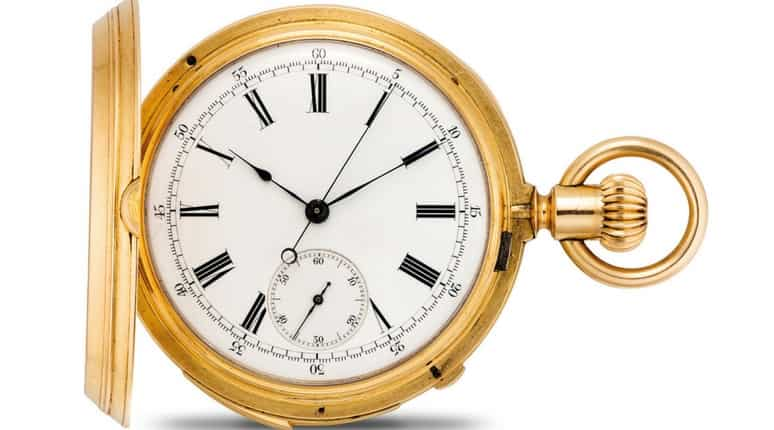
Jamsetji Tata's watch
WION spoke with Thomas Perazzi, Head of Watches, Asia, at Phillips, the auction house selling the watch
By Saurabh Bose
A 140-year-old Patek Philippe pocket watch, once owned by Tata founder Jamsetji Nusserwanji Tata, will be auctioned in Hong Kong on Tuesday.
The watch was custom-ordered by Tata and will be sold for an estimated $10,000 to $20,000.

The 18 karat, pink gold timepiece was gifted by Tata to English architect James Morris in 1890 as a thank you for his work on the Tata family mansion, Esplanade House, in Mumbai.
Engraved on the back of the watch is a dedication to Morris: "This watch is presented by Jamsetjee N Tata to James Morris Esq, the architect, Esplanade House, Bombay, in recognition of his professional skill and of the care and attention devoted by him during its construction, 1890."
 Jamsetji Nusserwanji Tata. (Image source: Tata Central Archives) (Others)

Ramayana: Part 1 post-credit scene explained: Sunny Deol's Hanuman entry, Raghav Juyal as Meghnad steals the show

Ex-CSK coach Hussey joins Australia coaching staff for Ashes, ODI World Cup, and Olympics

With a begging bowl in hand, Bihar officer protests 8 months without salary

Yashar rejects unity govt option after majority backing; urges Herzog to give Eisenkot premiership

First handshake? Radio signal with all hallmarks of alien technology detected in China

IPL 2027: 'He should not be captain', says ex-MI player Ambati Rayudu on Hardik Pandya

Houthis put a price on peace with Saudi: $51 billion and recognition as Yemen's rulers - Report

NewJeans' contract details revealed, HYBE responds to questions over artist rights and restrictions

US midterms 2026: Democrats close in on 260 seats, poised for historic House majority since 1991

The boy in the Manchester United shirt and the legend who gave me a lifetime of memories

Watch: Ilhan Omar breaks into a dance after securing fifth-term victory amid long-running Trump feud

Ramayana advance booking: Rs 150 cr collected before release, what it means for day 1

IGP Sujit Kumar highlights Kashmir Police's expanding role beyond security operations

US midterms 2026: Meet the Democrats who turned the election upside down and scored big wins across America

Harmeet Dhillon resigns as head of Justice Department's Civil Rights Division after 18 months

Saudi Arabia rolls over $3 billion financing to Pakistan as $10 billion US backstop fades

Arab Parties emerge as kingmakers in Israel, back opposition leader Gadi Eisenkot to form next government

'I am more Indian than Arab': Abdul El-Sayed on his Indian-origin wife

Patriarchal bias led historians to believe a powerful British female ruler was a man

Trump predicts 'very big' deal wit Russia that could involve 'all of Europe' after meeting Putin's envoy

Bengal CM Suvendu Adhikari threatens jail for factory blockades, confirms Singur investment talks with Ashok Leyland

Maharashtra looks to forgotten water architecture as drought deepens

'Another significant milestone': Rajnath Singh hails successful test of indigenous Pralay missile

Why did Sensex jump 2,000 points in biggest rally in months? Key triggers explained

'Final Destination stuff': Flying tyre out of nowhere hits boy on sidewalk in Chile - Video

'Nothing without our approval': Trump says Iran cannot act on nuclear programme

Mahadev app co-founder Ravi Uppal arrested in Dubai days after kingpin Sourabh Chandrakar’s extradition

The secret cost of using AI tools at work that no one is telling you about

Paraguay President Santiago Pena impeached minutes after his resignation as Ueno bank collapse triggers nationwide protests

LIV Golf, once a rocking force, to shut down after five years of disruption

New Friday OTT releases (November 6, 2026): I'm Game, Meesaya Murukku 2, Haiwaan- 6 titles to watch this Diwali on Netflix, JioHotstar and more

Trump blames 'Dumocrats' as US stock market plunges; Asian markets crash after US tech sell-off

Trump signals imminent decision on resuming war with Iran after midterm defeat

'Shawarma law, not Sharia law': Abdul El-Sayed's joke goes viral after historic Senate win | Video

Two Egyptian army officers killed in anti-mining campaign

California Governor Gavin Newsom commutes all 548 death sentences to life without parole

Dolly Parton's manager moves to drop complaint against late singer's nephew

Bengaluru man kills wife, 6 members of her family for interfering in their marital disputes

U19 Asia Cup 2026: Aaryavir Sehwag stars as India thrash Nepal by 10 wickets
 Jamsetji Tata's dedication to his architect James Morris. (Image source: Tata Central Archives) (Others)
WION spoke with Thomas Perazzi, Head of Watches, Asia, at Phillips, the auction house selling the watch.
Perazzi says that back then it was actually yellow gold that was in vogue, but Jamsetji asked for pink gold -- making this a rare watch.
Perazzi was also part of the team that sold Mahatma Gandhi's Zenith pocket watch, John F Kennedy's Elgin, Jackie Kennedy's Cartier Tank, and EthiopianEmperor Haile Selassie's Patek Philippe.
Perazzi says Jamsetji's Patek Philippe is a "repeating chronograph hunter case presentation watch", and that very few watchmakers had the skill to make that sort of watch back then.
And that five-minute repeaters, one of the most complex repeater mechanisms, are sought after by fine watch collectors as masterpieces of precision mechanical engineering.
Adding to the watch's value of course is the fact that it was owned by Jamsetji Tata and custom-ordered by him.
Perazzi says that unfortunately we do not have records of Patek Philipperetail prices at the time, but that a five-minute Patek Philippe repeater currently goes for over $300,000.
Nor was Phillips able to trace the full story of the watch and what happened to it after Morris -- a watch's value is calculated by brand, the complexity of its movement mechanism, and provenance -- but, says Perazzi, what we do know is that it was kept safely in a wise collector's safe all these years.