‘Peru and Latin America are two constant heartbeats in my work,’ says Peruvian artist Jade Rivera | Interview

&imwidth=600&imheight=450&format=webp&quality=medium "‘Peru and Latin America are two constant heartbeats in my work,’ says Peruvian artist Jade Rivera | Interview")
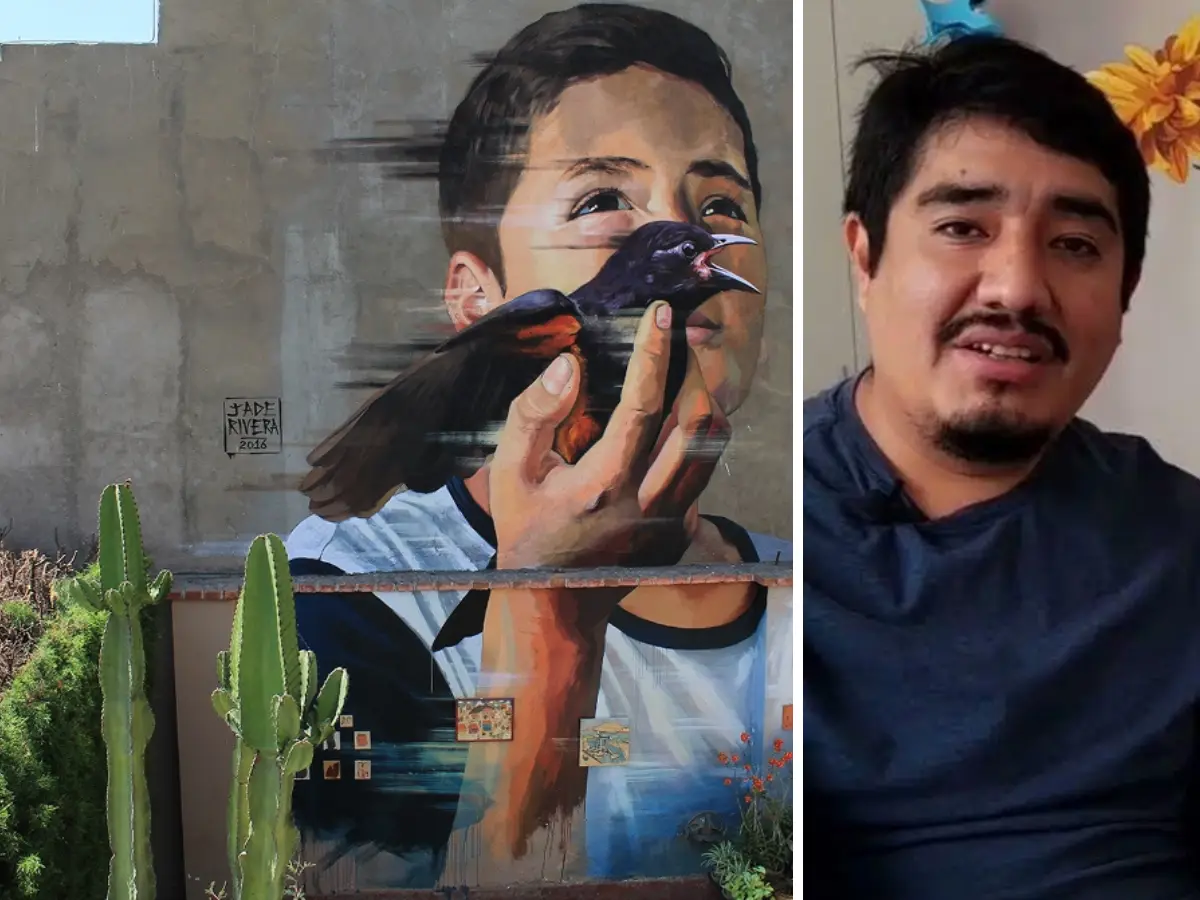
Jade Rivera (R ) and his work
Latin American culture has had a constant influence on Peruvian artist Jade Rivera. Rivera’s art can be found on walls around the world, yet it remains deeply rooted in the cultural and emotional textures of Peru.
Jade Rivera is a Peruvian contemporary artist known for his poetic murals and intimate explorations of human connection, memory, and transformation. His work blends realism and symbolism, capturing moments of quiet emotion within urban and natural landscapes. Rivera’s art can be found on walls around the world, yet it remains deeply rooted in the cultural and emotional textures of Peru. Through painting, sculpture, and installation, he invites viewers into a world where vulnerability meets strength and simplicity reveals depth. His creative universe extends across the Museo Jade Rivera, Jade Rivera Lab, and Jade Rivera World in Barranco, Lima.
What inspires you to create art?
For me, art is not an optional act—it is a necessity that rises from the deepest part of me. There is a creative urgency that pushes me to look at the world with both softness and intensity, to feel every gesture as if it carried a hidden meaning. That sensitivity—sometimes heavy, sometimes illuminating—inevitably becomes colors, symbols, and murals that seek to breathe.
Peru and Latin America are two constant heartbeats in my work. From these lands comes the strength that sustains me and the chaos that awakens me. Their histories, their wounds, their beauty run through me and give me a language of my own. Creating is my way of expressing gratitude, of healing, and of conversing with the territory that shaped me. Everything I paint is born from that blend of urgency, memory, and belonging.
Why do you paint so many children in your murals?
Children appear in my murals because they represent that essential part of ourselves that has not yet been shaped by fear or expectations. But also because I constantly return to my own childhood experiences to seek inspiration.
Trending Stories
&imwidth=280&imheight=210&format=webp&quality=medium)
&imwidth=280&imheight=210&format=webp&quality=medium)
&imwidth=280&imheight=210&format=webp&quality=medium)
&imwidth=280&imheight=210&format=webp&quality=medium)
&imwidth=280&imheight=210&format=webp&quality=medium)
&imwidth=280&imheight=210&format=webp&quality=medium)
&imwidth=280&imheight=210&format=webp&quality=medium)
&imwidth=280&imheight=210&format=webp&quality=medium)
&imwidth=280&imheight=210&format=webp&quality=medium)
&imwidth=280&imheight=210&format=webp&quality=medium)
&imwidth=280&imheight=210&format=webp&quality=medium)
&imwidth=280&imheight=210&format=webp&quality=medium)
&imwidth=280&imheight=210&format=webp&quality=medium)
&imwidth=280&imheight=210&format=webp&quality=medium)
&imwidth=280&imheight=210&format=webp&quality=medium)
&imwidth=280&imheight=210&format=webp&quality=medium)
&imwidth=280&imheight=210&format=webp&quality=medium)
&imwidth=280&imheight=210&format=webp&quality=medium)
&imwidth=280&imheight=210&format=webp&quality=medium)
&imwidth=280&imheight=210&format=webp&quality=medium)
&imwidth=280&imheight=210&format=webp&quality=medium)
&imwidth=280&imheight=210&format=webp&quality=medium)
&imwidth=280&imheight=210&format=webp&quality=medium)
&im=FitAndFill=(700,400)&imwidth=280&imheight=210&format=webp&quality=medium)
&imwidth=280&imheight=210&format=webp&quality=medium)
&imwidth=280&imheight=210&format=webp&quality=medium)
&im=FitAndFill=(700,400)&imwidth=280&imheight=210&format=webp&quality=medium)
&imwidth=280&imheight=210&format=webp&quality=medium)
&imwidth=280&imheight=210&format=webp&quality=medium)
&imwidth=280&imheight=210&format=webp&quality=medium)
&imwidth=280&imheight=210&format=webp&quality=medium)
&imwidth=280&imheight=210&format=webp&quality=medium)
&imwidth=280&imheight=210&format=webp&quality=medium)
&imwidth=280&imheight=210&format=webp&quality=medium)
&imwidth=280&imheight=210&format=webp&quality=medium)
&imwidth=280&imheight=210&format=webp&quality=medium)
&imwidth=280&imheight=210&format=webp&quality=medium)
For me, childhood is a sacred territory—a place where imagination ruled, where every gesture held magic, and every discovery carried the weight of a revelation. When I paint children, I return to that internal space that still preserves curiosity, tenderness, and wonder. They are characters that speak about who we were but also about what we can still recover.
In them, I find truth, and through them I try to remind the world of the importance of seeing with new eyes.
Do you think that in the next 100 years you could become for Peru what Frida Kahlo is for Mexico—a national icon known globally?
That is not something I can claim. My goal is not to become an icon, but to create a body of work that is honest, profound, and meaningful. If, over time, my work accompanies people, dialogues with Peruvian identity, and transcends borders, it would be an honor. But my focus is on the present—on continuing to create, observe, and contribute through my art.
What change would you like to see in Peru?
I dream of a more integrated Peru, where the diverse voices that shape our identity do not compete, but acknowledge and embrace each other. A country where inequality no longer determines destinies, and where creativity, education, and art become real and accessible paths for everyone.
I also long for a more empathetic and sensitive society. I feel that this ability to look each other in the eye, to listen without judgment, and to recognize another’s humanity is as urgent as any structural reform. Sensitivity is not fragility—it is a transforming force.
I would like to see a Peru where that sensitivity guides our collective decisions, where caring for one another becomes part of who we are, and where new generations grow up feeling that this country supports and celebrates them.
You’ve painted multiple murals across South America. Do you plan to create any in Asia? In India?
Yes, the idea of taking my work to Asia excites me. India, in particular, attracts me for its spirituality, its colors, and its symbolic connection with nature. I would love to collaborate with communities, festivals, or cultural projects there, and explore how my visual language can dialogue with other artistic traditions.
Tell us more about your fascination with birds. Why do you paint so many in your murals?
Birds have always seemed like messengers between worlds—creatures that carry in their wings the idea of freedom, movement, and transformation. When I paint them, I speak of journey, of memory, and of that human need to rise above ourselves.
But I also explore many other animals. Nature as a whole—its forms, its silences, its brutality and its tenderness—is a profound source of symbolism for me. Human beings and nature coexist in my work as two forces that search for one another, reflect each
other, and transform each other. I am interested in that dialogue between what we are and what surrounds us, between what we protect and what we forget.
It is not my intention to be recognized as “the artist who only paints birds.” Birds are one part of my language, not its entirety. My work emerges from the meeting of multiple symbols that together try to tell a broader story about our relationship with life.
What do you think it takes for an artist to go global?
I believe an artist becomes global by being faithful to their own language. In my case, that language is born from Latin America—its textures, its symbols, its wounds, and its vitality. Even if my work can be read universally, I only paint what truly represents me, what comes from my history and my emotional territory.
And interestingly, that is exactly what attracts people from other parts of the world. Collectors abroad are not interested in an “internationalized” version of my work, but in the deeply Latin American perspective I carry with me. Authenticity crosses borders—what is local, when it is honest, becomes universal.
I believe an artist becomes global when they are not trying to be—when their commitment lies in building a personal language so solid and so true that it can travel on its own and resonate in other geographies without losing its roots.
How do you share your love for art through your fashion brand Despierta?
Through Despierta, I seek to bring art into everyday life. Each piece is born from a concept, a drawing, or an emotion that I want people to wear, feel, and make their own. Fashion, for me, is another way of storytelling and awakening sensitivity—it is a canvas in motion. The brand is an invitation to look at the world with more intention and more creativity.
