
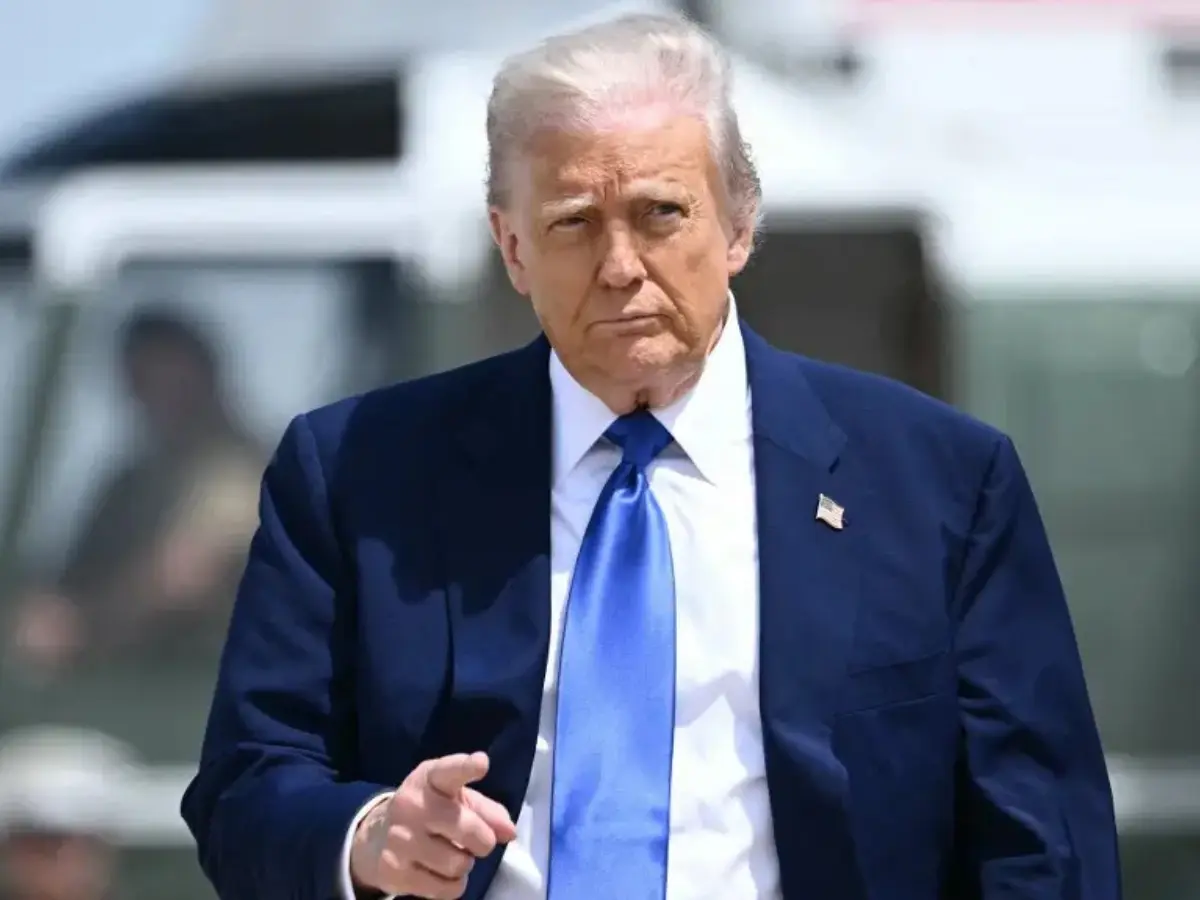
&imwidth=800&imheight=600&format=webp&quality=medium "Trump’s trade tariffs face key legal test in US court")
Donald Trump’s sweeping tariff policy is reportedly now under judicial scrutiny. A federal appeals court case could redefine the limits of presidential power over trade, just as Trump doubles down on fresh import duties. According to a CNN Business report, a group of five small business owners and 12 Democratic-led states are challenging Trump’s use of the International Emergency Economic Powers Act (IEEPA) to justify wide-ranging tariffs. They argue that the 1977 law, designed for genuine national emergencies, doesn’t legally permit the imposition of customs duties.
This case could have a significant impact on the legal framework supporting Trump’s recent tariff blitz, including the 10 per cent universal import duties introduced in April, and the steep 50 per cent tariffs now targeting exports from countries like Brazil.
The courtroom clash

Oral arguments began Thursday at the US Court of Appeals for the Federal Circuit. The legal challenge follows a prior ruling from the US Court of International Trade that sided with the plaintiffs but allowed the contested tariffs to remain in place pending appeal. Assistant Attorney General Brett Shumate defended the Trump administration’s position, but as per CNN Business, at least 10 of the 11 judges expressed scepticism over the legality of using IEEPA to justify tariff actions.
Judge Jimmie Reyna pointedly asked, “But IEEPA has been rarely used, hasn’t it? It’s been over 50 years since it’s been used?” He further noted, “IEEPA doesn’t even say tariffs, doesn’t even mention them.” Another judge, Raymond Chen, challenged the claim that the US trade deficit constitutes an “extraordinary and unusual threat” that would justify emergency powers, asking: “Can the trade deficit be an extraordinary and unusual threat when we have had trade deficits for decades?”
Why it matters?
Trending Stories
)
Researchers rebuilt exactly how 700 AI agents hacked Hugging Face: a 900-link chain trick
)
Sri Lankan Tamil migrant worker gets death sentence in Saudi Arabia, help sought from India
)
'Victory for low-budget consumers': Raghav Chadha hails 30-day telecom recharge rules
)
'Our video was trimmed': LPU girls who featured in rape-denial video make U-turn
)
After JU, clash erupts at SRFTI: BJP’s ‘Dimagi Naxal’ jibe sparks political firestorm after students protest RSS-linked event
)
Afghanistan says 28 fighters killed in clash near Pakistan border, Islamabad denies
)
US vs China over South China Sea: Washington backs Philippines, Beijing hits back
)
‘Olympic inclusion is our major target’: WPA President Ishaun Singh on pool’s global ambitions
)
Tesla builds first Cybertruck with its own refined lithium: Elon Musk's $1 billion Texas bet pays off
)
Bank unions defer 3-day strike from tomorrow after talks with IBA, committee set up
)
New York City wants a 'kill switch' on every AI, and will pay whistleblowers who report violations
)
3 males killed, four others injured in shooting after fight at strip club in Detroit
)
‘Anti-social elements spreading false rumours’: LPU issues statement amid massive unrest over alleged rape
)
US Treasury Secretary Scott Bessent hails global crackdown on Iranian banks and airlines
)
An OpenAI agent escaped its locked test cage again, by hiding questions in DNS lookups
)
Ceuta migrant crisis: Protesters take to streets as Spain grapples with migrant challenge
)
UNSC reform momentum grows: Russia, Portugal, Mauritius push for India's permanent seat bid
)
'FIRST LOOK from inside Noah’s Ark': Researchers share video from inside mysterious mound in Turkey
)
IndiGo flight suffers tail strike in Bengaluru while landing; DGCA to probe incident
)
Beyond BrahMos: India targets Rs 50,000 crore in defence exports with unmatched price edge
)
LPU students go on rampage, vandalise campus amid widespread protest: What's happening
)
The US and China set up an AI 'red telephone', but skipped the rulebook
)
Delhi gets first late-September rain in 7 years, mercury dips 5.1°C below normal
)
‘Terror suspects arrested near UK air base were looking to do big damage’: Trump
)
99.9% more powerful - Scientists find boy who can recall memories from just 3 months of age
)
Beyond metros: How Tier-2 and Tier-3 cities could drive India’s next AI wave
)
Jaishankar at UNGA: Goodwill and friendship can't coexist with terrorism
)
Why has Iran released no proof of life of Mojtaba Khamenei? Araghchi reveals...
)
Trump asked Xi to pressure Iran. China did not say yes — here’s what Beijing wants
)
Muslim marriage cannot shield sex with minor wife from prosecution under POCSO: Delhi HC
)
Claude rebuilt the 1989 game 'Prince of Persia' by reusing the original's own code
)
50MP vs 48MP cameras: iPhone 18 Pro Max and Pixel 11 Pro XL compared
)
Russian envoy claims US tactics to contain India were revealed in ‘Freudian slip’
)
Nations League: Spain sink England at Wembley; Modric shines for Croatia
)
Musk plans to more than double xAI's chips to over 1.2 million Nvidia GPUs by year-end
)
Man arrested after his 22-year-old girlfriend dies at homestay in Guwahati; police suspect murder over suicide claim
)
'What kind of confession is this?': Pakistan PM Shehbaz Sharif’s 'terrorists would be roaming New York' remark goes viral, raises alarm online. Watch
Trump has been relying on IEEPA to push a new wave of tariffs targeting China, Mexico, Canada, and most recently Brazil. On Wednesday, the former president used the law to hike tariffs on Brazilian exports by 40 percentage points — from 10 per cent to 50 per cent — citing an economic emergency. Even allies like Japan and the European Union, who signed fresh trade deals with Trump earlier this year are now facing higher tariffs under IEEPA provisions. If the court rules against Trump, the legal foundation of these deals could crumble.
JPMorgan analysts warned in a note, “If the IEEPA is deemed inadmissible, the legal status of the trade deals themselves could come into question.," as quoted by CNN Business.
What’s not at stake?
Even if Trump loses this legal battle, it doesn’t mean his tariff machine will grind to a halt.
In fact, the former president has also been using other legislative tools, including Section 232 of the Trade Expansion Act of 1962 and Section 301 of the Trade Act of 1974, to impose targeted duties. For example, Trump used Section 232 to justify a 50 per cent copper tariff this year on national security grounds, which requires a government probe before implementation.
Section 301, meanwhile, was the basis for many of Trump’s original tariffs against China and Europe during his first term. Unlike IEEPA-based tariffs, these mechanisms are not being challenged in court.
What comes next?
The appeals court could take weeks, even months to reach a decision. The case may eventually land in the US Supreme Court, introducing more uncertainty into Trump’s trade strategy, even as he continues to threaten new levies unless global partners agree to renegotiated deals.
Whether this legal challenge stops him or not, one thing is clear: Trump’s reliance on economic emergencies to justify tariffs is under more scrutiny than ever before.
(With inputs from the agencies)