US stocks climb to new peak after trade deal

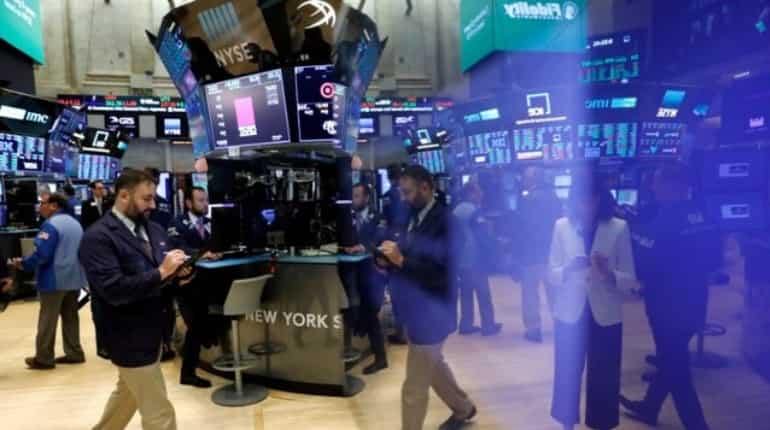
New York Stock Exchange
USPresident Donald Trump and Chinese Vice Premier Liu He signed a Phase 1dealthat will roll back some tariffs and see China boost purchases of USgoods and services, defusing a prolonged conflict between the world's two largest economies.
Liu said in remarks at the White House that the United States and China need to step up cooperation and that thedealbenefits both countries and the world. Thedealcapped an 18-month dispute that had roiledmarkets.
The centrepiece of thedealis a pledge by China to purchase at least an additional $200 billion worth of US farm products and other goods and services over two years, over a baseline of $186 billion in purchases in 2017.

Key world equity indexesclimbed tonewrecords on Wednesday on hopes a US-Chinatradedealwill reduce harmful tensions, butoilprices slid on doubts the pact will spur world growth and boost crudedemand.

[Traders work on the floor at theNewYork Stock Exchange (Courtesy: Reuters) ]
MSCI's all-world stock index and the three major indexes on Wall Street set record intraday highs. The MSCI benchmark, along with the Dow and S&P 500, also posted record closing highs, while the Dow closed above the 29,000 mark for the first time.
&imwidth=180&imheight=135&format=webp&quality=medium)
Viral video shows cross falling on Colombia priest, no official confirmation | WATCH
&imwidth=180&imheight=135&format=webp&quality=medium)
Rafale Marine fighter begins flight trials in Goa ahead of Indian Navy induction
&imwidth=180&imheight=135&format=webp&quality=medium)
Ranbir Kapoor apologises for Dussehra speech slip, clarifies remark at Ramayana event
&imwidth=180&imheight=135&format=webp&quality=medium)
Meta slapped with $25 billion fine in New Mexico over Facebook data practices, company plans appeal
&imwidth=180&imheight=135&format=webp&quality=medium)
WATCH: Woman IPS officer fires several rounds of AK-47, ignites debate online
&imwidth=180&imheight=135&format=webp&quality=medium)
WATCH | Mysterious haze grips Ohio city as toxic chemical leak forces mass evacuation – What is happening?
&imwidth=180&imheight=135&format=webp&quality=medium)
EU probes Booking.com under Digital Services Act
&imwidth=180&imheight=135&format=webp&quality=medium)
Pakistan signs another defence pact even as Makkah Alliance shows no teeth. This time, it's with Qatar, Indonesia, Turkey
&imwidth=180&imheight=135&format=webp&quality=medium)
Ilhan Omar breaks silence over alleged marriage to her brother; Trump thinks it's 'really good answer'
&imwidth=180&imheight=135&format=webp&quality=medium)
Kim Jong Un death rumors explode | China accused of secretly sending troops to Pyongyang
&imwidth=180&imheight=135&format=webp&quality=medium)
US-Iran war: Bibi, Trump gamble on new Iran war to save themselves in polls
&imwidth=180&imheight=135&format=webp&quality=medium)
From Agni-V to Project Kusha: How are India’s indigenous missile systems and defence shield reshaping modern warfare
&imwidth=180&imheight=135&format=webp&quality=medium)
Will Rohit and Kohli play ODI World Cup 2027? BCCI president Manhas says board 'not in a position to comment'
&imwidth=180&imheight=135&format=webp&quality=medium)
Why websites around the world are suddenly going offline? What you need to know about PHP
&imwidth=180&imheight=135&format=webp&quality=medium)
US midterms 2026: What polls and prediction markets indicate about Congress
&imwidth=180&imheight=135&format=webp&quality=medium)
'You are a dummy, you are a stupid person': Trump loses temper with CNN, ABC reporters after questions about Russia sanctions
&imwidth=180&imheight=135&format=webp&quality=medium)
China's dancing robot turns violent bodyguard, lifts cars and fights intruders - Watch
&imwidth=180&imheight=135&format=webp&quality=medium)
16-foot doomsday fish in Chile triggers fears that the next earthquake is coming
&imwidth=180&imheight=135&format=webp&quality=medium)
Are the US and Israel preparing for another major attack on Iran? Here's what report claims
&imwidth=180&imheight=135&format=webp&quality=medium)
Priyanka Chopra celebrates Dussehra 2026 with Nick Jonas and daughter Malti Marie | See pics
&im=FitAndFill=(700,400)&imwidth=180&imheight=135&format=webp&quality=medium)
New OTT releases this week (October 19-25, 2026): Gajab Raat to Chaar Yaar-8 titles to watch during Dussehra week on Netflix, Prime Video and more
&imwidth=180&imheight=135&format=webp&quality=medium)
‘I caution the president...’: Trump’s ex-press secretary warns after Zacharia’s exit
&imwidth=180&imheight=135&format=webp&quality=medium)
'Father of all bombs' vs 'mother of all bombs': Iran threatens US with new weapon as Trump hints at MOAB strike
&imwidth=180&imheight=135&format=webp&quality=medium)
Diljit Dosanjh's Oct 30 Delhi show hits roadblock, Delhi Police denies permission
&imwidth=180&imheight=135&format=webp&quality=medium)
Australia police arrest former national 100m champ Jake Doran for alleged child abuse
&imwidth=180&imheight=135&format=webp&quality=medium)
'Gyanu must go': CJP's Saurav Das, Ashutosh Ranka after release, despite Jantar Mantar protest undertaking
&imwidth=180&imheight=135&format=webp&quality=medium)
Kolkata airport: CISF detects ₹1.13 crore in US dollars hidden in bags of 2 Bangkok-bound passengers
&imwidth=180&imheight=135&format=webp&quality=medium)
Feds obtain DNA evidence that could prove Ilhan Omar married her brother: Report
&imwidth=180&imheight=135&format=webp&quality=medium)
US midterms 2026: Trump's approval rating hits record low as Democrats gain ground
Also Read:China will increase imports from US according to 'market principles': Official
Thedealis unlikely to significantly change the growth outlook, but it should allow companies to make the capital investments they have not, which is positive, said Marvin Loh, seniorglobalmacro strategist at State StreetGlobalMarkets.
"What's most important to investors is a potential de-escalation and signs that de-escalation will continue this year, which is the outlook period for a lot of investors," he said.
"If we can somehow take this out as one of the bigger risks that we had all last year, it does give some confidence to the market. Not necessarily from an economic but from a risk parameter perspective," Loh said.
MSCI's gauge ofstocksacross the globe gained 0.07%. Earlier in Europe, the pan-regional STOXX 600 index closed up 0.1% while MSCI's broadest measure of Asia-Pacificmarketsoutside Japan closed down 0.35%. Japan's Nikkei lost 0.45%.
On Wall Street, the Dow Jones Industrial Average rose 90.55 points, or 0.31%, to 29,030.22. The S&P 500 gained 6.14 points, or 0.19%, to 3,289.29 and the Nasdaq Composite added 7.37 points, or 0.08%, to 9,258.70.
Emerging marketstockslost 0.53%.
Oilprices slipped on concerns thetradeagreement may not provide much of ademandboost because the United States intends to keep tariffs on Chinese goods until a Phase 2dealis reached.
Prices were also under pressure from a report by the Organization of Petroleum Exporting Countries. OPEC expects lowerdemandfor itsoilin 2020 even asglobaldemandrises, as rival producers grab market share and the United States looks set for another output record.
Brent crude fell 49 cents to settle at $64.00 a barrel. USWest Texas Intermediate crude futures settled down 42 cents at $57.81 a barrel.
The dollar pared losses but remained lower against the euro and the yen after the signing of atradedealthat may prove a mild negative for the greenback as it removes uncertainty.
The dollar index, tracking the unit against six major peers, fell 0.14%, with the euro up 0.18% to $1.1147.
USTreasury yields declined as investors repositioned aroundnewdata showing producer prices barely rose in December.
A rise in the cost of goods was offset by weakness in services, the latest indication of tame inflation pressures that could allow the Federal Reserve to stand pat on interest rates this year.
Benchmark 10-year notes last rose 9/32 in price to push its yield lower to 1.7864%.
In Europe, investors flocked tonewfundraisings by Italy and Belgium a day after Spain saw recorddemand.
The 10-year German bond yield fell 3 basis points to -0.201%, not too far from the more than six-month highs of -0.157% touched at the start of January.
USgold futures settled up 0.6% at $1,554 an ounce.