India is building ‘capitalism without capital': NSE chief Ashish Chauhan

&imwidth=600&imheight=450&format=webp&quality=medium "India is building ‘capitalism without capital': NSE chief Ashish Chauhan")
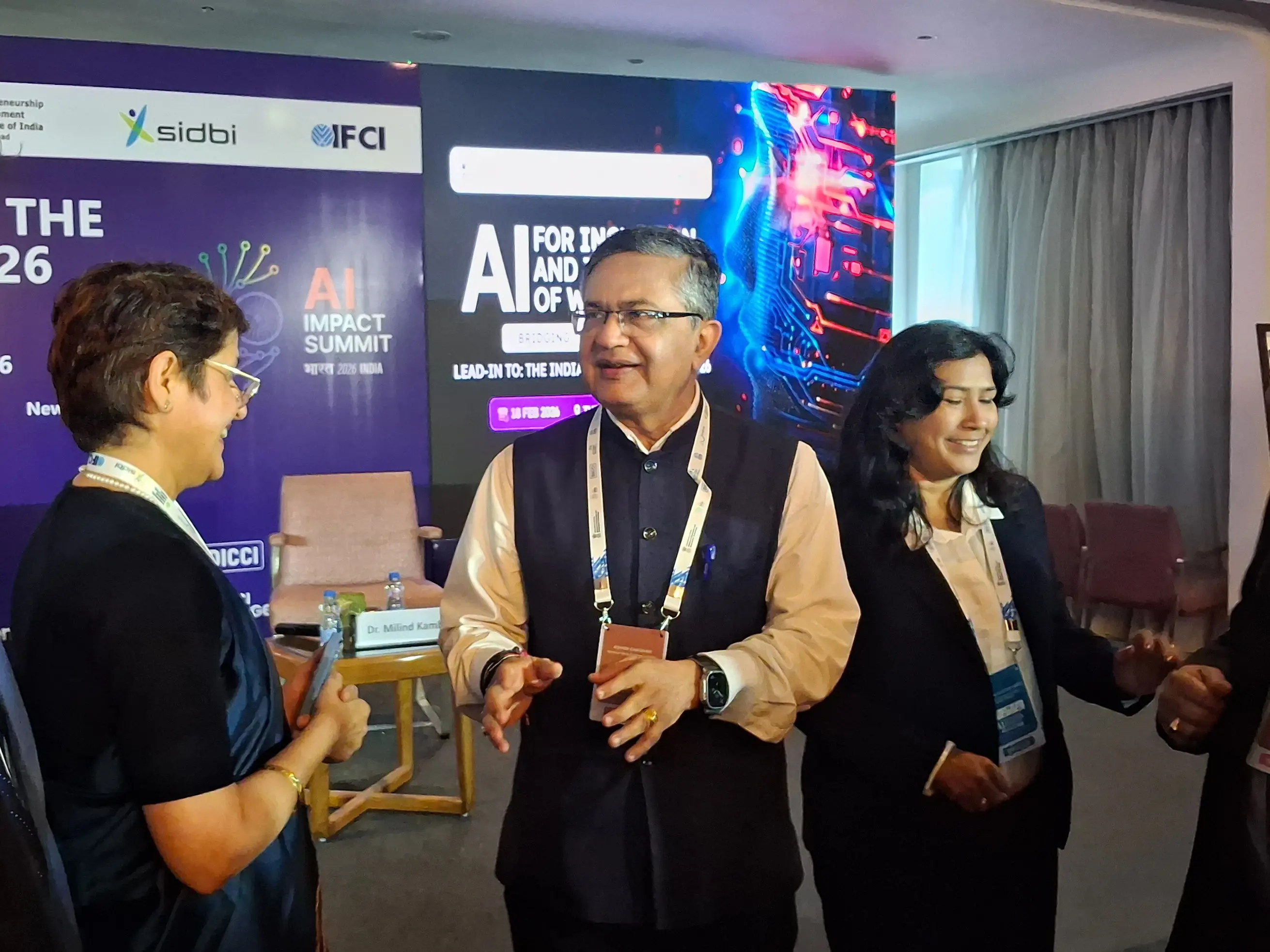
India is building ‘capitalism without capital,’ says NSE chief Ashish Chauhan Photograph: (WION)
Speaking at DICCI’s conclave in New Delhi, NSE MD & CEO Ashish Kumar Chauhan declared that India has effectively built “capitalism without capital,” backed by a $4.2 trillion economy and $1.2 trillion in annual savings
India is rewriting the rules of wealth creation, and artificial intelligence may be the most powerful tool yet in that transformation. That was the central argument Ashish Kumar Chauhan, Managing Director and CEO of the National Stock Exchange of India (NSE), made on Wednesday at a high-profile conclave in New Delhi, and it hit a nerve.
Speaking at DICCI’s International Conclave on AI for Inclusion and the Future of Work 2026, held at The Park Hotel, Chauhan offered a sweeping reimagination of what economic empowerment can look like in a country that was once locked out of traditional capital formation. His phrase, “capitalism without capital,” became the defining takeaway of the session. “Earlier, you required a lot of capital to create more capital, which is why Karl Marx called it capitalism,” Chauhan told the gathering of policymakers, technologists, and investors. “Since India was capital-starved when we became independent, we could not create large factories, and that’s how we could not create even further capital.”
That cycle, he argued, has decisively broken.
From Scarcity to Story
The shift, in Chauhan’s telling, began quietly, with services companies like Infosys and Wipro proving that intellect and execution, not industrial capital, could generate enormous wealth. Now, with India’s GDP at approximately $4.2 trillion and domestic savings running close to $1.2 trillion a year, the country is no longer capital-starved. It is capital-ready.
But the more striking claim was about what comes next. Today, Chauhan said, you don’t need a balance sheet to build a business; you need a story. And if that story is compelling enough, 127 million investors on NSE’s platform are waiting to hear it.
Trending Stories
)
)
)
)
)
)
)
)
)
)
)
)
)
)
)
)
)
)
)
)
)
)
)
)
)
)
)
)
)
&im=FitAndFill=(700,400))
)
)
)
)
)
)
)
)
)
&im=FitAndFill=(700,400))
)
)
“If you can convince even a thousand people out of 127 million people whom NSE services directly, you will be able to get that RS1 crore, RS2 crore, RS5 crore you want,” he said, pointing to the NSE EMERGE platform, the exchange’s dedicated segment for small and medium enterprises, as a live proof of concept.
The AI psych game
Chauhan was equally blunt about the global AI raceand the narrative he believes is designed to keep countries like India on the sidelines. He called the argument that AI requires trillion-dollar investments a “psych game,” a deliberate attempt by incumbents to signal the race is already over. He doesn’t buy it. “The other side is puncturing that, saying that every day I will come out with a new, better model,” he said. “That fight, let it be on.”
His point was practical, not merely defiant. Open-source, open-weight AI models, he noted, can now run on ordinary laptops and deliver useful results across a wide range of applications. India doesn’t need to win the model-building arms race to win the AI era; it needs to build the best use cases. “You don’t have to invent, if you can, very good,” Chauhan said. “But start using stuff which is available, and start developing things which are useful to your society, people around you.” He pointed to homegrown efforts like Sarvam AI as early signals of what Indian teams can do, and urged the country to move from consuming global AI to tinkering with it, the same way it once built the software services industry from scratch.
The electricity parallel
To frame the larger opportunity, Chauhan reached for a historical analogy. AI, he said, will behave like electricity, a horizontal technology whose greatest beneficiaries won’t be the inventors, but the countless people and industries that learn to use it. “The inventor did not get much. It’s the people who used it later who became very rich, but the entire society benefited,” he said. “And that is true with AI.”
The conclave, organised by the Dalit Indian Chamber of Commerce and Industry (DICCI) and supported by the Ministry of Electronics and Information Technology, was designed as a precursor to the India AI Impact Summit 2026. It brought together senior government officials, global policymakers, and industry leaders to deliberate on how artificial intelligence can be shaped as a force for equitable, not just efficient, growth.
A closing call to grab the moment
Chauhan closed with a call to action that was part economic thesis, part rallying cry. “AI is a new opportunity, let’s grab it with both hands,” he said. “The future is for us to win.” For a country that spent decades being told it lacked the capital to compete at the top table, that may be the most consequential argument of all. The DICCI conclave concluded with the adoption of the Delhi Declaration on Inclusive AI and the Future of Work, which will be formally presented at the India AI Impact Summit 2026.
About the Author
