
&imwidth=800&imheight=600&format=webp&quality=medium "China’s property slump deepens despite fresh easing measures")
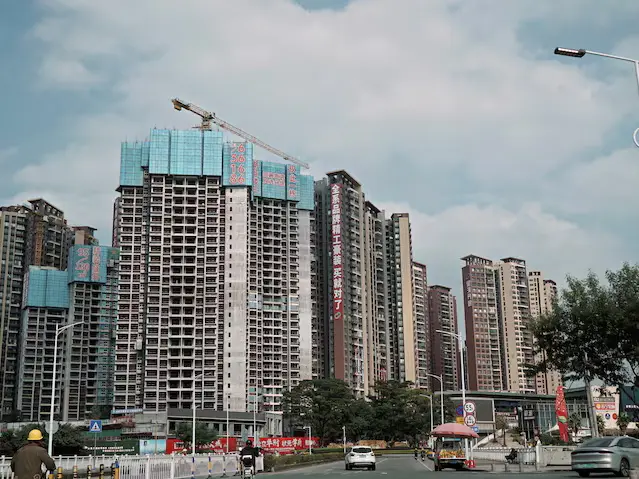
China’s property sector remained mired in a prolonged downturn in July, with fresh data showing sharp declines in investment, sales, and prices despite a steady rollout of easing measures by local authorities. Figures from the National Bureau of Statistics (NBS) on August 15 showed property investment fell 12 per cent in the first seven months of 2025 compared with the same period a year earlier, a steeper drop than the 11.2 per cent decline recorded in the first half. Property sales by floor area were down 4 per cent year-on-year, following a 3.5 per cent fall in January-June. New construction starts plunged 19.4 per cent, while funds raised by developers dropped 7.5 per cent.
New-home prices in 70 major cities fell 0.3 per cent month-on-month in July, matching June’s decline. On an annual basis, prices were down 2.8 per cent, slightly less than the 3.2 per cent fall in June, with modest narrowing of declines across tier-one to tier-three cities. Resale home prices also weakened, with tier-two and tier-three cities showing smaller drops but tier-one cities seeing wider falls.
Policy push meets market skepticism

The persistent weakness has added urgency to government efforts to stabilise the sector, which once accounted for roughly a quarter of China’s economic output. In recent months, more local governments have eased restrictions, including allowing greater use of housing provident funds and offering subsidies to buyers. In a notable step, Beijing last week scrapped purchase limits for qualified buyers in suburban areas outside the capital’s fifth ring road, though curbs remain in place closer to the city center.
Analysts expect Shanghai and Shenzhen may follow. However, HSBC Holdings analysts cautioned the change is “not meaningful,” noting that buyers seeking multiple properties are more likely to target prime locations. Despite the policy push, analysts remain wary about the near-term outlook. “A clear turnaround and stabilisation are not yet in sight,” said Li Kai, founding partner at Beijing Shengao Fund Management. ING analysts stressed that price stabilization is critical for restoring household confidence and reviving consumption.
Developers under pressure
Trending Stories
)
China thinned Himalayan troop presence in 2025, India defence report says; terms border situation 'stable'
)
Israeli minister calls to strip Gaza film directors of citizenship
)
China discovers vast gold and silver 'mine' in the Pacific with unheard-of deposits
)
Crude oil prices jump more than $107 per barrel following Houthi attacks on Saudi
)
Ganesh Chaturthi 2026: Devotees throng the iconic Lalbaugcha Raja pandal in Mumbai
)
Did China give Iran intel before US base strike that killed 3 troops? Trump says, 'You’re right...'
)
Did India risk its US trade deal despite softer stance at BRICS?
)
Turkish Airlines plane flies through a storm three times, triggering severe turbulence
)
Trump says Canada eager to reach a deal, it could come ‘fairly soon’ if Ottawa treats US farmers better
)
Russian drone hits Warsaw-bound train near Polish border, Zelensky accuses Moscow of ‘deliberate’ targeting
)
First naval drone battle? Ukraine says Sargan 3000 sank Russian unmanned boat
)
Video of Pakistani lawmaker struggling to read English tribute to Jinnah goes viral - WATCH
&im=FitAndFill=(700,400))
New OTT releases this week (September 14-20, 2026): Lust Stories 3, Waiting Hai, Irumudi- 5 new titles coming on Netflix, Prime Video and more
)
‘Want to reset ties with India, have engagement based on mutual interests,’ says Bangladesh minister
&im=FitAndFill=(700,400))
Why Chinese PL-15 air-to-air missiles use dual-pulse motors compared to European interceptors
)
Iran, India agree to deepen humanitarian and political ties, President Pezeshkian says
)
Plane carrying prominent figure crashes at Libya’s Misrata airport: Report
)
Natural caffeine sources gain popularity; matcha & botanicals offer calm energy
)
Saudi Arabia discovers 110 million tonnes of Uranium-rich ore in Madinah region
)
Humans may lose control of AI: Anthropic CEO calls for slowdown, Altman, Musk back him
)
Practical Magic 2 breaks Spidey spell over North American box office
)
‘Let’s go’: Newly declassified videos show dramatic rescue of US Air Force officers downed in Iran
)
800 million years old - Scientists discover 'fingerprints' of supercontinent Gondwana in ancient rocks
)
Russia proposes to build 360 kmph Ivolga FG trains in India: What happened on sidelines of BRICS
)
Women's Asia Cup 2026: India denied trophy once again despite winning the title
)
'Huge destructive power': North Korea calls its latest missile launches 'live-fire drill' even as US dismisses 'immediate threat'
)
Pakistan puts Pak Rs 70 lakh bounty on UN terrorist Masood Azhar; move draws skepticism in Delhi
)
Indian importers urge Bangladesh to lift export ban on 'Hilsa' fish ahead of Durga Puja
)
Delhi’s balancing act: BRICS serves as a stage for West Asia diplomacy
)
Liam Neeson sparks romance rumours after holding hands with Stella Stocker at TIFF 2026
&im=FitAndFill=(700,400))
Why European Meteor missiles use ramjet engines compared to standard US solid rockets
)
Veteran Bollywood actress Nafisa Ali shares health update as Stage 4 cancer progresses, starts targeted therapy
)
Orlando Bloom addresses Pirates of the Caribbean comeback and reunion with Johnny Depp
The deepening slump has accelerated the financial strain on developers. Mid-sized builder China South City Holdings was ordered to liquidate by Hong Kong’s High Court this week after defaulting more than a year ago. Since the crisis began in 2021, at least six Chinese developers have received wind-up orders from Hong Kong courts. China Evergrande Group, once the country’s largest developer, confirmed its Hong Kong stock will be delisted, marking a symbolic end to an era of rapid expansion.
Global banks remain split on the outlook. HSBC sees a “highly divergent” recovery favoring state-backed developers with strong pipelines, while UBS has pushed back its recovery forecast after a renewed sales slowdown in the second quarter. Fitch Ratings expects the market to weaken further in the second half, with recovery hinging on broader economic conditions, labor market stability, and household income growth.
(With inputs from agencies)