North Korean state agency threatens to 'sink' Japan, reduce US to 'ashes and darkness'

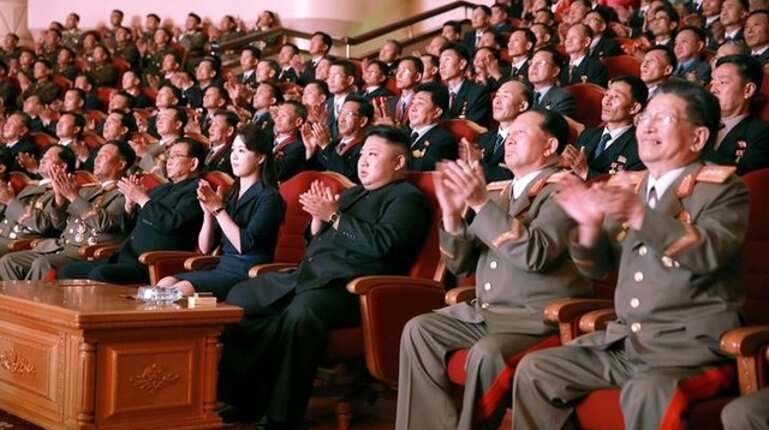
North Korean leader
A North Korean state agency threatened on Thursday to use nuclear weapons to "sink" Japan and reduce the United States to "ashes and darkness" for supporting a UN Security Council resolution
ANorthKorean state agency threatened on Thursday to use nuclear weapons to "sink" Japan and reduce the United States to "ashes and darkness" for supporting a UNSecurity Council resolution and sanctions over its latest nuclear test.
TheKoreaAsia-Pacific Peace Committee, which handles theNorth's external ties and propaganda, also called for the breakup of the Security Council, which it called "a tool of evil" made up of "money-bribed" countries that move at the order of the United States.
"The four islands of the archipelago should be sunken into the sea by the nuclear bomb of Juche. Japan is no longer needed to exist near us," the committee said in a statement carried by the North's official KCNA news agency.

Juche is theNorth's ruling ideology that mixes Marxism and an extreme form of go-it-alone nationalism preached by state founder Kim Il Sung, the grandfather of the current leader, Kim Jong Un.
Regional tension has risen markedly since the reclusiveNorthconducted its sixth and by far its most powerful, nuclear test on September 3, following a series of missile tests, including one that flew over Japan.
The 15-member Security Council voted unanimously on a US-drafted resolution and a new round of sanctions on Monday in response, banningNorthKorea's textile exports that are the second largest only to coal and mineral and capping fuel supplies.
)
Three labourers killed as DU student loses control of his car, rams into them on Dwarka Expressway
)
Pentagon revives mandatory testosterone testing for male troops aged 30 and above
)
FACT CHECK: Why did PM Modi ask Xi ‘is it okay’ at BRICS Summit? New video reveals...
)
India seeks to build a full semiconductor supply chain
&im=FitAndFill=(700,400))
From Abhishek Sharma to Sahil Chauhan, 5 batters with fastest T20I hundreds
)
Indian activist-lawyer Prashant Bhushan's post brings focus on ‘conflict of interest’ appointments of ex-govt officials at Reliance, Adani groups
)
Pyongyang dismisses US, western pressure over nuclear programme
)
US And Denmark reach Greenland deal, Trump announces expanded military presence
)
Google’s Gemini AI hacks real systems by guessing passwords during security test
)
Former India player Diana Edulji wants Smriti Mandhana to replace Harman as skipper at the earliest
)
China may have gained access to US's classified F-35 jets; parts meant for repairs diverted to Hong Kong, sparking Pentagon inquiry
)
NASA research plane reaches 61,000 feet over Panama
)
Godfather of AI Geoffrey Hinton gives US lawmakers a one-year warning on AI
)
Shivakumar attends 79th Kalyana Karnataka Utsav in Kalaburagi
)
Trump signs Russia sanctions law: India faces fresh 100% tariff threat over Russian oil
)
Why Ranveer Singh’s Dhurandhar missed India’s Oscar entry; FFI jury member reveals what happened
)
‘Will go to any extent’: Pakistan vows to defend Saudi Arabia amid Houthi attacks
)
The Verdict | When precision fails: US commits war crime in Minab school strike, UN finds
)
Trump signs Russia sanctions bill into law, targets Moscow’s energy sector
&im=FitAndFill=(700,400))
New Friday OTT releases (September 18, 2026): Lust Stories 3, You+Me, Best of the Best- 8 new titles coming on Netflix, Prime Video and more
)
Fast bowler Brydon Carse faces no charges over Derby nightclub incident
)
Flying cars in UAE: Ras Al Khaimah signs deal with Chinese company to test new transport
)
Africa is splitting, and a lot sooner than estimated, giving way to a new ocean
)
'Gangsta' crab shoves knife blade at man and his dog in Florida - Watch
)
Trump bans CNN, MS NOW and Politico from White House over ‘FAKE NEWS’
)
Trump 2.0: Dark days ahead for America’s ‘imperial presidency’
)
Trump's Greenland dream comes true? POTUS announces 'Infinite Life' deal with Denmark, claims permanent US control
)
Laura Wolvaardt sets new world record for most WT20I runs in a year
)
Drone strikes cooling tower at Russia's Kursk Nuclear Plant, IAEA confirms
)
Who is Khalilur Rahman? All you need to know about 81st UN General Assembly President
)
IIT Bombay student dies by suicide, was caught seeking AI help during exams
&im=FitAndFill=(700,400))
Meet top 5 bowlers in latest ICC T20I rankings
)
Indian Cinema bets big on mythology, brings ancient stories to modern audiences
)
Ukraine plans record $109 bn defence spending, nearly two thirds of budget amid Russia war
)
Russia holds first parliamentary elections since the beginning of the Ukraine war
&im=FitAndFill=(700,400))
Meet top 5 Indian batters with fastest T20I centuries
TheNorthreacted to the latest action by the Security Council, which had the backing of veto-holding China and Russia, by reiterating threats to destroy the United States, Japan and south Korea.
"Let's reduce the USmainland into ashes and darkness. Let's vent our spite with the mobilization of all retaliation means which have been prepared till now," the statement said.
Japan's Nikkei stock index and dollar/yen currency pared gains, although traders said that was more because of several Chinese economic indicators released on Thursday rather than a reaction to theNorth's latest statement.
SouthKorea's won also edged down around the same time over domestic financial concerns.
Despite theNorth's threats, SouthKorean President Moon Jae-in said he was against having nuclear weapons in his country, either by developing its own arsenal or bringing back U.S. tactical nuclear weapons that were withdrawn in the early 1990s.
"To respond toNorthKoreaby having our own nuclear weapons will not maintain peace on the Korean peninsula and could lead to a nuclear arms race innortheast Asia," Moon said in an interview with CNN.
SouthKorea's Unification Ministry also said it planned to provide $8 million through the U.N. World Food Programme and UNICEF to help infants and pregnant women in theNorth.
The move marks Seoul's first humanitarian assistance for theNorthsince its fourth nuclear test in January 2016 and is based on a longstanding policy of separating humanitarian aid from politics, the ministry said.
TheNorth's latest threats also singled out Japan for "dancing to the tune" of the United States, saying it should never be pardoned for not offering a sincere apology for its "never-to-be-condoned crimes against our people", an apparent reference to Japan's wartime aggression.
It also referred to SouthKoreaas "traitors and dogs" of the United States.
Japan criticised theNorth's statement harshly.
"This announcement is extremely provocative and egregious. It is something that markedly heightens regional tension and is absolutely unacceptable," Japanese Chief Cabinet Secretary Yoshihide Suga told reporters.
Japanese Prime Minister Shinzo Abe, visiting India, called for strict enforcement of the U.N. resolution, saying the world must force a change.
The 15-member Security Council voted unanimously on a U.S.-drafted resolution and a new round of sanctions againstNorthKoreaon Monday in response to its latest and most powerful test, banningNorthKorea's textile exports that are the second largest only to coal and mineral and capping fuel supplies.
NorthKoreahad already rejected the Security Council resolution, vowing to press ahead with its nuclear and missile programmes.
A tougher initial U.S. draft of Monday's resolution was weakened to win the support of China, the North's lone major ally, and Russia. Significantly, it stopped short of imposing a full embargo on oil exports toNorthKorea, most of which come from China.
The latest sanctions also make it illegal for foreign firms to form commercial joint ventures with NorthKorean entities.
U.S. President Donald Trump has vowed thatNorthKoreawill never be allowed to threaten the United States with a nuclear-tipped missile, but has also asked China to do more to rein in its neighbour. China, in turn, favours an international response to the problem.
Chinese Foreign Ministry spokeswoman Hua Chunying said the international community had reached a "high consensus" on trying to realise a peaceful solution.
"We urge the relevant directly involved parties to seize the opportunity and have the political nerve to make the correct political choice as soon as possible," Hua told a regular press briefing.
TheNorthaccuses the United States, which has 28,500 troops in SouthKorea, of planning to invade and regularly threatens to destroy it and its Asian allies.
The United States and SouthKoreaare technically still at war withNorthKoreabecause the 1950-53Korean conflict ended with a truce and not a peace treaty.