
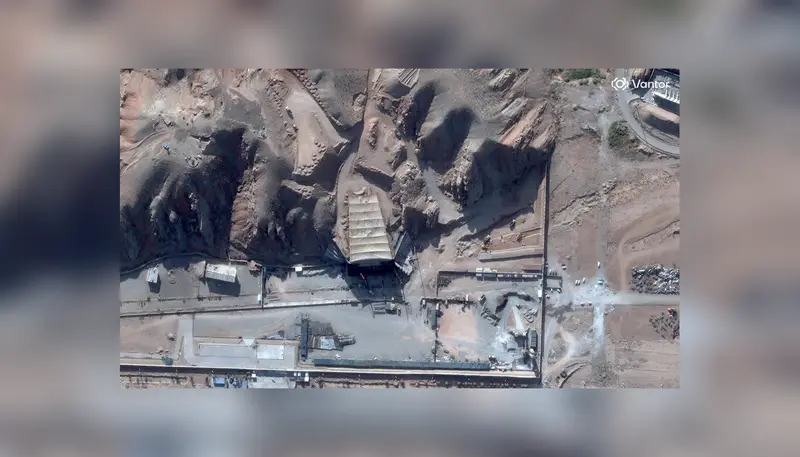
Iran may be rebuilding a military facility at the heart of long-running concerns over its past nuclear weapons research. New satellite images show construction work accelerating at the site despite repeated Israeli strikes.
The Taleghan 2 facility, located inside the sprawling Parchin military complex southeast of Tehran, is being reconstructed for the second time after being hit by Israeli bunker-busting weapons, the images suggest.
Images captured by Vantor on September 13 show a large tarpaulin stretched over the damaged underground facility, apparently shielding the work below from satellite and aerial surveillance.

Around the site, bulldozers, cranes, concrete mixers, dump trucks and concrete pumps can be seen operating, according to an assessment by the Washington-based Institute for Science and International Security. The analysis was led by David Albright, a former UN nuclear weapons inspector who has spent decades tracking Iran’s nuclear programme.
Iran adds more protection after Israeli strikes
Trending Stories
)
Three labourers killed as DU student loses control of his car, rams into them on Dwarka Expressway
)
Pentagon revives mandatory testosterone testing for male troops aged 30 and above
)
FACT CHECK: Why did PM Modi ask Xi ‘is it okay’ at BRICS Summit? New video reveals...
)
India seeks to build a full semiconductor supply chain
&im=FitAndFill=(700,400))
From Abhishek Sharma to Sahil Chauhan, 5 batters with fastest T20I hundreds
)
Indian activist-lawyer Prashant Bhushan's post brings focus on ‘conflict of interest’ appointments of ex-govt officials at Reliance, Adani groups
)
US And Denmark reach Greenland deal, Trump announces expanded military presence
)
Former India player Diana Edulji wants Smriti Mandhana to replace Harman as skipper at the earliest
)
China may have gained access to US's classified F-35 jets; parts meant for repairs diverted to Hong Kong, sparking Pentagon inquiry
&im=FitAndFill=(700,400))
Meet top 5 batters in the latest ICC T20I Rankings
)
Godfather of AI Geoffrey Hinton gives US lawmakers a one-year warning on AI
)
Shivakumar attends 79th Kalyana Karnataka Utsav in Kalaburagi
)
Trump signs Russia sanctions law: India faces fresh 100% tariff threat over Russian oil
)
Why Ranveer Singh’s Dhurandhar missed India’s Oscar entry; FFI jury member reveals what happened
)
How did an Australian river with 500 crocodiles pass the Olympic test? Here's how
)
‘Will go to any extent’: Pakistan vows to defend Saudi Arabia amid Houthi attacks
)
'He will always be ahead': India coach Gambhir says Sooryavanshi won't walk into team ahead of Samson
)
The Verdict | When precision fails: US commits war crime in Minab school strike, UN finds
)
Trump signs Russia sanctions bill into law, targets Moscow’s energy sector
&im=FitAndFill=(700,400))
New Friday OTT releases (September 18, 2026): Lust Stories 3, You+Me, Best of the Best- 8 new titles coming on Netflix, Prime Video and more
)
Fast bowler Brydon Carse faces no charges over Derby nightclub incident
)
Flying cars in UAE: Ras Al Khaimah signs deal with Chinese company to test new transport
)
Africa is splitting, and a lot sooner than estimated, giving way to a new ocean
)
'Gangsta' crab shoves knife blade at man and his dog in Florida - Watch
)
Trump bans CNN, MS NOW and Politico from White House over ‘FAKE NEWS’
)
Trump 2.0: Dark days ahead for America’s ‘imperial presidency’
)
Trump's Greenland dream comes true? POTUS announces 'Infinite Life' deal with Denmark, claims permanent US control
)
Laura Wolvaardt sets new world record for most WT20I runs in a year
)
Drone strikes cooling tower at Russia's Kursk Nuclear Plant, IAEA confirms
)
Who is Khalilur Rahman? All you need to know about 81st UN General Assembly President
&im=FitAndFill=(700,400))
Meet top 5 bowlers in latest ICC T20I rankings
)
Ukraine plans record $109 bn defence spending, nearly two thirds of budget amid Russia war
)
Russia holds first parliamentary elections since the beginning of the Ukraine war
&im=FitAndFill=(700,400))
Meet top 5 Indian batters with fastest T20I centuries
The latest construction also appears to include measures aimed at making the facility more resistant to another aerial attack. New concrete reinforcements are being built around the complex, with the work apparently designed to provide additional protection against blasts.
The institute said the latest activity leaves little doubt that Iran intends to restore the site, calling the continued rebuilding “deeply concerning” because of Taleghan 2’s suspected role in nuclear weapons-related research.
“What is clear is that Iran remains committed to rebuilding this facility,” the institute said.
What Iran plans to put inside the rebuilt complex, however, remains unclear.
Taleghan 2 and Iran's Amad programme
The facility has a history dating back to Iran’s secretive Amad programme, which Western intelligence agencies believe was aimed at developing the capability to build a nuclear weapon in the early 2000s.
The International Atomic Energy Agency and US intelligence assessments say Iran shut down the programme in 2003. Tehran has denied seeking nuclear weapons.
Taleghan 2 was believed to have housed a specially designed chamber used for high-explosive experiments that could have been relevant to the development of a nuclear warhead.
Israel first destroyed the building during air strikes on Iran in October 2024. Soon after, Iran began rebuilding it in May 2025, this time with a much more fortified structure featuring a reinforced steel frame, a concrete shell and an earth covering.
During that reconstruction, satellite imagery appeared to show a large cylindrical structure being placed inside the building. Analysts at the Institute for Science and International Security assessed that it could have been a high-explosive containment vessel.
Israel struck again in March
The facility was targeted again by Israel in March this year. High-resolution satellite imagery taken after the strike showed three large penetration holes caused by bunker-busting weapons directly above the part of the building where the suspected containment vessel had been located.
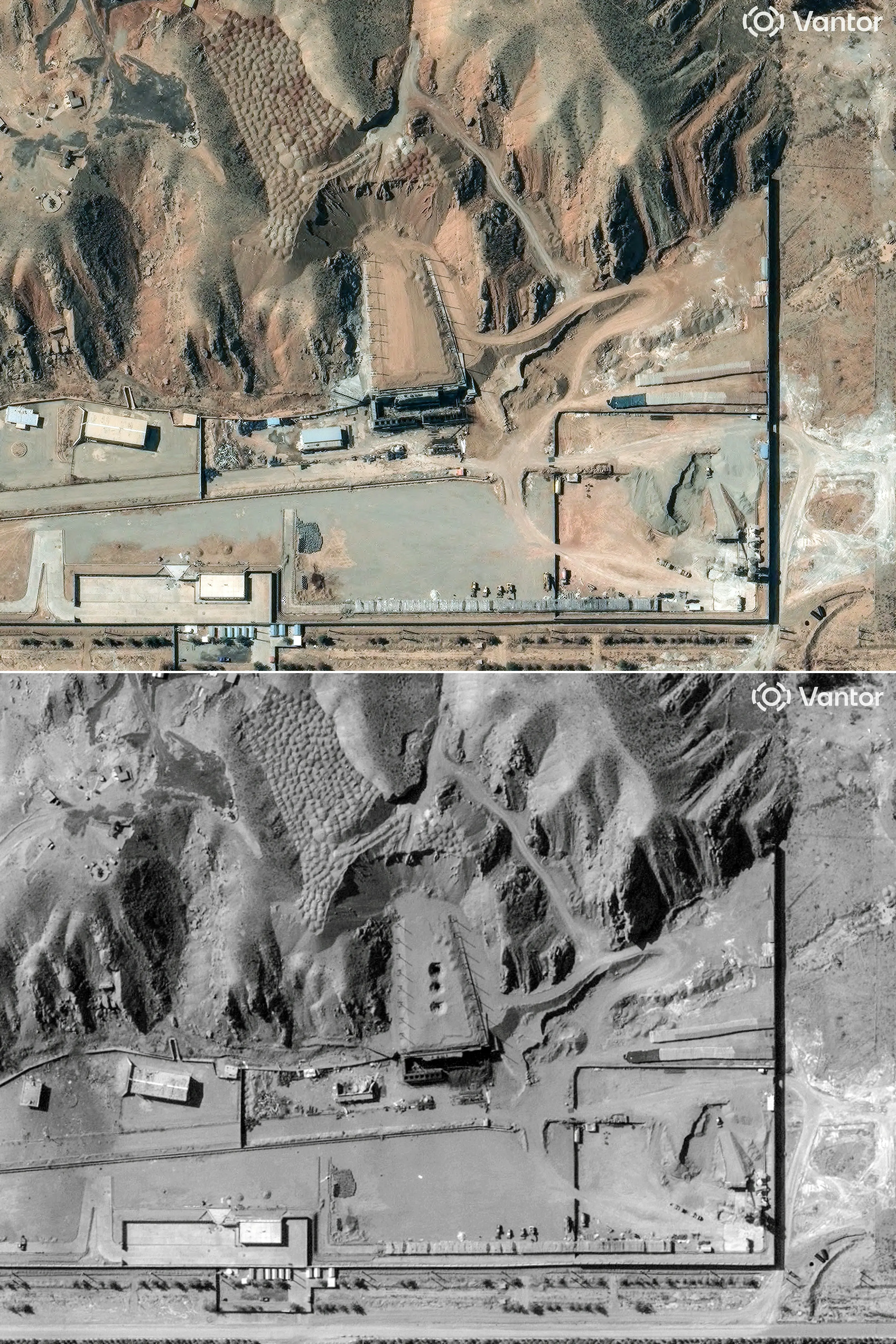
This combination of pictures created on March 11, 2026, using satellite images released courtesy of Vantor, shows a view of Taleghan 2 facility at the Parchin military complex, some 30 kms (20 miles) southeast of Tehran, Iran, on March 6, 2026 (top) and on March 11, 2026, after airstrikes.
The institute assessed that the precision strikes probably destroyed the vessel and caused major damage to the building’s internal structure.
Iran began repairing the damage in June. The initial work focused on covering the penetration holes, followed by the installation of reinforced concrete caps over them.
The latest imagery indicates that the reconstruction has since picked up pace.
Concrete aprons have now been built along both sides of the facility, adding another layer of protection, while construction continues beneath the tarpaulin.
The purpose of the new structure remains unknown, leaving the central question around Taleghan 2 unanswered: why does Iran continue to rebuild a facility with such a long history of suspected nuclear weapons-related work, and what does it ultimately intend to use the site for?

