At least five killed after Amazon cargo plane runs off overruns runway at Miami airport

&imwidth=600&imheight=450&format=webp&quality=medium "At least five killed after Amazon cargo plane runs off overruns runway at Miami airport")
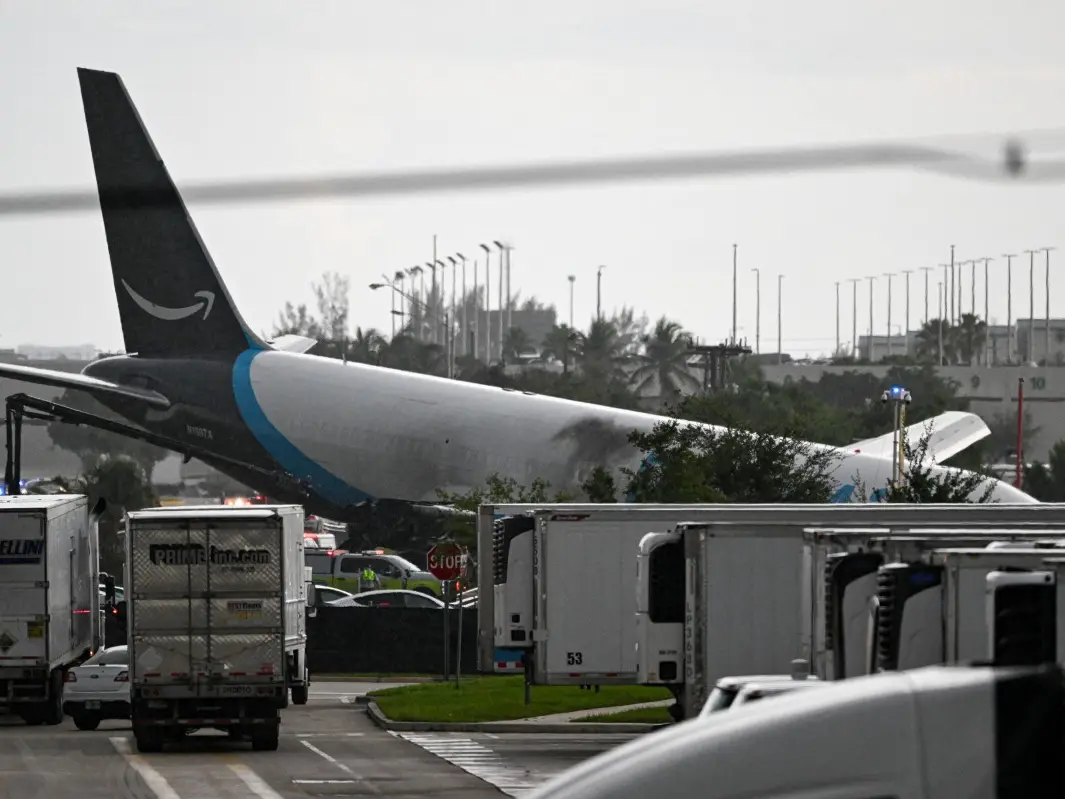
At least five killed after Amazon cargo plane runs off overruns runway at Miami airport Photograph: (AFP)
Amazon cargo plane crashes after overrunning a Miami airport runway, killing five, injuring five and triggering a major emergency response
An Amazon cargo plane overran a runway at Miami International Airport on Sunday after arriving from San Juan, Puerto Rico, striking vehicles on a nearby roadway and bursting into flames. Authorities said at least five people were killed and five others injured. The aircraft veered beyond the runway at around 2 pm and crossed a road used by warehouse employees and businesses operating around the airport. Miami-Dade County officials said three of the injured people were in critical condition, while two others suffered less serious injuries. Officials said it was too early to determine whether those killed were aboard the aircraft or inside the vehicles struck by the plane.
The crash created a massive emergency response, with thick black smoke rising above the airport. Miami-Dade Rescue Fire Chief Ray Jadallah said the pilot and copilot were trapped inside the cockpit, while several people in vehicles also became trapped. Emergency crews additionally had to rescue a person who was pinned beneath a vehicle. Around 200 emergency personnel responded to the incident. Firefighters encountered heavy flames and smoke coming from a complex engine compartment fire and used specialized airport firefighting equipment and foam to bring the blaze under control. Hours after the crash, crews were still working to contain a fuel leak from the aircraft.
The Prime Air aircraft eventually came to rest beside a roadway near two semi-trucks. Images from the scene showed the Boeing 767 resting on its belly and appearing largely intact despite extensive fire damage. The cause of the crash remained unknown. Investigators had not determined whether weather conditions contributed to the accident, although thunderstorms and wind gusts reaching about 30 mph (48 kph) were reported in the area around the time of the crash, according to the National Weather Service.
Watch the video
The flight was operated by 21 Air, a North Carolina-based cargo carrier. According to flight-tracking website Flightradar24, the 32-year-old Boeing 767 was initially manufactured as a passenger aircraft and operated with several airlines for more than 20 years before being converted into a freighter in 2015. The accident significantly disrupted operations at Miami International Airport, with flights suspended for much of Sunday afternoon. FlightAware reported that more than 160 flights had been canceled and nearly 325 delayed by late Sunday. Officials at Orlando International Airport, located more than 200 miles (320 km) north of Miami, said some flights were diverted there.
The National Transportation Safety Board said it was dispatching an investigative team to Miami under the leadership of Chairwoman Jennifer Homendy. Amazon said it would cooperate fully with the investigation. "We're heartbroken to learn that five people lost their lives in today's incident at Miami International Airport," the company said. "Our deepest sympathies go out to the families, loved ones, and all those affected by this devastating loss."
The Miami crash comes less than a year after another deadly cargo-plane accident in the United States. A UPS aircraft crashed after losing an engine while accelerating down the runway at Louisville's Muhammad Ali International Airport. The accident killed all three pilots and 12 people on the ground, while another 23 people were injured. Aviation safety expert Steve Arroyo said a Boeing 767 cargo aircraft operating a domestic flight would generally have two crew members: a pilot and a copilot. International flights would typically require additional pilots, with long-haul international operations potentially carrying a total of four pilots.
Arroyo said investigators will likely examine where the Amazon aircraft touched down and why the crew did not abort the landing if the plane was already beyond the appropriate touchdown area. "Did the aircraft land within the required touchdown zone?" he asked. “If it did, what happened?” The standard landing zone is generally within the first 3,000 feet (914 meters) of a runway. Investigators are expected to closely examine the aircraft's touchdown point, speed, braking performance, runway conditions and the crew's decisions during the landing.
According to the FAA, runway arresting systems have been credited with helping save at least 497 lives aboard aircraft involved in runway overruns. The investigation will determine what caused the Amazon cargo aircraft to leave the runway and whether factors including the aircraft's touchdown point, weather, runway conditions, braking, mechanical performance or crew actions contributed to the deadly accident.
Trending Stories
&imwidth=280&imheight=210&format=webp&quality=medium)
&imwidth=280&imheight=210&format=webp&quality=medium)
&im=FitAndFill=(700,400)&imwidth=280&imheight=210&format=webp&quality=medium)
&imwidth=280&imheight=210&format=webp&quality=medium)
&imwidth=280&imheight=210&format=webp&quality=medium)
&imwidth=280&imheight=210&format=webp&quality=medium)
&imwidth=280&imheight=210&format=webp&quality=medium)
&imwidth=280&imheight=210&format=webp&quality=medium)
&imwidth=280&imheight=210&format=webp&quality=medium)
&imwidth=280&imheight=210&format=webp&quality=medium)
&imwidth=280&imheight=210&format=webp&quality=medium)
&imwidth=280&imheight=210&format=webp&quality=medium)
&imwidth=280&imheight=210&format=webp&quality=medium)
&im=FitAndFill=(700,400)&imwidth=280&imheight=210&format=webp&quality=medium)
&imwidth=280&imheight=210&format=webp&quality=medium)
&imwidth=280&imheight=210&format=webp&quality=medium)
&imwidth=280&imheight=210&format=webp&quality=medium)
&imwidth=280&imheight=210&format=webp&quality=medium)
&imwidth=280&imheight=210&format=webp&quality=medium)
&imwidth=280&imheight=210&format=webp&quality=medium)
&imwidth=280&imheight=210&format=webp&quality=medium)
&imwidth=280&imheight=210&format=webp&quality=medium)
&imwidth=280&imheight=210&format=webp&quality=medium)
&imwidth=280&imheight=210&format=webp&quality=medium)
&imwidth=280&imheight=210&format=webp&quality=medium)
&imwidth=280&imheight=210&format=webp&quality=medium)
&imwidth=280&imheight=210&format=webp&quality=medium)
&imwidth=280&imheight=210&format=webp&quality=medium)
&imwidth=280&imheight=210&format=webp&quality=medium)
&imwidth=280&imheight=210&format=webp&quality=medium)
&imwidth=280&imheight=210&format=webp&quality=medium)
&imwidth=280&imheight=210&format=webp&quality=medium)
&imwidth=280&imheight=210&format=webp&quality=medium)
&imwidth=280&imheight=210&format=webp&quality=medium)
&imwidth=280&imheight=210&format=webp&quality=medium)
&imwidth=280&imheight=210&format=webp&quality=medium)

