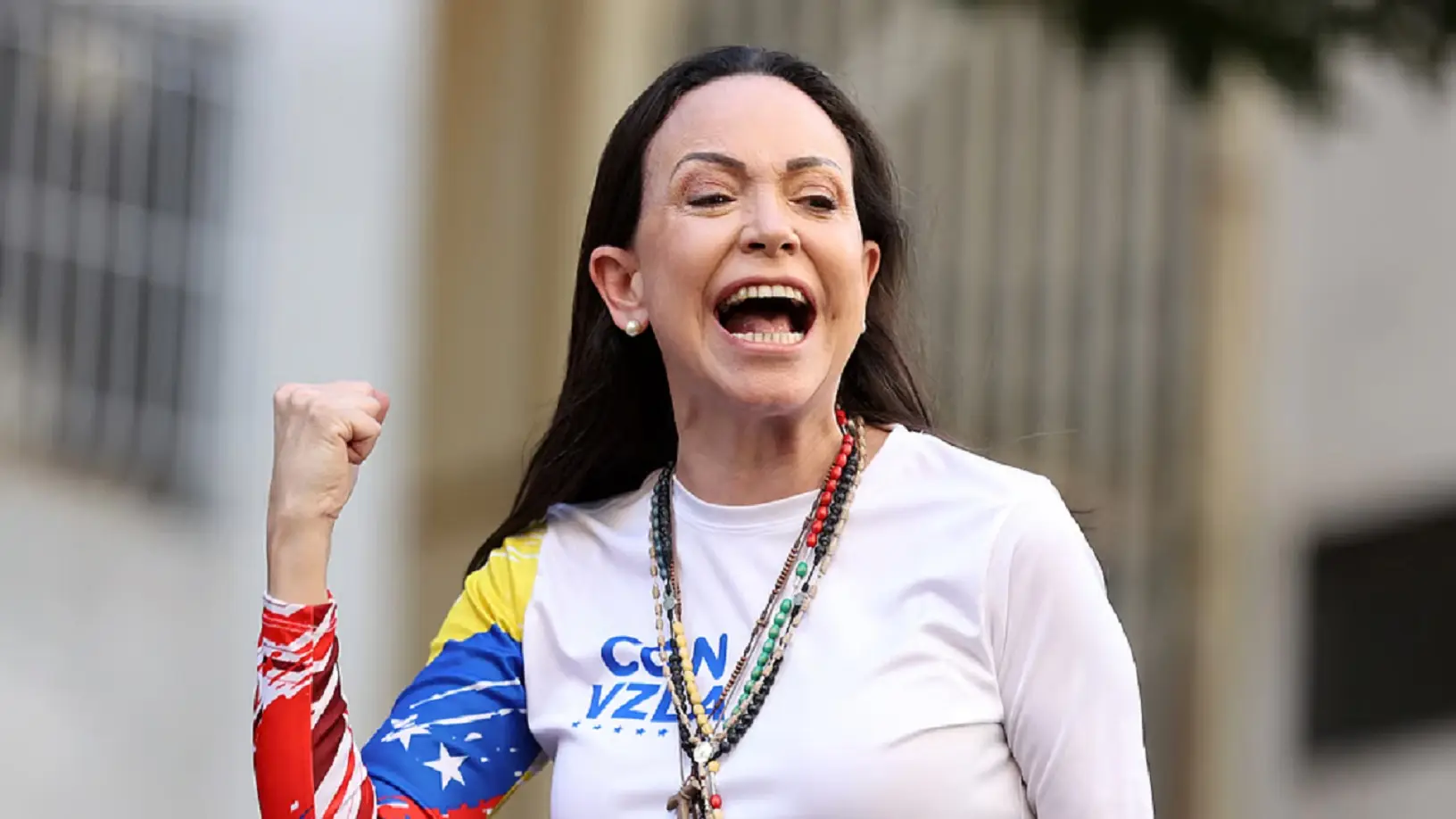
Twenty-three years, failed coup, treason charges, one Nobel Prize: The making of María Corina Machado

&imwidth=600&imheight=450&format=webp&quality=medium "Twenty-three years, failed coup, treason charges, one Nobel Prize: The making of María Corina Machado")
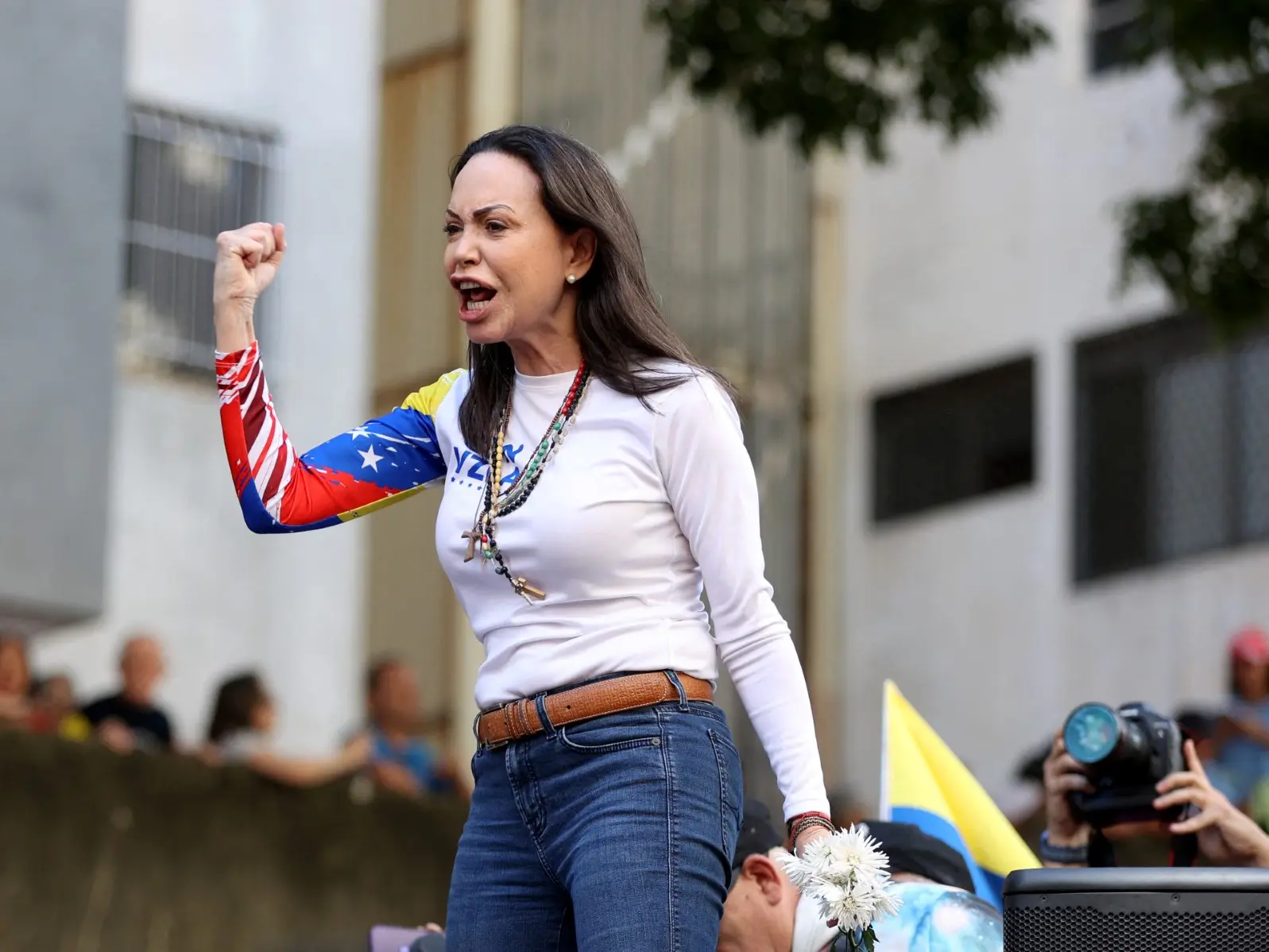
Venezuelan opposition leader Maria Corina Machado addresses supporters during a protest called by the opposition on the eve of the presidential inauguration, in Caracas on January 9, 2025. Venezuela is on tenterhooks facing demonstrations called by both the opposition and government supporters. Machado emerged from hiding to lead protests in Caracas against the swearing-in of Nicolas Maduro for a highly controversial third term as president Photograph: (AFP)
María Corina Machado wins the 2025 Nobel Peace Prize for democracy in Venezuela despite her ties to the 2002 coup and support for U.S. sanctions. The Nobel Committee picked someone who supports war crimes over those who are fighting against them.
October 10, 2025, María Corina Machado won the Nobel Peace Prize for ‘promoting democratic rights’. The Nobel committee congratulated her and praised her "tireless work" for democracy in Venezuela. Ironically, on April 11, 2002, Machado signed away democratic institutions in an attempt to overthrow a democratically elected government, and twenty-three years later, she is the flagbearer of Western democracy.
The 2002 failed coup d'état and the Carmona Decree
Hugo Chavez, then President of Venezuela, who was elected with 56 per cent of the vote, was removed from power to install a Business leader, Pedro Carmona. He passed a document called the Carmona Decree, which dissolved all branches of government institutions and invalidated the 1999 constitution. Machado was present during the brief coup at Miraflores presidential palace; she was also one of the signatories of the Carmona Decree that abolished all government institutions. While Chavez was not the most democratic leader, he was also not an elitist. He passed agrarian reforms to redistribute land and wealth, and his new petroleum policy imposed additional duties on foreign oil companies. The 2001 Hydrocarbon Law, which increased the royalty rate for foreign companies from 16 per cent to 30 per cent and mandated a 51 per cent government stake in any new oil ventures, was the primary problem for many foreign companies like US-based Chevron, ExxonMobil, and ConocoPhillips. While they were not directly involved in stirring up a coup, they were aligned with the opposition. The Carmona decree reversed all the social and economic reforms of Chávez, especially the nationalisation of the Oil sector. Several reports, including investigative reports from the Centre for Economic and Policy Research, investigative journalist Eva Golinger, and The New York Times, indicated that the National Endowment for Democracy (NED) increased its funding for Venezuela, providing large funding for groups that were opposing Chavez. CIA declassified documents show that the Bush administration was aware of the coup plot weeks in advance. But the coup lasted for less than 47 hours, and Chavez restored power. As Chavez was being held captive, mass popular protests by his supporters broke out across the streets of Caracas, and the military forces, which remained loyal to him, staged a counter-coup, took over the Presidential palace and restored Chavez to power. Pedro Carmona fled to Colombia.
Post-coup Machado: The Sumate and the NED
Machado was not leading the coup but was part of it, so she was charged with treason, but she remained in Venezuela. The coup, even though it failed, can not be dismissed as youthful idealism; she was in her mid-30s, and it was the beginning of her political career. She cofounded Sumate (Join-Up) and positioned it as an election monitoring organisation just three months before the coup. It was organising opposition against Chavez. Right after the failed coup, the NED awarded $1,000,000 to Venezuelan benefactors. After 2003, it was receiving regular funding from the NED. The US-funded civil society started operating with the objective of removing Chavez. In 2004, Sumate organised a recall referendum against Chavez, but Chavez won the referendum, started to investigate Sumate and the NED money trail. Machado and other Sumate leaders were charged with treason and conspiracy. This was the second treason charge, but she was not imprisoned; her defence created a ridiculous argument for the 2002 coup charges. She claimed that she was falsely instructed to sign the Carmona Decree, whose true intentions were unknown to her. Both the treason charges were annulled in February 2006. Why the second treason charge was annulled still is not openly documented; many argue that it was because of the international pressure, the prosecution had a lack of evidence to frame her (Venezuela was yet to descend into complete authoritarianism) and imprisoning her would turn her into a martyr and promote the narrative of a political prisoner, the treason charges itself made her an icon. But it never resulted in imprisonment.
From Chavez to Maduro, opportunity in crisis
Trending Stories
&imwidth=280&imheight=210&format=webp&quality=medium)
&imwidth=280&imheight=210&format=webp&quality=medium)
&imwidth=280&imheight=210&format=webp&quality=medium)
&imwidth=280&imheight=210&format=webp&quality=medium)
&imwidth=280&imheight=210&format=webp&quality=medium)
&imwidth=280&imheight=210&format=webp&quality=medium)
&imwidth=280&imheight=210&format=webp&quality=medium)
&imwidth=280&imheight=210&format=webp&quality=medium)
&im=FitAndFill=(700,400)&imwidth=280&imheight=210&format=webp&quality=medium)
&imwidth=280&imheight=210&format=webp&quality=medium)
&imwidth=280&imheight=210&format=webp&quality=medium)
&imwidth=280&imheight=210&format=webp&quality=medium)
&imwidth=280&imheight=210&format=webp&quality=medium)
&imwidth=280&imheight=210&format=webp&quality=medium)
&imwidth=280&imheight=210&format=webp&quality=medium)
&imwidth=280&imheight=210&format=webp&quality=medium)
&imwidth=280&imheight=210&format=webp&quality=medium)
&imwidth=280&imheight=210&format=webp&quality=medium)
&imwidth=280&imheight=210&format=webp&quality=medium)
&imwidth=280&imheight=210&format=webp&quality=medium)
&imwidth=280&imheight=210&format=webp&quality=medium)
&imwidth=280&imheight=210&format=webp&quality=medium)
&imwidth=280&imheight=210&format=webp&quality=medium)
&imwidth=280&imheight=210&format=webp&quality=medium)
&imwidth=280&imheight=210&format=webp&quality=medium)
&imwidth=280&imheight=210&format=webp&quality=medium)
&imwidth=280&imheight=210&format=webp&quality=medium)
&imwidth=280&imheight=210&format=webp&quality=medium)
&imwidth=280&imheight=210&format=webp&quality=medium)
&imwidth=280&imheight=210&format=webp&quality=medium)
&imwidth=280&imheight=210&format=webp&quality=medium)
&im=FitAndFill=(700,400)&imwidth=280&imheight=210&format=webp&quality=medium)
&imwidth=280&imheight=210&format=webp&quality=medium)
&imwidth=280&imheight=210&format=webp&quality=medium)
&im=FitAndFill=(700,400)&imwidth=280&imheight=210&format=webp&quality=medium)
Machado was elected to the National Assembly in 2006, and she maintained her opposition to the Chavez government. Chávez was re-elected in 2006 with a wide margin, and again in 2012. There were accusations of Media control, some amount of sledging at polling booths, unusual access to public funding and irregularities with the electoral roll. However international observer noted that the results reflected the overall sentiment. In 2013, Chavez died, and Maduro succeeded him in a contested election. The economic crisis started to deepen as the world oil market collapsed in 2014. Machado was expelled from the National Assembly and became a symbol of government repression, attracting major international attention. Venezuela went into recession due to over-reliance on oil revenue and massive welfare spending without attracting foreign investment and without diversifying the economy. The United States under Obama started to impose sanctions on the Venezuelan government officials in 2015, but not targeted at oil companies or trade relations. In 2017, Trump went on a full-scale trade war, and the situation worsened. He prohibited the trading of Venezuelan bonds in US markets, prohibited the use of Venezuelan digital currency. There was a complete embargo against the Venezuelan government.
Now follows another coup attempt of 2019. On January 23, 2019, Juan Guaidó, head of Venezuela's opposition-controlled National Assembly, declared himself ‘interim president.’ Within minutes, Trump recognised him, and about 50 more countries did the same. Machado, even though she supported him at first, later distanced herself from him, questioning his strategies. However, the coup failed, and the repeated attempt in 2020 also failed. These attempts set a precedent; no electoral victory was needed; all that mattered was Western recognition for a government. Guaido was too young and obviously a US creation; the movement fizzled out in 2022-23. But the pattern could be repeated, create another opposition leader, fund him and what is required is international legitimacy. Machado steps forward as a meaningful alternative. She won the 2023 opposition primary and raised her profile dramatically, but in 2024, she was barred from participating in the election for 15 years. The Court stated that it was for her support of US sanctions on Venezuela and Maduro, and for being ‘involved... in the corruption plot orchestrated by the usurper Juan Guaido’ which had led to a "criminal blockade of the Bolivarian Republic of Venezuela, as well as the shameless dispossession of the companies and wealth of the Venezuelan". This turned her into an international icon and flag bearer of democracy. In the 2024 election, she fiercely rallied around candidate Edmundo Gonzalez, operating under precarious conditions. But Maduro claimed himself the winner, and the opposition claimed that they had documents to show otherwise. In 2025, the Venezuelan government intercepted her convoy when she was out on a rally in Caracas; she was forced off the road and went into hiding, becoming Venezuela's most famous fugitive.
The Nobel Prize chose Venezuela over Gaza
The Norwegian Nobel Committee awarded Machado the peace prize on October 11. Even though this is not as disturbing as that of Henry Kissinger and Aung San Suu Kyi. But this blatantly appears like a legitimisation project for a regime change in Venezuela. Venezuela has the world's largest oil reserves, and the West is unable to access them. The committee did mention her struggle against an authoritarian regime. But it did not mention her open support of sanctions on Venezuela, which is pushing the country into further economic crisis, it did not mention her signing away of all democratic institutions or her economic platform explicitly modelled on Pinochet and Thatcher and no mention of the public support of the Gaza warcrime. This is particularly alarming because she was chosen over a UN agency providing humanitarian aid, along with Palestinian journalists, many of whom have died in Israeli war crimes. On winning, she dedicated it to Trump; the journey is complete from the Carmona Decree to the MAGA movement.