Virgin Galactic's new spaceplane will fly humans to space in 2027


Virgin Galactic's Apeiron spaceplane being carried by VMS Eve carrier aircraft. Photograph: (Virgin Galactic)
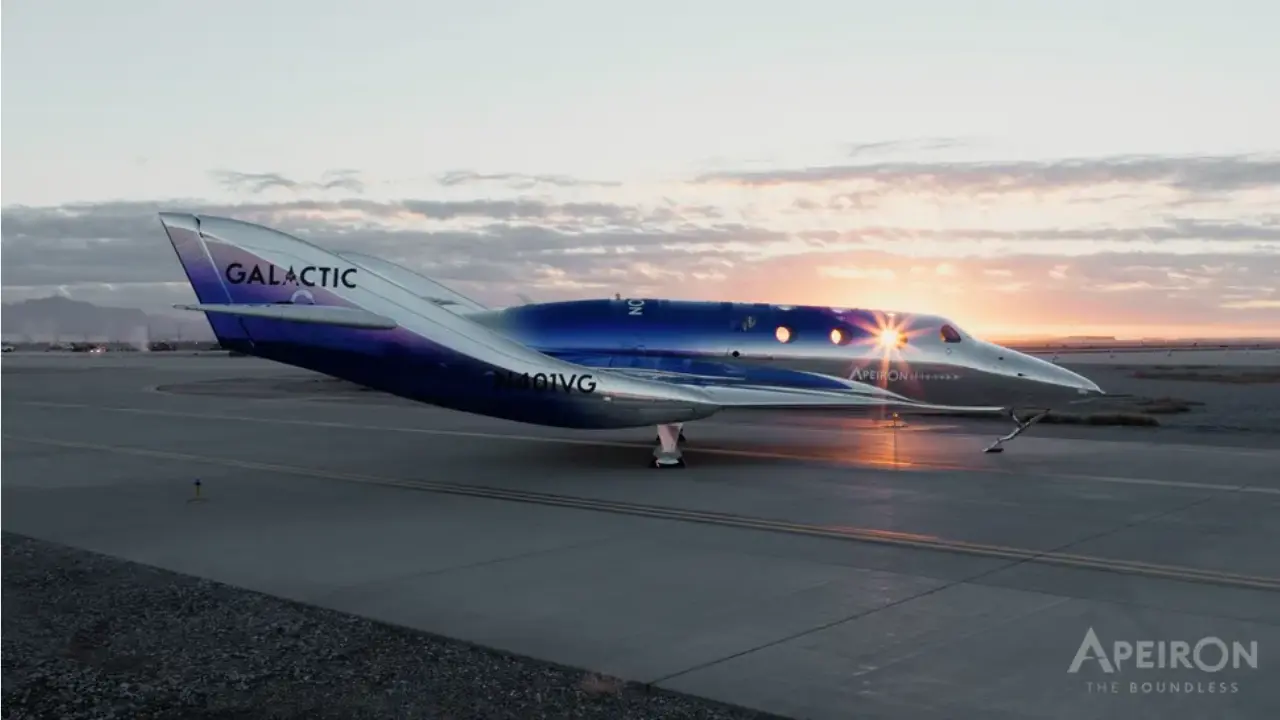
Virgin Galactic unveiled its new spaceplane on Wednesday, which is named Apeiron. The company plans to resume human spaceflights from mid-2027 using its Delta line. More than 600 people are in the queue, waiting to fly to space.
Virgin Galactic now has a new spaceplane, which it unveiled on Wednesday (October 28). The spacecraft belongs to its next-gen "Delta" line and has been named Apeiron after the company held a worldwide vote to pick one. Pronounced "A'-per-on", it comes from the ancient Greek word meaning "boundless," the company said in an announcement. People from 83 countries and six continents participated in the name poll.
The spaceplane left the manufacturing facility in Mesa, Arizona, for Spaceport America in New Mexico on Wednesday. Flight tests will begin once the final preparations are done.
Virgin Galactic's employees had submitted a list of 276 names to choose from, and the company narrowed it down to four names: Apeiron, Horizon, Explorer and Ascend. The public voted on the four names, after which Apeiron emerged as the winner.
Virgin Galactic CEO Michael Golglazier said in a statement that the name "captures the ambition of human spaceflight and the possibilities it opens for humanity," adding the "extraordinary response to the public vote made choosing this name even more meaningful."
Trending Stories


The spaceplane was taken to Spaceport America after being attached to the company's VMS Eve carrier aircraft. Virgin Galactic plans to fly customers to space on the plane by mid-2027. It previously had the VSS Unity, which operated between 2023 and 2024. The spaceplane was suspended to focus on the new model, Apeiron.
Virgin Galactic spaceplanes
Virgin Galactic is also developing a second spaceplane which will also be sent to Spaceport America around the same time Apeiron begins taking humans on sub-orbital flights. With the Delta-class vehicles, the company has planned to undertake eight flights every month. Virgin Galactic has a long wait list of passengers, with 675 ticket-holders scheduled to go to space on board its spacecraft. More than 100 of them have started preparing to take the spaceflight.
Today, Virgin Galactic charges $850,000 per seat for a space flight. The prices have seen a considerable jump over 12 years, as the first tickets cost $200,000 in 2014. These spaceplanes do not enter Earth's orbit and are only capable of suborbital flights. This means they cross the 100-kilometre-high Karman line, the internationally recognised boundary of space.

