
&imwidth=800&imheight=600&format=webp&quality=medium "'Maybe one day I will try a marathon': Seven-time Olympic medalist Andre De Grasse")
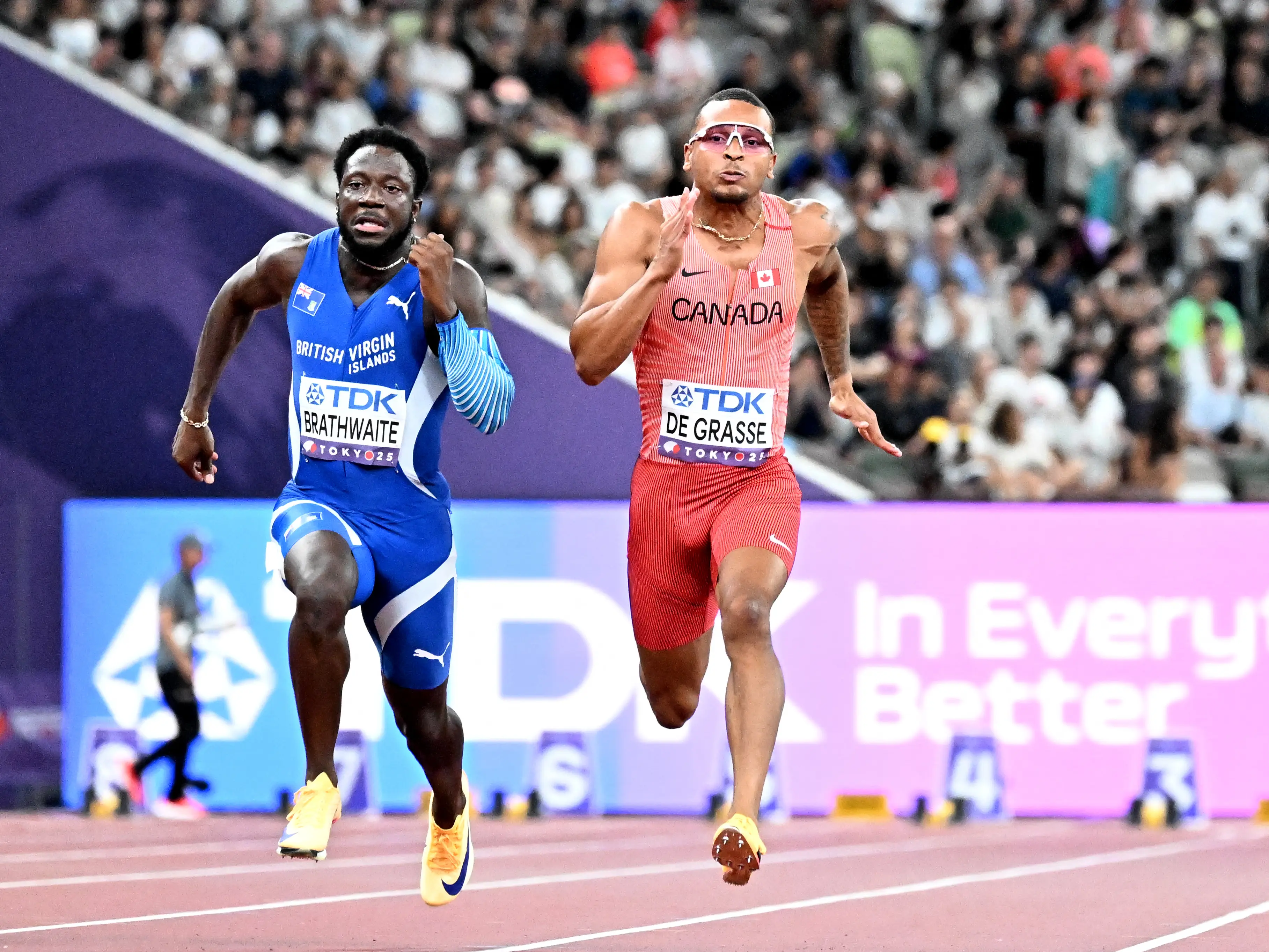
Seven-time Olympic medalist Andre De Grasse doesn’t look like a man built for patience. Everything about him, the broad shoulders, the relaxed swagger, the coiled calm in his movements, suggests someone designed for explosive moments rather than long, grinding ones. The braided hair frames a face that has seen Olympic podiums and world championship tracks, but in person, the Canadian sprinter carries himself with an ease that feels almost unhurried.
Perhaps that’s the paradox of elite speed. The fastest men in the world often move slowly off the track. In Mumbai, ahead of his first close association with India’s biggest marathon, the Tata Mumbai Marathon, De Grasse was visibly taking it all in. The scale of the event intrigued him, more than 65,000 runners, thousands of stories, one long road stretching across the city. “I’ve always wanted to experience a big international marathon,” he said. “And I heard Mumbai is one of the biggest. Plus, it’s my first time in India, so it felt like the right moment.”
For someone whose career has been defined by races lasting under 20 seconds, the marathon sits at the opposite end of the athletic spectrum. Sprinting is about instant power, precision, and controlled violence. Marathon running is about restraint, rhythm, and survival. Yet, despite the contrast, De Grasse believes the two disciplines quietly borrow from each other. Sprinters, he admits, could learn a great deal from marathon runners, particularly when it comes to fitness.

“Before we even sprint, we have to work on our fitness,” he said. “That’s how you stay healthy and avoid injuries. Breathing, pacing, staying efficient, those are things marathon runners do extremely well.”
Speed, in contrast, plays a subtler role in endurance running. Marathoners don’t chase maximum velocity; they chase control. Knowing when not to push can matter more than knowing how fast you can go. That understanding doesn’t come naturally to a sprinter. De Grasse laughed when asked about his own experiments with long distance. “I’ve only ever raced up to 800 metres,” he said. “If you even count that as long distance.” In training, though, he has flirted with endurance — albeit in a very sprinter-specific way. “I’ve gone up to about two miles, but in intervals,” he explained. “Broken down: 400s, 300s, 200s. By the end of a workout, it adds up.” An actual long-distance race, however, remains unexplored territory. “Maybe one day I’ll try a marathon,” he said, smiling. “We’ll see.”
Trending Stories
)
'George Soros playbook': Understanding the foreign funding network around Sonam Wangchuk
)
Man with babyish face spends Rs 10 lakh on beard transplant to be taken seriously at work
)
FIFA 2026 | 'I am truly sorry': Argentina's Enzo Fernandez, who get red card in final, reacts to loss
&im=FitAndFill=(700,400))
Why the specialized paint on an S-400 costs thousands of dollars per truck
)
India avoids higher US tariff, secures lower 10% rate. Here's how
)
‘Stole the show’: Young man’s uncanny imitation of Trump leaves internet stunned | WATCH
)
Russia-Ukraine war escalates| Zelensky pushes patriot missile production as Black sea crisis deepens
)
Ranbir Kapoor-Yash's Ramayana trailer postponed, producer cites Sony Pictures deal as reason
)
India invites Bangladesh PM Tarique Rahman to BRICS Summit
)
Delhi Police chief gets NSA detention powers but force denies link to CJP protests
)
WATCH: Sonam Wangchuk ends hunger strike after meeting Union Ministers JP Nadda, Jitendra Singh
)
FACT CHECK: Passport of CJP protesters to be cancelled? Delhi Police clarifies
)
Ukrainian drone wrecks irreplaceable Russian bomber 800km inside the country, satellite images show it halved
&im=FitAndFill=(700,400))
Why US fighter jets use seamless bubble canopies compared to Russian jets
)
'Oh my god!' Orca deliberately rams into sunfish so hard that it exploded. For food or fun?
)
‘10/10 strategy’: Iran's Ghalibaf mocks US strategy after oil prices surge past $100
)
Russia-Ukraine war: Zelensky says Trump meeting could come soon
)
He predicted COVID-19 and 2008 economic crisis, was labeled fearmonger. Now he has another dire warning
)
Maharashtra Bandh call on July 23: What all you need to know
)
Scientists decode rare metal that allows China's radar satellite to spy over Asia Pacific
)
Iran flew IRGC men, advisers and military gear to Yemen, bolstered Houthis for Red Sea blockade: Sources
)
Trump imposes fresh tariffs on 60 trading partners over forced labour concerns
)
'Most important foundation': Dharmendra Pradhan's long note on 'school education' amid calls for his resignation
)
NEET Protests riddled with misinformation? Delhi Police block 480 Pakistan-based handles spreasing 'fake news' since Operation Sindoor
)
Will India switch to plastic currency? Why RBI wants to replace paper currency, and what it means for your wallet | WION Decodes
)
US-Iran War: Iran destroys US Patriot Air-Defence System
'Sonam, it’s done, bro. Don’t extend this': Salman Khan now urges protesting students to go home, offers Wangchuk home cooked food to end fast
)
Jana Nayagan movie review: Thalapathy Vijay deserved a sharper send-off
)
That openness reflects where De Grasse is in his career: experienced, reflective, but still competitive. Having won Olympic bronze twice in the 100 metres and gold in the 200, he has little left to prove. Yet the hunger hasn’t entirely faded. The road to LA 2028 is still very much on his mind. “I want to do one more Olympics,” he said. “That would be special, close to home. But I still have to qualify like everyone else.”
He speaks about the future without bravado, aware of how quickly athletics evolves. Rivalries shift, new names emerge, and technology advances. Shoes get faster, tracks get quicker, margins get thinner. For De Grasse, evolution is inevitable, and mostly welcome. “We want better performances,” he said. “Technology changes everything else in our lives. As long as we’re careful about injuries, it’s good for the sport.”
In Mumbai, surrounded by runners preparing for a challenge that lasts hours rather than seconds, De Grasse seemed comfortable being the outsider, the sprinter observing endurance. Speed brought him here, but curiosity kept him engaged. And somewhere between the 100 metres and 42.195 kilometres, he appeared to recognise a simple truth: no matter the distance, the road always teaches you something.

