WION Exclusive: Afganistan ground report

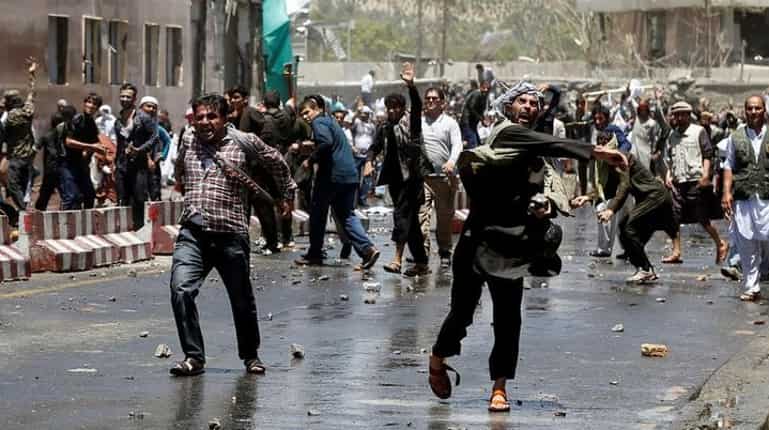
Afghans, Kabul
The increase in attacks in Kabul has brought out other economic grievances. The result of this mix could be more instability and a power vacuum
“We will stay here until the government will grant us our rights. We will stay here for one day, one week, one month or one year, whatever it takes,” says Hangeza Habibia,an Afghan woman in her thirties. She is one of the rare womenfoundinthe protest tents around Kabul.
“Every woman who is willing to protest should come. You see that I am alone now, but normally 30 per cent of the people in this tent are women.”
Demonstrators like Hangezaaskfor increasedsafety inKabul's streets. “We are coming here because in one day we had 600 people murdered or injured. We are coming here to protect our brothers and to avoid that their blood floods the street once again. Who will grant that we are not killed tomorrow? Who will grant that we can stay safe in our houses?”

Demonstrators criticise both President Ashraf Ghani and the Chief Executive Officer (CEO) Abdullah Abdullah, requesting theyeither resign orfire their topmost security advisers.
The May 31 attack whichkilled more than a hundred peopleis where it all started, the sourceof the current boutof political instability throughoutthe city. To make things worse, suicide attackers targeted thefuneral, killing another seven people and injuring 119.
People took to the street to demand more security.
)
Trump bans CNN, MS NOW and Politico from White House over ‘FAKE NEWS’
)
Russia holds first parliamentary elections since the beginning of the Ukraine war
)
Fast bowler Brydon Carse faces no charges over Derby nightclub incident
)
Flying cars in UAE: Ras Al Khaimah signs deal with Chinese company to test new transport
&im=FitAndFill=(700,400))
From Abhishek Sharma to Sahil Chauhan, 5 batters with fastest T20I hundreds
)
Indian Cinema bets big on mythology, brings ancient stories to modern audiences
)
US And Denmark reach Greenland deal, Trump announces expanded military presence
)
Drone strikes cooling tower at Russia's Kursk Nuclear Plant, IAEA confirms
)
‘Will go to any extent’: Pakistan vows to defend Saudi Arabia amid Houthi attacks
)
Trump signs Russia sanctions law: India faces fresh 100% tariff threat over Russian oil
)
How did an Australian river with 500 crocodiles pass the Olympic test? Here's how
)
Ukraine plans record $109 bn defence spending, nearly two thirds of budget amid Russia war
)
India seeks to build a full semiconductor supply chain
)
'Gangsta' crab shoves knife blade at man and his dog in Florida - Watch
)
Pentagon revives mandatory testosterone testing for male troops aged 30 and above
)
Why Ranveer Singh’s Dhurandhar missed India’s Oscar entry; FFI jury member reveals what happened
)
Who is Khalilur Rahman? All you need to know about 81st UN General Assembly President
)
FACT CHECK: Why did PM Modi ask Xi ‘is it okay’ at BRICS Summit? New video reveals...
)
Indian activist-lawyer Prashant Bhushan's post brings focus on ‘conflict of interest’ appointments of ex-govt officials at Reliance, Adani groups
&im=FitAndFill=(700,400))
Meet top 5 bowlers in latest ICC T20I rankings
)
Trump signs Russia sanctions bill into law, targets Moscow’s energy sector
)
Laura Wolvaardt sets new world record for most WT20I runs in a year
)
IIT Bombay student dies by suicide, was caught seeking AI help during exams
)
Former India player Diana Edulji wants Smriti Mandhana to replace Harman as skipper at the earliest
&im=FitAndFill=(700,400))
Meet top 5 Indian batters with fastest T20I centuries
)
Africa is splitting, and a lot sooner than estimated, giving way to a new ocean
)
Godfather of AI Geoffrey Hinton gives US lawmakers a one-year warning on AI
)
China may have gained access to US's classified F-35 jets; parts meant for repairs diverted to Hong Kong, sparking Pentagon inquiry
&im=FitAndFill=(700,400))
New Friday OTT releases (September 18, 2026): Lust Stories 3, You+Me, Best of the Best- 8 new titles coming on Netflix, Prime Video and more
)
Shivakumar attends 79th Kalyana Karnataka Utsav in Kalaburagi
)
Three labourers killed as DU student loses control of his car, rams into them on Dwarka Expressway
)
Trump 2.0: Dark days ahead for America’s ‘imperial presidency’
)
Trump's Greenland dream comes true? POTUS announces 'Infinite Life' deal with Denmark, claims permanent US control
&im=FitAndFill=(700,400))
Meet top 5 batters in the latest ICC T20I Rankings
)
The Verdict | When precision fails: US commits war crime in Minab school strike, UN finds
Police forces reacted aggressively:They started shooting against the crowd.Nine protestors died and many got injured. According to police sources, only two people died and their men started shooting because protesters were carrying weapons and started shooting first.
“The Afghan national police shot against our chests. They killed people during demonstrations and this is why we put up these tents,” says 35-year-old Raheem Mukhtari. He has been part of the protests since the very beginning, and likemany others has no intention ofleaving.
More than security
There are at least six tents across the city where people gather to rally and chant slogans throughout the day. The city’s security is no longerthe sole causeof the protest; the protesters are bonded byamix of anger andfrustration stemming fromthe country’s brutaleconomy, its lowjob prospects and, of course, the increasedviolence.A feeling of mistrust towards the government has always accompanied President Ghani; The recent massive explosion functioned as an ignitor,transforming the general sentiment of mistrust intopermanent protest.
Many political groups and partiesalso feel sidelined, and would be happy to see Ghani’s presidencyend.
“I fought for this country, I spilled my own blood,” shouts a man in his forties from the tent's stage. “And for what? Now, wherever I stamp my foot I only see blood coming out from this soil.”
Several tents displaybanners with a crossed-outpicture of President Ghani.
“We are asking to the government to resign, they did not deliver what they promised during the election and we want them to go. Every day we have martyrs and new killings. We want Abdullah Abdullah and Ghani to resign, we want a temporary government until they organise new elections,” says Ameen Ameni, a 24-year-old demonstrator.
The tents are not very crowded and the protest does not seemcapable of crossing the city’s boundaries.
This does not mean that things are under control though. Kabul is a city full of weapons and informal political militias who are ready, and often willing,to enter in action if requested to. The capitalis not the entire countrybut the crucial power centres are here, and that is where much of the country’s politicaland economicalgame is decided.
Protesters say that they do not belong to any political party, but listening to the many informal conversations in and around the tents, it turns out many of them are sympathisers of the influential political party, Jamiat-e Islami, currently led by the Ministry of Foreign Affairs Salahuddin Rabbani. According to the non-profit research organisation Afghanistan Analyst Network, the party has not yet decided its position onwhether or not they want street riots to end.So far,they have not said or done anything to stop or calm the people.
Givenrecent events, the request for safety and stability is totally legitimate, but the political turn that the protest is taking could become dangerous. The Kabul "tent sit-ins", even if not visibly massive, contain all the ingredients to give rise tocountrywide instability anda power vacuum; Both, possiblythe last two things Afghanistan currently needs.
Watch:
WIONs Daniele Pagani is in Kabul tracking the developments there. He brings this ground report on the mood on the streets of Kabul (WION)
(WION)