NASA's James Webb may have found answers to planets' extreme puffiness around stars

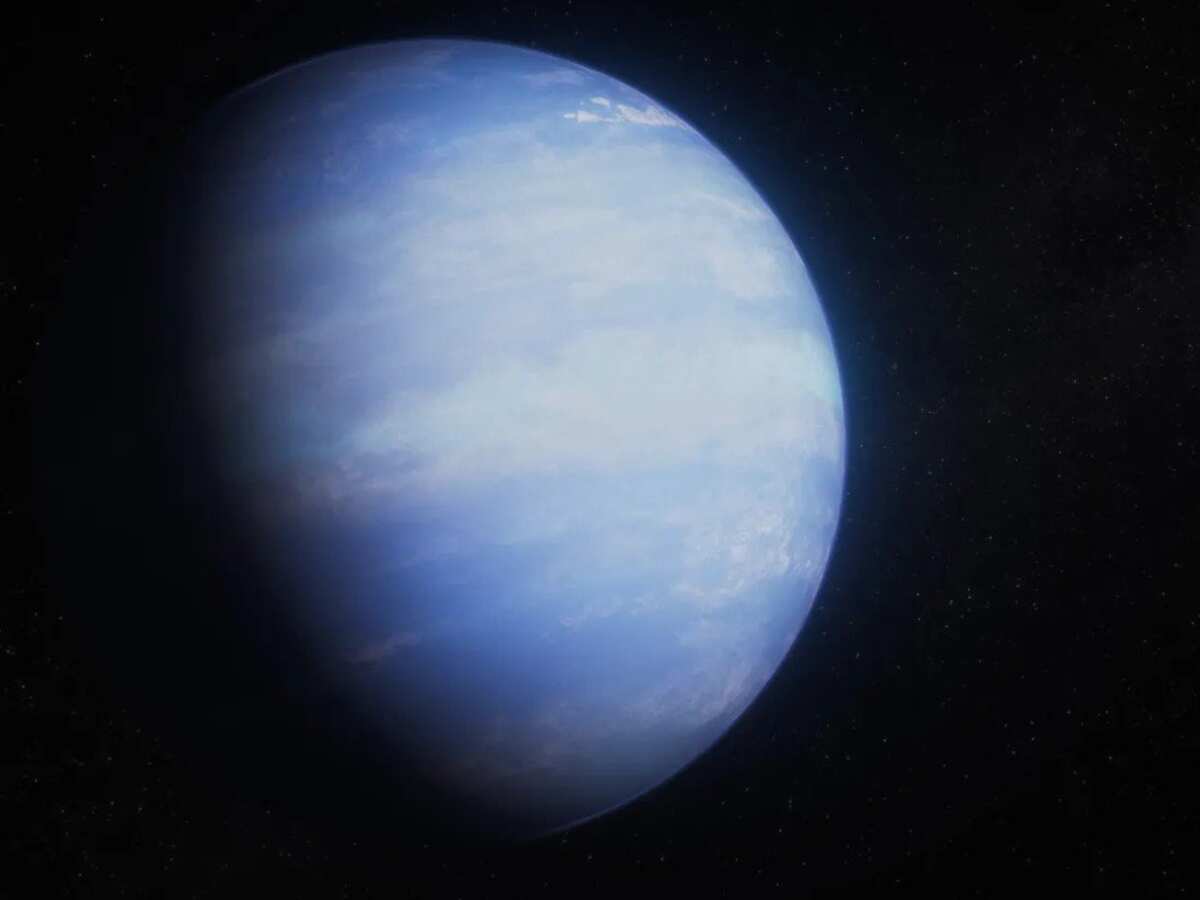
Puffy exoplanet WASP-107 b
NASA’s James Webb Space Telescope (JWST) may have found the answer to why some planets swell at staggering amounts in the presence of a star, a mystery that puzzled scientists when recently they spotted a puffy exoplanet, WASP-107 b.
A surprisingly low reservoir of methane in a planet might unravel the mystery of a planet growing weirdly puffy near a star. The observations made by JWST show that planetary atmospheres can inflate immensely, which defies some of the existing planet formation theories.
"The Webb data tells us that planets like WASP-107 b didn't have to form in some odd way with a super small core and a huge gassy envelope," explains Michael Line, an extrasolar planetologist at Arizona State University.

Also Read |What is ecological grief and how can you help your loved ones cope with it?
"Instead, we can take something more like Neptune, with a lot of rock and not as much gas, just dial up the temperature, and poof it up to look the way it does."
WASP-107 b was discovered in 2017 by the Wide Angle Search for Planets (WASP) consortium, roughly 200 light-years away from Earth in the constellation Virgo. It was found to be the lightest of known exoplanets.
)
‘Kill all in the name of...’: FBI arrests 21-year-old over alleged ISIS-inspired mass-casualty attack plot
)
Space mines, lasers & robotic arms: Lt Gen Pannu decodes US disclosure of weapons in space
)
Bitter Zelensky snubs Trump for playing politics with Ukraine war | Gravitas
)
US fires up to 70 interceptors against Iran attack on Jordan, putting supplies under pressure
)
‘US military task force aiding Saudi Arabia forces with intel, planning support’: Official
)
OpenAI boss Sam Altman repeats AI 'slow down' call, says world 'right to be afraid'
)
Top military commanders from US, Israel, and 7 Arab nations held secret meeting on Iran War
)
Sydney Sweeney defends provocative ad choice, the internet is still not impressed
)
India to host IPL 2027 auction; WPL 2027 auction set for late October in Kochi
)
Shahzad Bhatti Network declared terrorist organisation under UAPA: Govt order
)
'Definitely feel bad for yourself': Kuldeep Yadav opens up on India Test snubs
)
US, China dominate global economy: Where does India rank among the world's biggest economies?
)
Ex-India all-rounder Yuvraj Singh wants India to avoid 'massive changes' before ODI World Cup 2027
)
Ed Sheeran’s US tour loses all support acts after Macklemore’s removal | Controversy explained
)
Ex-England footballer Raheem Sterling pleads guilty in reckless driving and crashing his Lamborghini
)
China's property crisis deepens as investment plunges nearly 20%
)
Alex Saab, ally of Venezuela's Maduro, pleads guilty in US corruption case
)
Messi set to play in farewell match on October 6 in Argentina vs Benin friendly
)
Who was Eliana Moreno? NBC LA aerial reporter killed in Chatsworth crash
)
Putin-linked Russian oligarch, Melania links: Why Trump skipped his son’s Bahamas wedding bash?
)
800 million years old - Scientists discover 'fingerprints' of supercontinent Gondwana in ancient rocks
)
Trump's name cannot return to Kennedy Center, US judge rules
)
Pakistan naval vessel returns to harbour with 'severe damage' after collision with Indian warship in Arabian Sea
)
Water equivalent to two Pacific Oceans could be stashed 2,900 km inside Earth
)
Ex-CIA officer caught with gold bars worth $40 million seeks plea deal | Gravitas
)
Pakistan: Imran Khan's sons Kasim & Sulaiman claim their father is 'tortured' in jail
)
Trump's Iran war faces fresh House rebuke; 7 Republicans join Democrats in push to end conflict ahead of midterms
)
US Treasury yields cross 5% as Scott Bessent warns of ‘global issues’ impacting bonds
&im=FitAndFill=(700,400))
New OTT releases this week (September 14-20, 2026): Lust Stories 3, Waiting Hai, Irumudi- 5 new titles coming on Netflix, Prime Video and more
)
Who is Kalyan Bainsla, accused in the Gurugram hit-and-run case involving woman biker?
)
Saudi Arabia discovers 110 million tonnes of Uranium-rich ore in Madinah region
)
Los Angeles helicopter crash: At least three dead, several injured; NTSB to investigate
)
India summons top Pakistan diplomat after Pak Navy ship collides with Indian warship at high seas
)
Saudi Arabia accuses Houthis of drone attack on Mecca, first-ever red alert in Islam's holiest site sparks panic
)
'Like a thug you are using agency to go after..': Kash Patel grilled by Senate Democrats over FBI firings, journalist investigations and hiring policy
)
Abhishek Sharma rises to No. 2 in T20Is; ENG’s Robinson 3rd after record Pakistan Tests
)
Canada to become EU’s first ‘associate member’? Von der Leyen proposes move amid US tensions
Despite being as large as Jupiter, WASP-107 b weighs just 12 per cent of the planet's mass, which is equivalent to only 30 Earths. For context, one Jupiter mass is equal to about 318 Earth masses. This planet is so puffy, the team says, that its density can be compared to a microwaved marshmallow.
James Webb suspects low methane in planets ascause of their puffiness
The study was conducted on the basis of data from JWST and previous observations from the Hubble Space Telescope- divided among two independent teams.
In a nutshell, the teams discovered that methane in the planet’s atmosphere is 1,000th of what would be expected for the world. As methane is unstable at high temperatures, researchers say the astonishingly low amount of it is evidence that the gas from deep within the planet is “mixing vigorously with cooler layers higher up,” says David Sing of John Hopkins University (JHU) in Maryland, who led one of the two studies.
Also Read |Are fish oil supplements causing more harm to the heart than good?
"The fact that we detected so little, even though we did detect other carbon-bearing molecules, tells us that the interior of the planet must be significantly hotter than we thought."
One thing that could explain this extra heat is the fact that WASP-107 b zips around its star every 5.7 days in an orbit that is not a perfect circle, the researchers say. The star's constant gravitational pull on WASP-107 b, whose distance from its star keeps varying throughout, stretches and contracts the planet’s profile, thereby heating it up. On Earth, a similar force by the moon causes high and low tides.
Also Read |Neanderthal weds Homo sapien: When intermingling shaped human population in Europe
The planet's hot core combined with tidal heating from its star is also changing the chemistry of the gases deep within the planet, Zafar Rustamkulov, who is a graduate student at JHU and a co-author of one of the two new studies, said in a statement. "We think this heat is causing the chemistry of the gases to change, specifically destroying methane and making elevated amounts of carbon dioxide and carbon monoxide."
The planet’s extremely puffy nature helps astronomers look about 50 times deeper into its atmosphere than they can for a world like Jupiter.
This research is described in two studies published Monday (May 20) in the journal Nature.
(With inputs from agencies)