Ode to Russian Nikolai Gogol, the bizarre and beautiful literary master who died on this day in 1852

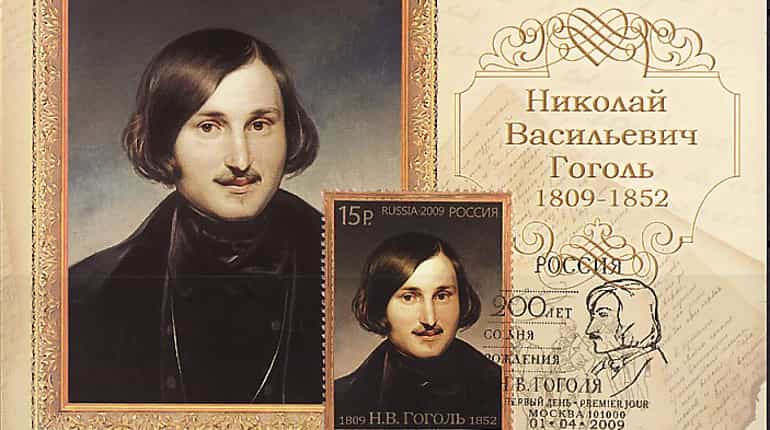
Nikolai Gogol
Famous for weird short stories featuring ghosts and a man who wakes up one day without a nose, it's 'Dead Souls' that will live forever
Nikolai Gogol was a weird, complex writer. Early on, he wrote shortstories about thecountryside that Russians stillread in school today. I haven't bothered reading these because Vladimir Nabokov, who dearly loved Gogol's writing, said they're terrible. The Russian-reading sellerat one of theToronto book stores I cherishagreeswith Nabokov, so I stuckto his later short stories, many of them major masterpieces, and the first part of his immortal novel, Dead Souls.
Dead Soulsis filled with comedy, but the laughs havethe unfortunate side effect of distracting readers from the novel'shidden depths. It is a scathing review of human kind. Gogol's writing contains some of the Antisemitism typical of his time and place, and he had misanthropic tendencies to blast as stupid, crude and unevolved basically theentire world.But his gift is the rare ability to capture in his writing a concept that is only identified by the Russian word,poshlost.Understanding this term is essential to understanding Gogol.
Nabokovdescribesposhlostthusly: "Corny trash, vulgar cliches, Philistinism in all its phases, imitations of imitations, bogus profundities, crude moronic and dishonest pseudo-literature--these are obvious examples."

Thisposhlost excerpt is from an essay Nabokov wrote, which itself overlaps with thebook he wrote onGogol called, fittingly,Nikolai Gogol. The chapter onDead Soulsunpacks theshimmering and radiantposhlost of the protagonist, Mr Chichikov.
What is Dead Soulsactually about?
Chichikov arrives in a minor Russian village to run a scam, but nobody knows that's what he's there to do. He goes aroundsaying whatever is needed to charm whoever he's currently speaking to, meanwhile learning about them, what they possess, and how he can obtainfrom themwhat he wants.
)
AI kill switch explained: Why shutting down a dangerous AI may not be as simple as pressing a button
)
US ships in Indian Ocean ‘will be attacked’ if war resumes, warns Iran
)
SNL UK takes aim at Ed Sheeran with AI Princess Diana sketch
)
Trump says he'll build an 'AI Force' and appoint a czar, for 'high IQ' people only
)
‘0% chance’: Nvidia CEO Jensen Huang dismisses AI extinction fears by 2030
&im=FitAndFill=(700,400))
What TSMC's 2nm technology means for Apple
)
'Were you here to sell chickpeas?': Wasim Akram criticises Babar Azam's captaincy
)
Sikh bus driver assaulted, bus stolen and rammed into cars in England; video surfaces
)
Mark Carney mimics Trump in hilarious moment over C$70 billion clean-energy investment; room erupts in laughter
&im=FitAndFill=(700,400))
Top 10 countries in mathematics: See the world’s best performers in 2026
)
Apple reportedly building AI server with M8 Ultra chips, may use Nvidia technology
)
TIFF 2026: Theja Rio’s Angh wins Platform Prize, puts Nagaland story on global stage
)
BTS' fans question iHeartRadio’s treatment of group after brief festival set
)
Asian Games 2026: India win first medal as women’s 10m air rifle team claims silver
)
Samsung raises Galaxy S26 prices by Rs 20,000: Here’s what each model now costs
)
Bessent meets China’s He Lifeng to prepare for Trump-Xi summit
)
Trump defends AI amid growing alarm, announces new 'AI force' and promises an 'AI czar'
)
S Jaishankar, former Army chief among high-profile names issued Delhi SIR notices
)
Iran sets 7 conditions to end war with US: What are Tehran’s demands?
)
Trump announces ‘AI Force’ as debate grows over AI risks and regulation
)
Arvind Kejriwal, family members, Delhi CM Rekha Gupta get SIR notices
)
AI actress Tilly Norwood glitches mid-interview, switches from English to Chinese | Watch
)
Saudi vs Houthis: Houthis claim missiles & drones used in attack on key Saudi sites
)
Ed Sheeran addresses Macklemore's removal, Gaza conflict during Philadelphia concert: 'I cannot hide how I feel'
)
Saudi Arabia exits China-led mBridge digital currency platform amid Saudi-Houthi conflict
)
'Lot of things to learn from experienced players': Jayasuriya backs Rohit, Virat for 2027 ODI World Cup
)
Chancellor Friedrich Merz vows to stay on as exit polls signal major poll setback
)
North Korea's nuclear tests triggered 1,399 earthquakes: Earth is still shaking | Gravitas
)
Several petrol pumps, other businesses to refuse UPI payments above Rs 2,000 from Oct 16: Is it legal?
)
Kampala-Ankara rift deepens: Uganda suspends military ties, seeks Fred Lumbuye's extradition
)
AUS vs ZIM, 3rd ODI: Ellis stars as Australia edge Zimbabwe by one wicket in last-over thriller
)
West Indies Squad for India Series: Hetmyer included for T20Is, Holder rested
)
China now makes advanced memory chips without the machines it was banned from buying
)
Harry Brook targets long reign at top of T20I rankings after Sri Lanka sweep
)
Trump in ‘deciding mode’ on Iran, says ‘very big things’ going to happen soon
)
Microsoft executive called AI training the ‘largest theft of labour in human history’
)
Munich Mayor taps first keg to kick off Oktoberfest
Chichikov's goal is to buy people'sdead serfs, also known then as "souls". Bureaucratically speaking, a serf who had died in real life but wasn't yet registered in the censusas dead was still alive as far as the state was concerned. Chichikov goes around town acquiring such dead-but-alivepeople. The sellers are confused! Why does this man want to pay real money for peopleno longer alive? The owners of thedead serfs pay taxes until they officiallyregister the deadas dead, but still, their various vices makes them reluctant to pay. Ultimately each negotiation is a dance between the devil, Chichikov, and a lesser and petty provincial devil. Through Chichikov's interactions, which are really negotiations,Gogollambaste's humanity with more richness, variety, and vigour than any writer I've come across. It's hilarious, not without a moral foundation, but the main thing is feeling the esoteric strangeness of the author that can't quite be put into words exceptby him.
The plot is brilliant, yetis not the main feature of the novel. The story itself is a framework through which poshlost is to be exposed and expanded. Revelling in the discrepancy between the character's surface actions and their real motivations, and the interplay between various types of clashing vulgarity posing as if they're dignified,is somehow life-affirming, hilarious, and no other writer I have encountered lays human kind'sfollies so bare.
The question still remains, why does Chichikov want to buy the rights to dead people? Because he'srunning a get-rich-quick scam! His plan is totake out an enormous loan against the deadpeople, who the bank will think are still alive. Except a rumour breaks out among the bumbling country people that, somehow, Chichikovis either Napoleon or a local one-legged bandit (Chichikov has two legs!)and, for good measure, intends to elope with the mayor's daughter. The various follies of the townspeople somehow accumulate,expand, and takeon a life of theirown,becomingthis nonsensical rumour. So the book ends with Chichikov fleeingtown, just like his creator: Gogol had a habit of fleeing to Rome after publishing in Russia.
Socially-minded critics were apt to attribute to Chichikov and the characters he meetsall the vices ofRussian. These criticsare all wrong. Gogol's unique absurdity is intrinsically his, it's not a reflection of the outer world.Plyushkin, Sobochka, Nozydryov, Manilov and the rest all come from Gogol's imagination, and are more incarnations of a certain kindof universal poshlost than the embodiment of somecontemporary country bumpkin.
Myunderstanding is admittedly limited since, tragically, I cannot read the original Russian text. But Nabokov and Henri Troyat and many others reach this conclusion, and it's the interpretationI favour. If people enjoy Gogol despite interpreting his literaturein away I consider wrong, well, there are worse sins in the world.
Dead Soulswas originally meant to be a three-part epic poem.The first part echoesHomer, andthenovel's roundness and its voyage throughhellscapes has some Dante, too.But Gogol died in the middle of writing the second part, and the text ends abruptly.
Typical of Gogol, he wrote the novel,then decided what it was about--the first part was meant to be devilish, and would be redeemed bythe next books. Except Gogol, who was a Christian, believed way more strongly in the Devil than in God. His writing is really only alive when inspired by Satan. God stifled and infected his writing because it wasn't natural to him.
Decades later,there wasn't room in Russia for both God and Tolstoy, so the Russian Orthodox Churchexcommunicated Tolstoy, whotook manyfollowers along, butdied alone in a train station. If this is poetically fitting for the literary giantwho by the end became world famous as anascetic saint to people who hadn't read his tomes, Gogol, thatstrange strange devil who wrote "The Nose",died in Moscow while some monstrous doctordrainedGogol's enormousnose of blood with leecheswhile the great author,hands tied to the bedposts, screamed in protest.
RIP, Nikolai.
(WION)