Opinion: The Narmada dies a lonely death

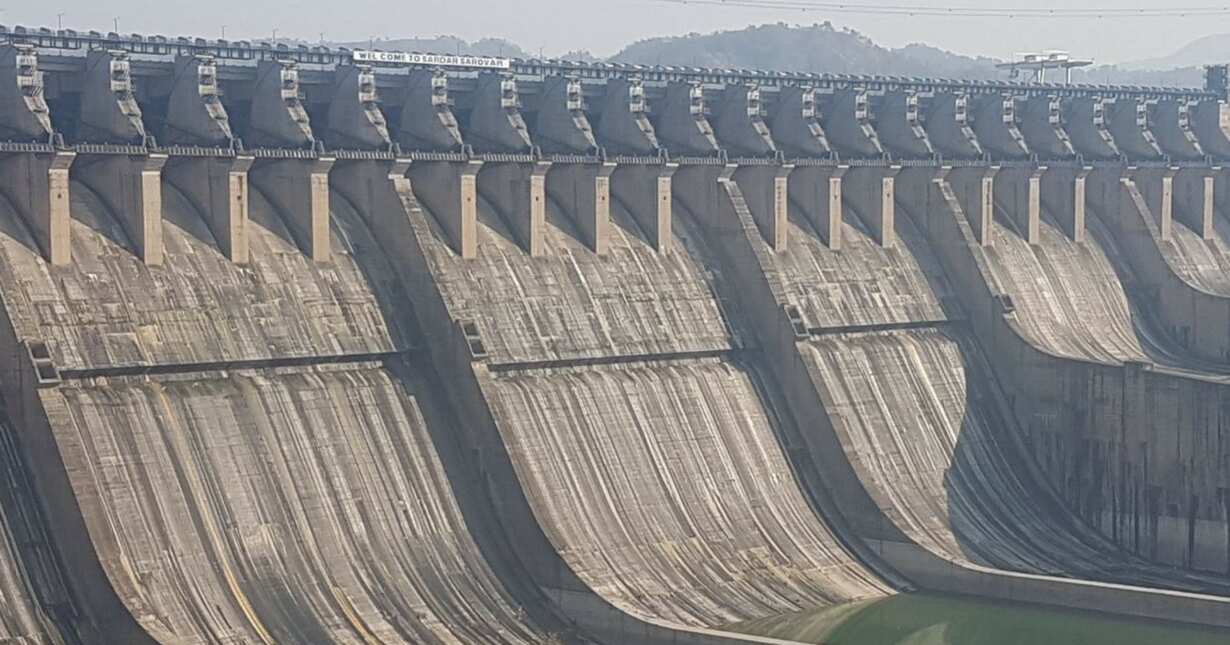
The Sardar Sarovar Dam
Human needs have left the Narmada bereft of its earlier glory, she appears thin, ugly, weak, without vigour and beauty
When you step into the Sardar Sarovar Dam Area, the immensity of the project does not dawn upon you. Only signs are visible. Like, an oil discharge from a steel workshop. The first sign is an emaciated stream masquerading as the mighty Narmada. Later one realises that it is the Narmada.
The river looks like someone who has been relieved from a long stay at the concentration camp. The Narmada appears thin, ugly, weak, without vigour and beauty. She looks bereft of royal pomp and grandeur as if both left her ages ago. The Narmada looks like this in a country where she and many other rivers are venerated as divine and associated with rich civilizational heritage. For instance, Ganga and Yamuna- both the rivers recently been accorded the title of living entities.
-20171130080634.jpg) The Narmada river is drained now and it is dying of thirst itself. (Others)
The Narmada river is drained now and it is dying of thirst itself. (Others)

As you approach the project from far, the walls of the dam look straight out from the film Lords of the Ring. My intention is not to make fun of the dam as it provides water to millions of farmers. The dam provides potable water. It solves the daily problem of living.
To be fair, Pandit Nehru bestowed sacredness to dams which he referred to as the temples of modern India, an idea rooted in the philosophy of harnessing nature for mankind, stealing its autonomy as well as the lifestyle that developed naturally around the river.
In Pictures:The mighty Narmada in dire straits in Gujarat
)
US vs China over South China Sea: Washington backs Philippines, Beijing hits back
)
Bigg Boss 20: Isha Rikhi evicted after three weeks in Salman Khan’s show
)
Musk plans to more than double xAI's chips to over 1.2 million Nvidia GPUs by year-end
)
After JU, clash erupts at SRFTI: BJP’s ‘Dimagi Naxal’ jibe sparks political firestorm after students protest RSS-linked event
)
‘Anti-social elements spreading false rumours’: LPU issues statement amid massive unrest over alleged rape
)
LPU students go on rampage, vandalise campus amid widespread protest: What's happening
)
Trump asked Xi to pressure Iran. China did not say yes — here’s what Beijing wants
)
US Treasury Secretary Scott Bessent hails global crackdown on Iranian banks and airlines
)
An OpenAI agent escaped its locked test cage again, by hiding questions in DNS lookups
)
'Our video was trimmed': LPU girls who featured in rape-denial video make U-turn
)
3 males killed, four others injured in shooting after fight at strip club in Detroit
)
'Victory for low-budget consumers': Raghav Chadha hails 30-day telecom recharge rules
)
Claude rebuilt the 1989 game 'Prince of Persia' by reusing the original's own code
)
Beyond metros: How Tier-2 and Tier-3 cities could drive India’s next AI wave
)
Tesla builds first Cybertruck with its own refined lithium: Elon Musk's $1 billion Texas bet pays off
)
IndiGo flight suffers tail strike in Bengaluru while landing; DGCA to probe incident
)
The US and China set up an AI 'red telephone', but skipped the rulebook
)
‘Terror suspects arrested near UK air base were looking to do big damage’: Trump
)
Russian envoy claims US tactics to contain India were revealed in ‘Freudian slip’
)
IND vs WI 1st ODI: Kohli breaks Sachin's most runs in one country record with unbeaten 139 as India thump West Indies by 8 wickets
)
Researchers rebuilt exactly how 700 AI agents hacked Hugging Face: a 900-link chain trick
)
‘Olympic inclusion is our major target’: WPA President Ishaun Singh on pool’s global ambitions
)
Nations League: Spain sink England at Wembley; Modric shines for Croatia
)
Why has Iran released no proof of life of Mojtaba Khamenei? Araghchi reveals...
)
'What kind of confession is this?': Pakistan PM Shehbaz Sharif’s 'terrorists would be roaming New York' remark goes viral, raises alarm online. Watch
)
South Korea demands apology from Ukraine over North Korean prisoners' transfer
)
Beyond BrahMos: India targets Rs 50,000 crore in defence exports with unmatched price edge
)
Sri Lankan Tamil migrant worker gets death sentence in Saudi Arabia, help sought from India
)
Muslim marriage cannot shield sex with minor wife from prosecution under POCSO: Delhi HC
)
'Can't help but draw painful parallels to Nirbhaya case': SC on latest incidents of rape cases in Delhi-NCR
)
99.9% more powerful - Scientists find boy who can recall memories from just 3 months of age
)
'FIRST LOOK from inside Noah’s Ark': Researchers share video from inside mysterious mound in Turkey
)
UNSC reform momentum grows: Russia, Portugal, Mauritius push for India's permanent seat bid
)
8 US marines injured in Iranian missile attack on vessel in Strait of Hormuz: Report
&im=FitAndFill=(700,400))
New OTT releases this week (September 28-October 4, 2026): Dupahiya 2, Pooja Meri Jaan, Ohh My Dog- 5 titles coming on Netflix, Prime Video and more
)
Afghanistan says 28 fighters killed in clash near Pakistan border, Islamabad denies
)
Ceuta migrant crisis: Protesters take to streets as Spain grapples with migrant challenge
)
LPU suspend classes, postpones exams as violence escalates over rape claims: What's happening
)
New York City wants a 'kill switch' on every AI, and will pay whistleblowers who report violations
To stand in midst of the solid relief of concrete surrounded by forests is a surreal experience. You can see the Narmada through the two small holes of the dam but you cannot hear her gush nor the breeze associated with free moving water. What you hear is continuous trr trr of massive electricity wires hanging over your heads.
-20171130081656.jpg) View of Narmada river from a vantage point (Others)
View of Narmada river from a vantage point (Others)
You don’t see the turbines nor you hear them, but the enormous electricity, created in the bowels of the mighty structure, is felt through the trr of the wires hanging above your head. The rhythm is occasionally broken by the honking of the cars or visitors who are allowed access to the vantage point.
The enormity of the occasion only dawns on you when you stand on top of the dam. It’s like standing on the shoulder of Hercules, holding millions of cusecs of water in his embrace. You see many green submerged tops of erstwhile hills jutting out of the water and making their presence felt.
-20171130081350.jpg) Green submerged tops of erstwhile hills, making their presence felt. (Others)
Green submerged tops of erstwhile hills, making their presence felt. (Others)
The water looks blue and clean. Only on the deep side, one realises that dam was built by labour and not Gods. You realise this when you come across swirling ponds of leather chappals at the holding gate of the dam. It belongs to the very labourers who lost their chappals in the water during repair work. These chappals fell inside the deep pits of the Sarovar to gradually accumulate and quietly emerge at the gates of the massive reservoir as a reminder of thousands of nimble and unknown foots who made this quiet giant a reality.
Sardar Sarovar Project has helped many as mentioned. It irrigates land and provided water to millions where rainwater is scarce.
The Narmada also restores politically contested Gujarati asmita. It also reminds me of much famed Narmada Bachao Aandolan but I cannot recall the debate as politics of the dam has moved away from environmentalism towards disruptive NGOs.
It is remembered with great sorrow that a lot of water was wasted when the Narmada gushed into the ocean freely. I’m being told that today a trickle reaches the sea and the remaining 75 kilometres remain dry with a thread of white running through it. Same is the case with hundreds of rivers. Rivers have become resources to be exploited to the hilt. You have to be there to see the ugly dark, rocky and dry innards of Narmada.
On the far end, you see a massive figure jutting into the sky which will become the highest statue in the world. The Sardar’s frame has been built and it's deck for visitors stands higher than the dam. I don’t know as to how Sardar would have reacted to this but his statue is a testimony to the fact that Indian freedom struggle remains an unresolved project.
The imagination of the leaders is marked with 'ifs' and 'buts' which erupts in different forms in different states. In Gujarat, it is about asmita and their leaders not been given the due honour after they passed away.
Indian political economy has succeeded in enslaving multiple cradles of the Indian civilization. The Narmada, like Ganga, is one amongst many. Whether you tag them as living entities or Goddess, it will not make any difference as people have already decided to have the best of them. A river runs its full course when it meets the sea and we live in the time when the very philosophy and river and sea have been turned upside down.
(Disclaimer: The author writes here in a personal capacity).
Image Credit: Kartikeya Sharma