
&imwidth=800&imheight=600&format=webp&quality=medium "Indian Govt to fund startup aiming to build Methane-LOX rocket engine")
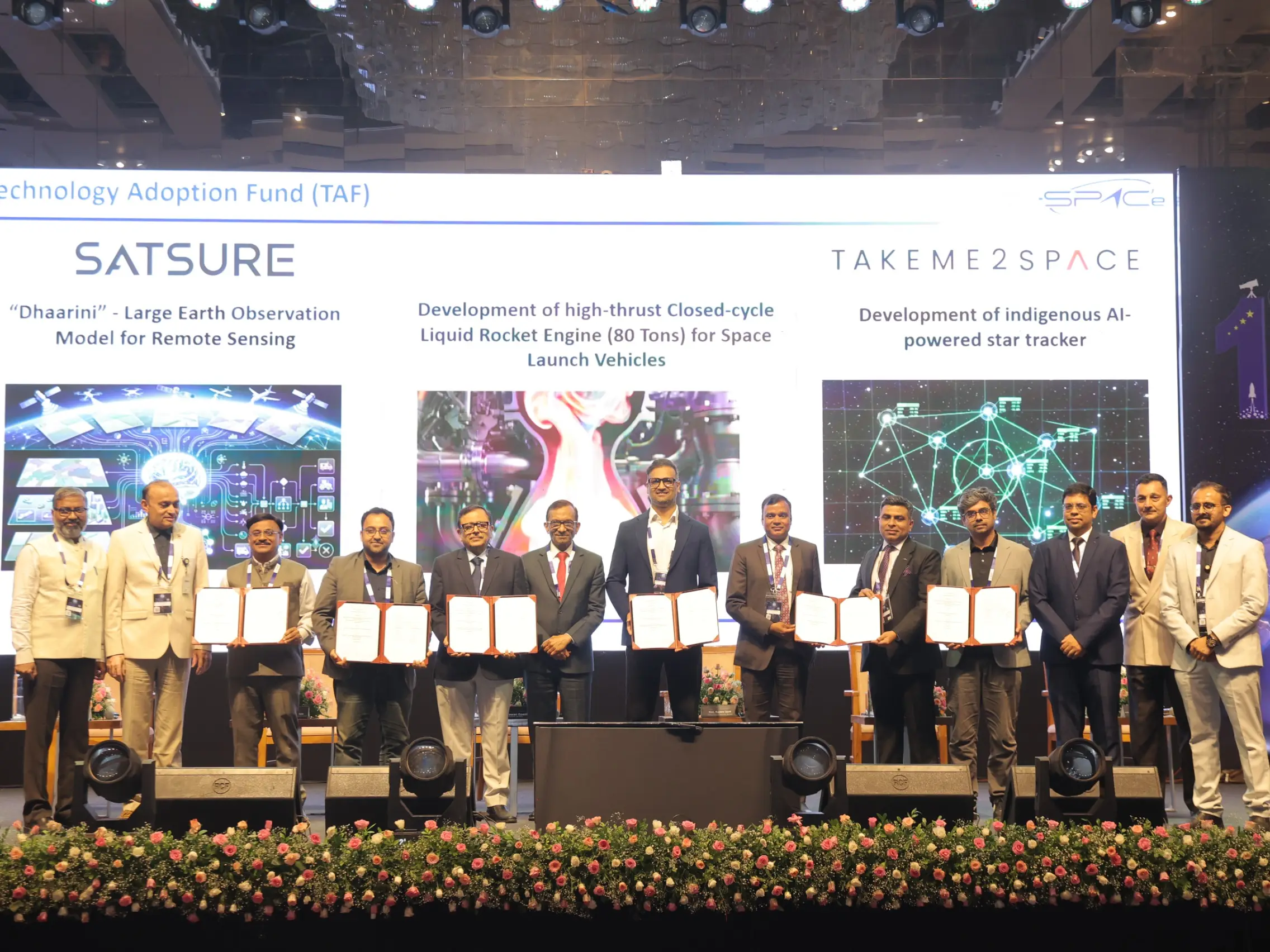
Indian Government agency IN-SPACE announced that it has selected three Indian space startups: Astrobase Space Technologies, SatSure Analytics India and TM2SPACE Technologies, as the first set of entities that would receive funding under its Technology Adoption Fund (TAF) Scheme. The TAF is designed to support Indian industry in absorbing, adapting, and commercialising advanced space technologies, thereby bridging the gap between research and operational deployment.
Among the three firms, Bengaluru-based startup Astrobase Space Technologies is the one with the most ambitious goal, they aim to develop a high-thrust Closed-Cycle Liquid Rocket Engine (delivering 80-ton thrust) for space launch vehicles. The startup aims to develop an 80ton-class reusable Methane-Liquid Oxygen(Methane-LOX) rocket engine with high efficiency, which could potentially serve as a commercial propulsion solution for next-generation rockets.
For context, space agency ISRO's most powerful and mainstay operational rocket engine, the Indo-French Vikas engine also delivers about 80-tons of thrust. While the 1970-era Vikas engine is propelled by a toxic combination of Unsymmetric Dimethyl Hydrazine(UDMH) and Nitrogen Tetroxide, the engine being developed by Astrobase is meant to be propelled by relatively clean fuels Methane and Liquid oxygen. The Methane-LoX combination is what powers the SpaceX Raptor engine, which delivers over 280tons of thrust. Indian space agency ISRO is also working on a Methane-Lox engine producing 110-tons of thrust.

IN-SPACE would also be funding Bengaluru-based space analytics company SatSure Analytics India, which is developing Dhaarini, a Large Earth Observation Model (LOM) designed to serve as India's foundational AI platform for remote sensing applications. Trained on diverse satellite and aerial datasets, the model is meant to generate actionable insights across agriculture, infrastructure, and disaster management, enabling data-driven decision-making at a national scale.
Hyderabad-based TM2SPACE Technologies will receive Government funding to develop an indigenous AI-powered star tracker system for satellites, enabling the pointing accuracy required for high-resolution imaging and communication missions. The project will develop StarSense Lite for CubeSats and StarSense Pro for satellites above 50 kg, delivering high-precision attitude determination through advanced optics, electronics, and onboard algorithms.
While the quantum of funding and the timeline for technology development have not been revealed, IN-SPACE said that these three firms were chosen based on a multi-stage evaluation process conducted by an expert committee comprising members from ISRO, the Department for Promotion of Industry and Internal Trade (DPIIT), the Department of Science and Technology (DST), industry, academia. IN-SPACE said it will provide continued technical guidance, monitoring, and milestone-linked disbursement of funds to ensure successful implementation of the selected projects.
Trending Stories
)
All Indian goods to get duty-free access to New Zealand
)
Veteran actor Anant Nag honoured with Indian cinema’s highest award
)
Trump backs PM Modi’s anti-opium push even as India remains on US illicit drug-producing list
)
Who was Eliana Moreno? NBC LA aerial reporter killed in Chatsworth crash
)
Extreme warming in Indian Ocean added 695 billion tons of ice to Antarctica ice sheet
)
Pakistan naval vessel returns to harbour with 'severe damage' after collision with Indian warship in Arabian Sea
)
800 million years old - Scientists discover 'fingerprints' of supercontinent Gondwana in ancient rocks
)
Sydney Sweeney defends provocative ad choice, the internet is still not impressed
)
Daayra movie review: Kareena Kapoor, Prithviraj Sukumaran shine in Meghna Gulzar’s cop-versus-cop crime thriller
)
War will be ‘completely different and very short’ if Europe attacks Russia, warns Lavrov
)
US Treasury rallies global financial institutions for Op Economic Outcast to isolate Iran
)
Trump's Iran war faces fresh House rebuke; 7 Republicans join Democrats in push to end conflict ahead of midterms
&im=FitAndFill=(700,400))
Suriya and Jyothika say ‘I do’ again after 20 years! See their dreamy wedding pics
)
Shahzad Bhatti Network declared terrorist organisation under UAPA: Govt order
)
Fed raises rates for first time in 3 years, Kevin Warsh defies Trump as inflation mounts
)
Meghan Markle's phone number leaked from children's WhatsApp group, couple switches Archie and Lilibet's school
)
PNS Hunain: All you need to know about Pakistani vessel that hit Indian Navy warship
)
Abhishek Sharma rises to No. 2 in T20Is; ENG’s Robinson 3rd after record Pakistan Tests
)
Finnish president Stubb calls Trump 'good for NATO' as allies increase defense expenditure
)
Hockey: Pakistan urges AHF to move Asian Champions Trophy out of India over security concerns
)
Ex-CIA officer caught with gold bars worth $40 million seeks plea deal | Gravitas
&im=FitAndFill=(700,400))
New OTT releases this week (September 14-20, 2026): Lust Stories 3, Waiting Hai, Irumudi- 5 new titles coming on Netflix, Prime Video and more
)
Lionel Messi for 2026 Ballon d’Or over Mbappe and Yamal, says Diego Simeone
)
FBI Director Kash Patel grilled over change of hiring rules on bestiality
)
At least 20 killed after war-damaged apartment building collapses in Gaza; rescuers search for survivors
)
US, China dominate global economy: Where does India rank among the world's biggest economies?
)
Bigg Boss 20: Mahhi Vij reveals she lost Yuva role to Kareena Kapoor; 'didn’t work out in my favour'
)
What is Article 10 of the 1991 treaty at the centre of Pakistan Navy's 'unprofessional conduct'
)
No Pandya as Auqib Nabi earns maiden ODI call-up; Mayank returns for WI T20Is| check full squads
)
Pakistan: Imran Khan's sons Kasim & Sulaiman claim their father is 'tortured' in jail
)
BRICS success stuns White House, Trump targets India with 100% tariff | Gravitas
)
The Early Spring season 2 is happening, but fans have one request - 'don't change the actors'
)
Alex Saab, ally of Venezuela's Maduro, pleads guilty in US corruption case
)
Saudi vs Houthis: Riyadh claims to have shot Houthi drone targeting Mecca
)
Riyadh warns of ‘red line’ after Mecca targeted; Houthis claim downing Saudi fighter jet – What’s happening?
“The selection of these projects under the Technology Adoption Fund (TAF) marks a pivotal step in our mission to transform Indian private entities into global space leaders. With this fund, our vision is to bridge the critical gap between early-stage development and commercial success. By offering this financial support, we are empowering the private sector to work on cutting-edge space technologies. These projects are not just innovative concepts; they are practical, market-ready solutions that will increase our footprint in the global space economy," said Dr. Pawan Goenka, Chairman, IN-SPACE.
