EXPLAINED | Chandrayaan-3's landing site is named Shiv Shakti. Here's how these points are named

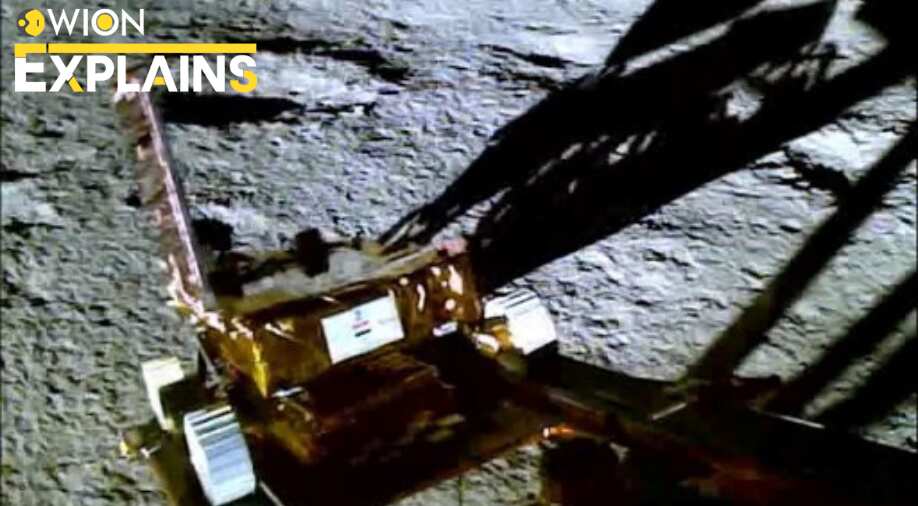
Who names the landing sites on the moon
Chandrayaan-3 'Shiv Shakti': After the successful landing of Chandrayaan-3 on the Moon's south pole on August 23, Indian Prime Minister Narendra Modi on Saturday (August 26) announced that the landing point will be called "Shiv Shakti".He added that there was also a discussion over naming the point where Chandrayaan-2 crashed in 2019 and the point has been named "Tiranga".
The announcements were made when Prime Minister Modi was at the Indian Space Research Organisation (ISRO) headquarters in Bengaluru, where he congratulated the scientists who contributed to the moon mission's success.
Also read |After moon, ISRO aims for the Sun with its Aditya-L1 mission. Launch due in September | Check details
During a press address, ISRO Chief K Somnath said, "The country has every right to name the landing site. The naming of the landing site is not the first incident. Several Indian names are already there on the Moon. We have a Sarabhai crater on the Moon. Other countries have also named places related to their scientific accomplishment. All places related to even minor experiments would be named. That is a tradition."

However, it is to be noted that the "Moon" does not come under any jurisdiction. Why? It is because of the Moon Treaty. What is it and what are its rules, here we explain.
WATCH |PM Modi salutes ISRO scientists: India celebrates Chandrayaan-3's success
&imwidth=180&imheight=135&format=webp&quality=medium)
'My name has always been Ilhan Omar': Congresswoman hits back at Trump, calls him a 'creep'
&imwidth=180&imheight=135&format=webp&quality=medium)
Gravitas | US attack could trigger WW III: Russian planes in Tehran, Israeli jets, US warships in action
&imwidth=180&imheight=135&format=webp&quality=medium)
Viral video shows cross falling on Colombia priest, no official confirmation | WATCH
&imwidth=180&imheight=135&format=webp&quality=medium)
US Navy, Marine Corps boards defy Trump's transgender military ban, vote to retain troops
&imwidth=180&imheight=135&format=webp&quality=medium)
Will the US attack Iran this weekend? Trump's envoy says, 'absolutely'
&imwidth=180&imheight=135&format=webp&quality=medium)
Fauzi teaser out: Prabhas takes on the British Empire in patriotic avatar | Watch
&imwidth=180&imheight=135&format=webp&quality=medium)
India-China face-off continues near Arunachal’s Taksing, reveals ITBP chief in first official confirmation of tensions
&imwidth=180&imheight=135&format=webp&quality=medium)
Nairobi building collapse: Several feared trapped after 16-storey structure crumbles; rescue operation underway
&imwidth=180&imheight=135&format=webp&quality=medium)
Pakistan airline PIA unveils new crew uniforms, faces online criticism
&imwidth=180&imheight=135&format=webp&quality=medium)
Did Neha Bora call for Bangladesh-like GenZ protest, 'anarchy' in India? WION Fact-checks viral claim
&imwidth=180&imheight=135&format=webp&quality=medium)
'Already tired of his 9-to-5': Baby born with a moustache becomes internet sensation, video goes viral | Watch
&imwidth=180&imheight=135&format=webp&quality=medium)
Horrific video shows the moment 18-year-old fell to her death from Mexico amusement park ride
&imwidth=180&imheight=135&format=webp&quality=medium)
'Black triangle' UFO flying at 1,800mph spotted over sensitive US site: Latest Trump admin UFO file dump
&imwidth=180&imheight=135&format=webp&quality=medium)
IND-W vs ZIM-W, 1st ODI: Rawal, Charani star in India’s nine-wicket win over Zimbabwe
&imwidth=180&imheight=135&format=webp&quality=medium)
Massive 7.2 magnitude quake off Vanuatu triggers tsunami warning for coasts within 300 km
&imwidth=180&imheight=135&format=webp&quality=medium)
French Open: PV Sindhu storms into final with win over Hina Akechi
&imwidth=180&imheight=135&format=webp&quality=medium)
Google Fitbit Air’s new health guardian feature tracks trends: How it works
&imwidth=180&imheight=135&format=webp&quality=medium)
US midterms 2026: Trump revises Canada tariffs as Susan Collins faces tight re-election race in Maine
&imwidth=180&imheight=135&format=webp&quality=medium)
US midterms 2026: Viral video claims Lindsey Graham paid underage men for sex; clip released weeks before his sister's Senate race
&imwidth=180&imheight=135&format=webp&quality=medium)
IND vs NZ 2nd T20I: Shreyas Iyer on brink of breaking Rohit Sharma’s record
&imwidth=180&imheight=135&format=webp&quality=medium)
AI deepfakes are spreading online: Why is removing them so difficult?
&imwidth=180&imheight=135&format=webp&quality=medium)
China's dancing robot turns violent bodyguard, lifts cars and fights intruders - Watch
&imwidth=180&imheight=135&format=webp&quality=medium)
Global cybersecurity alert: PHP flaws trigger website shutdowns as hack attempts surge into millions
&imwidth=180&imheight=135&format=webp&quality=medium)
'You’re a horrible little reporter, aren’t you?': Trump snaps at NBC reporter questioning his support for Ramaswamy's campaign ad
&imwidth=180&imheight=135&format=webp&quality=medium)
Chemical warehouse explosion in Mexico: Several injured in multiple blasts, 1,000 evacuated in León
&imwidth=180&imheight=135&format=webp&quality=medium)
US charges two former FBI officials with lying to Congress about Hunter Biden probes. 'Politically motivated' Trump grievance or something else?
&im=FitAndFill=(700,400)&imwidth=180&imheight=135&format=webp&quality=medium)
How smart robots and AI assemble vehicles in 20 hours
&im=FitAndFill=(700,400)&imwidth=180&imheight=135&format=webp&quality=medium)
New Friday OTT releases (October 23, 2026): Gajab Raat, Dorothy, Chaar Yaar- Watch these 6 new movies and TV shows on Netflix, Prime Video and more
&imwidth=180&imheight=135&format=webp&quality=medium)
Anthropic security chief issues grim cyberattack warning: ‘It’s going to get a lot worse’
&imwidth=180&imheight=135&format=webp&quality=medium)
Tu Hai Meri Kiran film review: Sonakshi Sinha and Zaheer Iqbal's thriller gets tangled in its own twists
&imwidth=180&imheight=135&format=webp&quality=medium)
First Lady Melania Trump secures ceasefire between Russia, Ukraine in Oleshky: White House
&imwidth=180&imheight=135&format=webp&quality=medium)
Negotiators from Ukraine, Russia, United States to meet in Abu Dhabi: Zelensky
&imwidth=180&imheight=135&format=webp&quality=medium)
Farooq Abdullah says Pakistan’s raising of Kashmir issue keeps pressure on Delhi
&imwidth=180&imheight=135&format=webp&quality=medium)
Emmanuel Macron calls Paris suburb shooting a 'racist terrorist attack' after one killed, several injured
Why can no one own the Moon?
The Moon Treaty or the Outer Space Treaty was signed during the Cold War era, whose primary objective is "to provide the necessary legal principles for governing the behaviour of states, international organisations, and individuals who explore celestial bodies other than Earth, as well as administration of the resources that exploration may yield."
However, Article 2 of the Treaty states, "Outer space, including the moon and other celestial bodies, is not subject to national appropriation by claim of sovereignty, by means of use or occupation, or by any other means." In simple words, this means that the countries have to cooperate in their space exploration activities and cannot stake a claim to the Moon.
Who names the landing sites on the Moon?
The International Astronomical Union (IAU) founded in 1919 is the nodal body to standardise the nomenclature of celestial objects. Its tasks involve forcing an executive committee, divisions, commissions and working groups that comprise astronomers from across the world.
On naming the space surfaces, it says, "When the first images of the surface of a planet or satellite are obtained, new themes for naming features are chosen and names of a few important features are proposed, usually by the appropriate IAU Task Group in collaboration with the mission team."
"As higher resolution images and maps become available, names for additional features may be requested by investigators mapping or describing specific surfaces or geological formations."
After following the protocols, the IAU’s Working Group for Planetary System Nomenclature (WGPSN) approves the proposed names and posts them on its website. Objections to the names can be raised by mailing the IAU General Secretary within three months.
However, this process can take some time. For example, China’s Moon mission Chang’e 5 landed on the lunar surface on 1 December 2020. The landing site was named Statio Titanchuan. The name was approved by the IAU in May 2021.
What are the norms for naming the sites?
The IAU made some suggestions while proposing the names. It stated that for planetary objects, the names should be simple, clear, unambiguous and should not copy existing names.
"No names having political, military or religious significance may be used, except for names of political figures prior to the 19th century."
"Commemoration of persons on planetary bodies should not normally be a goal in itself, but may be employed in special circumstances… Persons being so honoured must have been deceased for at least three years, before a proposal may be submitted."
Has India ever named sites on the Moon?
The answer to this question is yes. Before Chandrayaan-3 and 2, India named a site on the Moon. In 2008, following the Chandrayaan-1 probe that crashed, the spot was named “Jawahr Sthal” after the first Prime Minister of independent India Jawaharlal Nehru.
All eyes are on ISRO's Pragyaan rover which is on a 14-day exploration of the lunar surface. The rover will collect information and send it to the space agency. Notably, India has created history by becoming the first country to land a probe on the far side of the Moon.
(With inputs from agencies)
WATCH WION LIVE HERE
You can now write for wionews.com and be a part of the community. Share your stories and opinions with us here.