Does this terracotta tablet from around 1000 BCE depict Lord Krishna and Arjuna ?

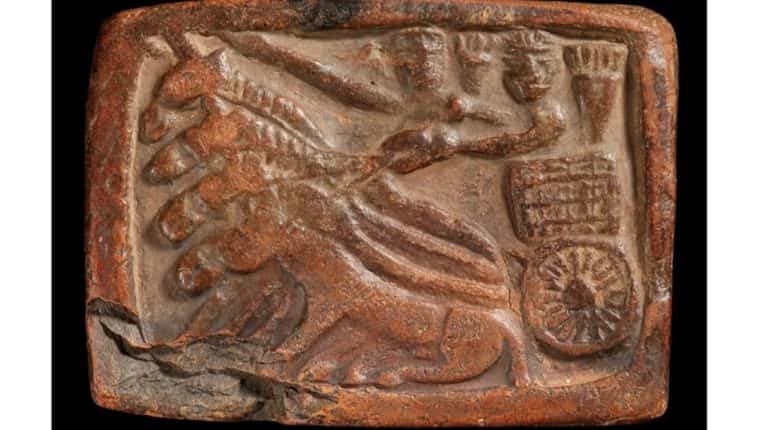
Terracotta tablet. Image courtesy: CP Ramaswami Aiyar Foundation
A 9-cm wide terracotta artefact lies in Hong Kong, in the possession of an art dealer, but the inferences and interpretations from it could possibly lead to interesting revelations about the time period of the Indian epic Mahabharata and its occurrence.
The tablet depicts a man holding four horses, standing on the back of a half chariot with a spoked wheel. There are two figures in the chariot, one who is presumably the charioteer, while another has his hand pointed in a direction. Both the figures in the chariot have quivers that contain arrows.
Curious to know more about the tablet, Jeremy Pine, the owner had sent a picture of it toDrNanditha Krishna, CPR Institute of Indological Research and requested her to share her interpretations of the same and its historical significance.DrNanditha along with other historians and domain experts had studied the image and historical texts to draw inferences.

According to a document shared with the media, the tabled is said to have been authenticated by Oxford Authentication using Thermoluminescence (TL testing) on May 142019. Its resultstates that the terracotta was fired between 2300 and 3600 years ago iebetween 1600 to 300BCE.
This date corresponds to the late Indus Valley Culture (1500 BCE) and the historical period (600 BCE), a period known as the Painted Grey Ware Culture, an Iron Age Culture of North India lasting roughly from 1200 BCE to 600 BCE. According to “The Painted Grey Ware Culture of the Iron Age” by BBLal, the period has been associated with the settlements at Hastinapura and the fivevillages which the Pandavas had requestedfrom the Kauravas in the epic Mahabharata.
DrNanditha Krishna, based on her four-month study and interpretation of the images of the terracotta told WION, “We see four horses in a war chariot, the art of managing horses was fairly well developed by this time, till now we do not have horses belonging to 1000BC, we don’t see horses in any kind of art. It has a spoked wheel, which is described in the Rig Veda, which means that the Mahabharata also uses the same spoked wheel. All these inferences link it to the Mahabharata age.”
)
Did India risk its US trade deal despite softer stance at BRICS?
)
Pakistan puts Pak Rs 70 lakh bounty on UN terrorist Masood Azhar; move draws skepticism in Delhi
)
First naval drone battle? Ukraine says Sargan 3000 sank Russian unmanned boat
)
Practical Magic 2 breaks Spidey spell over North American box office
)
'Huge destructive power': North Korea calls its latest missile launches 'live-fire drill' even as US dismisses 'immediate threat'
)
‘Let’s go’: Newly declassified videos show dramatic rescue of US Air Force officers downed in Iran
)
Delhi’s balancing act: BRICS serves as a stage for West Asia diplomacy
&im=FitAndFill=(700,400))
Why European Meteor missiles use ramjet engines compared to standard US solid rockets
)
Iran, India agree to deepen humanitarian and political ties, President Pezeshkian says
)
‘Want to reset ties with India, have engagement based on mutual interests,’ says Bangladesh minister
)
Trump says Canada eager to reach a deal, it could come ‘fairly soon’ if Ottawa treats US farmers better
)
Turkish Airlines plane flies through a storm three times, triggering severe turbulence
&im=FitAndFill=(700,400))
Why Chinese PL-15 air-to-air missiles use dual-pulse motors compared to European interceptors
)
Orlando Bloom addresses Pirates of the Caribbean comeback and reunion with Johnny Depp
)
China thinned Himalayan troop presence in 2025, India defence report says; terms border situation 'stable'
)
800 million years old - Scientists discover 'fingerprints' of supercontinent Gondwana in ancient rocks
)
Russia proposes to build 360 kmph Ivolga FG trains in India: What happened on sidelines of BRICS
)
Israeli minister calls to strip Gaza film directors of citizenship
)
'Nobody knows if it can be in control': ‘Godfather’ of AI, China spy chief back AI slowdown calls, flags political threat
)
China discovers vast gold and silver 'mine' in the Pacific with unheard-of deposits
)
Russian drone hits Warsaw-bound train near Polish border, Zelensky accuses Moscow of ‘deliberate’ targeting
)
War is making Russia stronger? How Ukraine is shaping Moscow’s next generation of weapons
)
Plane carrying prominent figure crashes at Libya’s Misrata airport: Report
)
Veteran Bollywood actress Nafisa Ali shares health update as Stage 4 cancer progresses, starts targeted therapy
)
NEET-UG to move to computer-based test soon, NTA DG says ‘CBT is the future’
)
Woman removes all her clothes on American Airlines flight, performs 'indecent acts'; arrested
)
Liam Neeson sparks romance rumours after holding hands with Stella Stocker at TIFF 2026
&im=FitAndFill=(700,400))
New OTT releases this week (September 14-20, 2026): Lust Stories 3, Waiting Hai, Irumudi- 5 new titles coming on Netflix, Prime Video and more
)
Indian importers urge Bangladesh to lift export ban on 'Hilsa' fish ahead of Durga Puja
)
Video of Pakistani lawmaker struggling to read English tribute to Jinnah goes viral - WATCH
)
Did China give Iran intel before US base strike that killed 3 troops? Trump says, 'You’re right...'
)
Crude oil prices jump more than $107 per barrel following Houthi attacks on Saudi
)
Women's Asia Cup 2026: India denied trophy once again despite winning the title
)
Humans may lose control of AI: Anthropic CEO calls for slowdown, Altman, Musk back him

Speaking of the possible identity of the two men on the chariot, she said, “Many people in the Mahabharata are said to have driven four-horse chariots, but only Arjuna’s four horses are given specific names and have an identity of their own. When I saw it, the first thing I thought was - this is Krishna and Arjuna. The general picture of ‘Gitopadesham’ is that of Krishna holding the horses and Arjuna pointing to his grandfather and his cousins and refusing to fight them.”
However, the observations also note that since Krishna chose not to fight, so the second quiver of arrows could not belong to him. One of the reasons stated is that Arjuna- the world’s greatest archer, may need more than one quiver of arrows for a day of battle.
Another possibility is thatwhen Arjuna asks Krishna what he would do if Arjuna is killed in battle, Krishna says, “maybe the fire will become cold, but if it happens, I will take up my weapons and kill Karna and Salya”. So, maybe Krishna had his weapons with him “just in case”.
According to the observations, if the two figures are Arjuna and Krishna as suggested, this would be the earliest available portrayal of the ‘Gitopadesham’ scene of the Bhagwad Gita, going back to about 1000 BCE. The two figures are also seenwearing Harappa-style headbands. Thus raiding the question of whether the Mahabharata extended into the late Harappan period.
What makes it even more interesting is thatthis observation, if true, would place the Bhagawad Gita and Mahabharata in a much earlier period than generally accepted.
The chariot in the terracotta tablet is said to be similar to a half-chariot that was excavated from Sanauli in Uttar Pradesh’s Baghpat District. The find is said to be dated back to around 2000-1800 BCE. Baghpat is said to be one of the five villages demanded by the Pandavas. However, the major difference remains that the Sanauli wheel is solid, whereas the terracotta tablet depicts a spoked wheel.
“I have no doubt personally that this is Krishna and Arjuna, but I will agree with anyone who says that there is no inscription that says so. But why would you just have two people - one driving the chariot and another pointing in one direction, that’s only the ‘Gitopadesham’. Which makes the ‘Gitopadesham’, just on the basis of this tablet, a minimum of 1000BCE“, DrNanditha Krishna told WION.