Data Lab | India’s Supreme Court gives nod to abortion, regardless of marital status

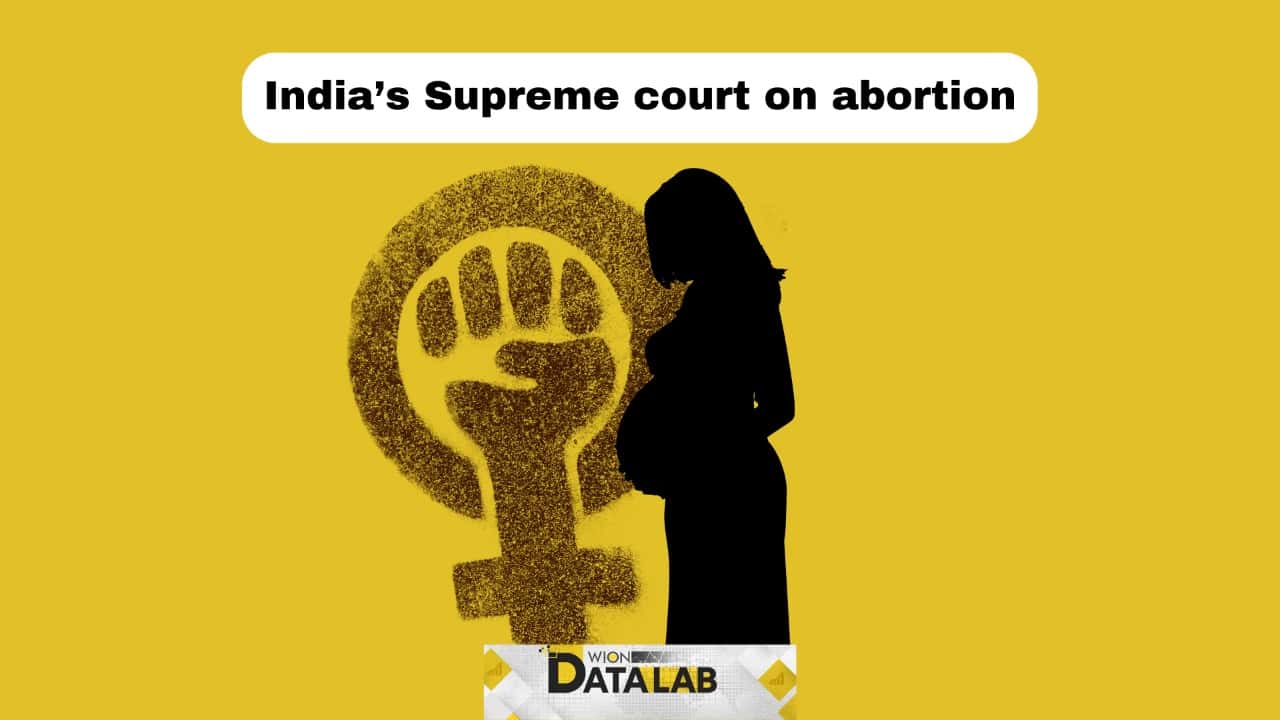
India’s Supreme court legalises abortion regardless of marital status
Only a few weeks after the United States Supreme Court issued a contentious ruling allowing individual states to outright ban or severely restrict the ability of pregnant women to seek abortions, news of a similar case made headlines in India.
The 1973 Roe v. Wade decision was overturned in the US, which was seen as "a massive step back for women's rights," while Thursday's verdict by the Indian Supreme Court is being welcomed as "historic" and "a big stride ahead" for women's rights.
The Indian apex courtsaid that all women, even those who are not married and those who are not cisgender women, have equal rights to abortion, which is undoubtedly progressive in a nation where 73 million unmarried women reside.

Abortion statistics in India
)
Justice eludes Air India 1985 bombing victims as Canada probe goes 'inactive' | Gravitas
)
Trump revives India-Middle East-Europe economic corridor as India emerges central to West Asia’s future: What is it?
)
Erdogan again raises Kashmir issue at UNGA, calls for dialogue under UN Charter
)
Major League Soccer referee sacked for sexist comment about female match referee
)
Trump signs Greenland security deal with Denmark, paving way for two new US military bases
)
IND vs JPN T20I: How an overturned wide became point of difference between India's win and a tie
)
Trump-Xi summit: From trade to Taiwan, what will the US and Chinese presidents discuss in Washington?
)
Cyclone Arnab: Landfall expected before midnight tomorrow as IMD issues orange alerts across six states
)
ICC plans T20I expansion and fewer ODIs in 2027–2031 FTP cycle: Report
)
US-China tech war: Businesses in the front line
)
'Mumma’s boy from Gwalior who dared to dream': Kartik Aaryan pens long note after first National Award win
)
Gravitas | Boosting NHS productivity could save 20,600 lives in UK annually: Report
)
Nor'easter could batter 13 US states this week. What you should know
)
US and China vie for AI dominance as calls grow for regulation | Gravitas
)
Yemen clashes kill 154 people in two days as cornered Saudi battles Houthi offensive | Gravitas
)
Bomb scare in New York amid UNGA: Suspicious suitcase found near UN headquarters
)
IND vs JPN, one-off T20I: Japan captain Kendel on pushing India to the brink - ‘It was special’
)
Mikel Arteta verbally agrees to three-year extension with Arsenal after title-winning Premier League season
)
WION Iconic Tourism Summit and Awards 2026: Key voices to discuss India’s tourism future
)
WION Iconic Tourism Summit and Iconic Awards 2026: India's travel economy leaders gather in Delhi
&im=FitAndFill=(700,400))
New OTT releases this week (September 21-27, 2026): Shaque: Trust No One, Hunkkaar, Don’t Be Shy- 5 new titles coming to Netflix, Prime Video and more
)
81st UN General Assembly: Burnham announces UK-US AI defence tie-up
)
Trump calls on nations to quit ‘rogue’ and ‘out-of-control’ International Criminal Court, rips UN
)
Infections transmitted from pregnant woman linked to autism risk
)
'What kind of confession is this?': Pakistan PM Shehbaz Sharif’s 'terrorists would be roaming New York' remark goes viral, raises alarm online. Watch
)
Elephants hide behind trees, stage surprise attack on poachers targeting rhinos in South Africa
)
IIT Bombay professor Suryanarayana Doolla sent on leave amid Sahil Wakode death probe
&im=FitAndFill=(700,400))
National Film Awards 2026: Kartik Aaryan, Mammootty, Yami Gautam, Randeep Hooda and other key winners
)
El Niño 2026 heats up to become strongest in 1,000 years
)
Anne Hathaway to run in supporting race for Nolan's epic
)
Over 4,200 books withdrawn from circulation in J&K colleges, 94% from Kashmir
)
From Gaddafi tearing up UN Charter to Trump’s ‘escalatorgate’: Most unforgettable UNGA moments
)
Explainer: Why rare-earth export licences and Board of Trade are US priorities ahead of Trump-Xi summit
)
Asia prepares for record El Nino, food shock
)
Forget apps: Qualcomm CEO says AI agents will change how we use smartphones
)
Four female students raped during 'Red Zone' at California university. What we know
The decision was made in response to a petition filedin July by a 25-year-old single woman who had been in a consenting relationship and was 22 weeks pregnant.
The woman claimed that carrying an unborn child would expose her to "social stigma and persecution" asher partner had abruptly declined to marry her.
She also claimed that because she didn't have a career and didn't come from a wealthy household, she couldn't afford to raise a child and that she wasn't psychologically ready to do so. After the Delhi High Court denied her request for an abortion, the woman went to the top court.
The regulations were so strict that even survivors of rape, including minors who were unaware of their pregnancy, had to go to court to request authorisation to end a pregnancy if it was found after 20 weeks.
The case of ‘bodily autonomy’
The Indian court said that a woman's right to bodily autonomy and the freedom to determine the course of her own life lay "firmly rooted" in the decision of whether to carry a pregnancy to term or end it. It said that an unintended pregnancy could negatively impact a woman's entire life "by interrupting her education, her career, or affecting her mental well-being."
The court further stated that single women's exclusion would encourage them to seek unsafe abortions, which kill a startling number of women in India. The UN Population Fund estimates that every day in the nation, some eight women pass away due to complications from unsafe abortions.
Single women have sex too. Period.
Women's rights advocates from all over India have applauded the decision, and a reading of the verdict demonstrates why it is crucial on a number of levels.
In addition to granting all women the same rights and freedoms, the court also recognised that single women can have relationships that involve sex. This is a fairly novel idea in a country with a strongly patriarchal culture where women have little sexual autonomy, premarital sex is frowned upon, and some communities even require brides to take a humiliating "virginity test" to prove that they are "virgin" on their wedding night.
The judges emphasised that because Indian society and the family have changed significantly over time, laws cannot be interpreted based on "narrow patriarchal principles" about what is considered "permissible sex." Additionally, live-in relationships, premarital sex, and gay sex cannot be "seen through the lens of criminality."
Addressing marital rape
The judgment's statements regarding marital rape are another significant factor that has contributed to its media attention in India.
A petition to make rape within marriage a crime is currently being heard by the Supreme Court. According to an outdated colonial-era rule that still exists in India, sex "by a man with his wife" that is not a juvenile is not considered to be rape.
The judges made it very clear that if a woman became pregnant "due to a husband's act of sexual assault or rape, she should not be compelled to give birth to and raise a child with."
But as that issue was being heard by another bench," they did not intend their order to address the legality of marital rape.