
&imwidth=800&imheight=600&format=webp&quality=medium "Conquering the Himalayas: Zojila tunnel breakthrough signals new era of connectivity for Ladakh")
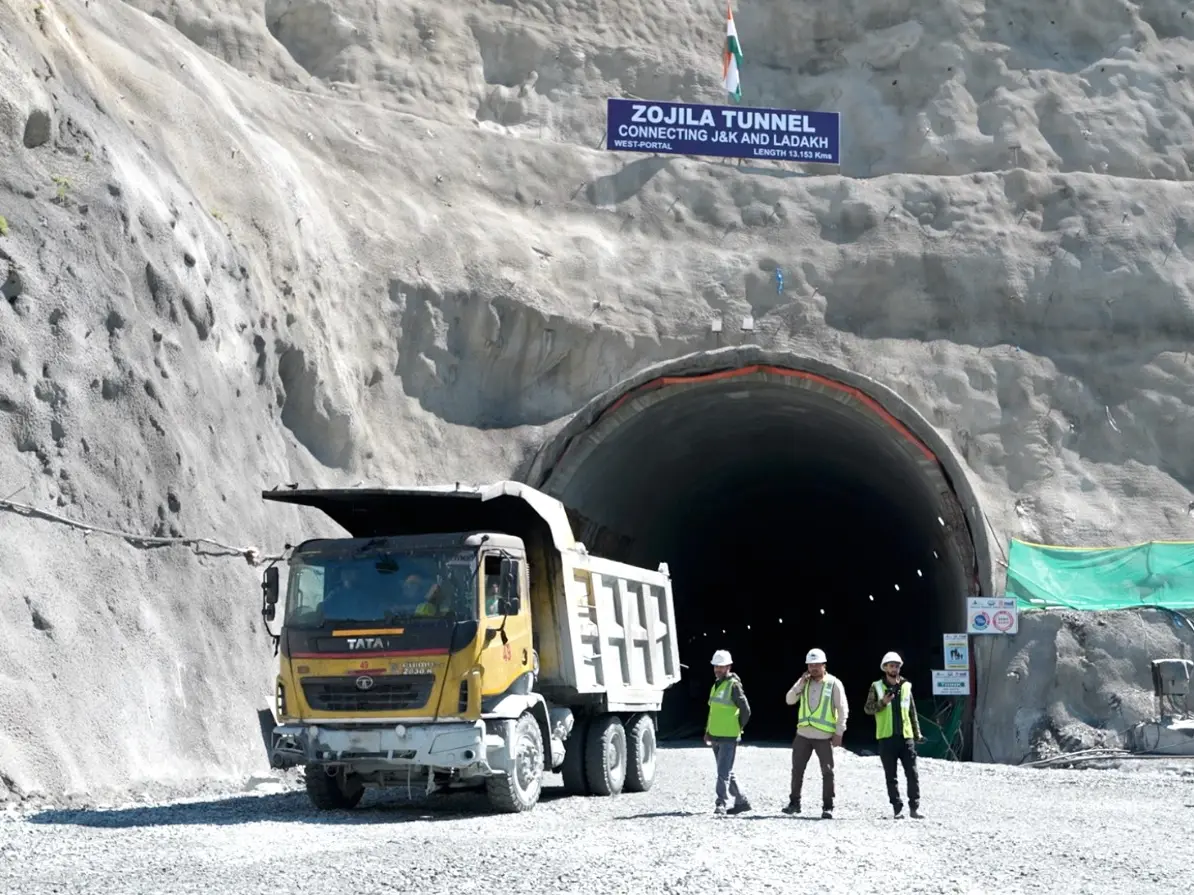
In a landmark achievement for India's infrastructure sector, the final breakthrough of the 13.153-kilometre Zojila Tunnel will be achieved on June 9, marking the successful completion of the excavation phase of one of the country's most ambitious and challenging transportation projects.
Situated at an elevation of approximately 11,578 feet above sea level in the rugged Himalayas, the Zojila Tunnel will become the world's longest single-tube bi-directional road tunnel at such a high altitude. The project connects Baltal near Sonamarg in Jammu & Kashmir with Meenamarg in the Drass-Kargil region of Ladakh, providing all-weather connectivity across a route that remains cut off for months each year due to heavy snowfall, avalanches and extreme weather conditions.
The breakthrough represents a defining milestone in India's infrastructure history and brings the long-awaited vision of uninterrupted road connectivity between Kashmir and Ladakh significantly closer to reality. The project is being executed by Megha Engineering & Infrastructure Limited (MEIL) for the National Highways & Infrastructure Development Corporation Limited (NHIDCL). Tunnelling operations were carried out simultaneously from both the western and eastern portals, overcoming some of the most demanding geological and climatic conditions ever encountered in Indian tunnel construction.

Engineers adopted the New Austrian Tunnelling Method (NATM), an internationally recognised technique particularly suited to fragile mountain geology. The method enabled construction teams to respond dynamically to changing rock formations through sequential excavation, immediate support systems, and continuous monitoring.
The scale of the project extends far beyond the main tunnel. The overall corridor development spans 30.894 kilometres and includes approach roads, bridges, protective structures, cut-and-cover sections, snow galleries, and the Nilgrar twin tunnels. Three major bridges, seven cut-and-cover structures stretching over 2.35 kilometres, and a 450-metre snow gallery form integral components of the project.
Trending Stories
)
Lady Gaga is a mom! Oscar-winning singer welcomes first child with fiance Michael Polansky
)
BRICS Summit 2026: Iran's Pezeshkian praises PM Modi at BRICS
)
Israeli film on Gaza creates record, gets 25 minutes long ovation at Venice
)
North Korea fires missiles after US, South Korea and Japan military drills but America says 'does not pose immediate threat'
)
BRICS Summit 2026: 30+ countries seek BRICS membership
)
Frustrated man demolishes his kitchen after thousands flock to see Mother Mary his wife spotted on the wall
)
BRICS summit: India faces delicate Iran-UAE diplomatic test
)
After praising Modi, Pezeshkian meets Indian religious leaders, Hurriyat's Mirwaiz Umar Farooq
)
Manipuri singer Chongtham Vikram Singh beaten to death: Autopsy reveals internal bleeding, fractured ribs
)
Houthis vs Saudi Arabia: East-west oil pipeline shut after drone attacks from Iraq
)
South Africa batter Jordan Hermann hits highest individual score on ODI debut
)
800 million years old - Scientists discover 'fingerprints' of supercontinent Gondwana in ancient rocks
)
Vladimir Putin in New Delhi for BRICS Summit: Russia-India defence, energy and nuclear ties in focus ahead of meeting with PM Modi
)
Osama Bin Laden's son ALIVE? Al-Qaeda releases video 7 years after US declared him dead
)
BRICS Summit 2026: South Africa says it will use the summit to advance its economic priorities
)
Gravitas | Iran hammers US air power in West Asia after Navy badly hit
)
Did you know THIS actor narrowly escaped the 9/11 terror attacks due to a last-minute change of travel plans?
)
BRICS Summit 2026: Rivals in West Asia, partners in BRICS, UAE, Iran, and Saudi delegations in Delhi
)
9-year-old Chennai prodigy clears Cambridge IGCSE grade 10 exams
)
BRICS Summit: China resumes Guangzhou-New Delhi flight, issues 'good-neighbourliness' remark ahead of Xi-Modi meet
)
Satya Niketan horror: Who is responsible?
)
BRICS Summit 2026: Top world leaders in New Delhi; West Asia war casts shadow on BRICS Summit
&im=FitAndFill=(700,400))
New Friday OTT releases (September 11, 2026): The Revolutionaries, Vishwanath & Sons, Ghamasaan- 6 new titles coming on Netflix, Prime Video and more
)
In first of its kind, Trump admin deports Afghan woman via Alien Terrorist Court
)
Baba Vanga's first prophecy for 2027 is out, and straight out of science fiction
)
Saudi Arabia shuts East-West oil pipeline, key Hormuz bypass, after attacks
)
WION Expertspeak: Understanding India's BRICS presidency amid wars, trade tensions and global turmoil
)
Satellite images show construction surge at Iran’s Pickaxe nuclear site amid US war
Among the engineering highlights are three massive ventilation and emergency shafts. The western shaft, measuring 474.3 metres in depth, is the longest vertical tunnel shaft ever constructed in India. The project's journey has been marked by extraordinary challenges. Construction teams endured temperatures plunging to -30 degrees Celsius for nearly 100 days each year while facing repeated avalanche threats.
Over the past five years, the project area experienced five major avalanche incidents, including severe events in January 2023 that damaged equipment and stranded workers. In one dramatic rescue operation, the Indian Army evacuated more than 172 workers following a massive secondary avalanche near the Nilgrar Tunnel zone.
Across the 13-kilometre alignment, rock classifications changed 67 times, forcing engineers to continuously adapt excavation and support strategies. Despite these obstacles, the project has maintained an impressive safety record, achieving 10 million safe man-hours as of April 2026.
A workforce of more than 1,200 personnel has contributed to the project, with nearly 80 per cent drawn from local communities. To support operations in the remote Himalayan environment, a self-sustaining base camp accommodating over 1,100 workers was established with medical facilities, transportation systems, specialised nutrition and round-the-clock logistical support.
Beyond its economic benefits, the tunnel carries substantial strategic importance. By providing reliable all-season access through a sensitive frontier corridor, it will strengthen logistical preparedness and operational mobility in one of India's most strategically significant regions.
