

&imwidth=800&imheight=600&format=webp&quality=medium "Why Trump’s $893 Billion Military Budget Cuts F-35s and Boosts Drones, Missiles?")
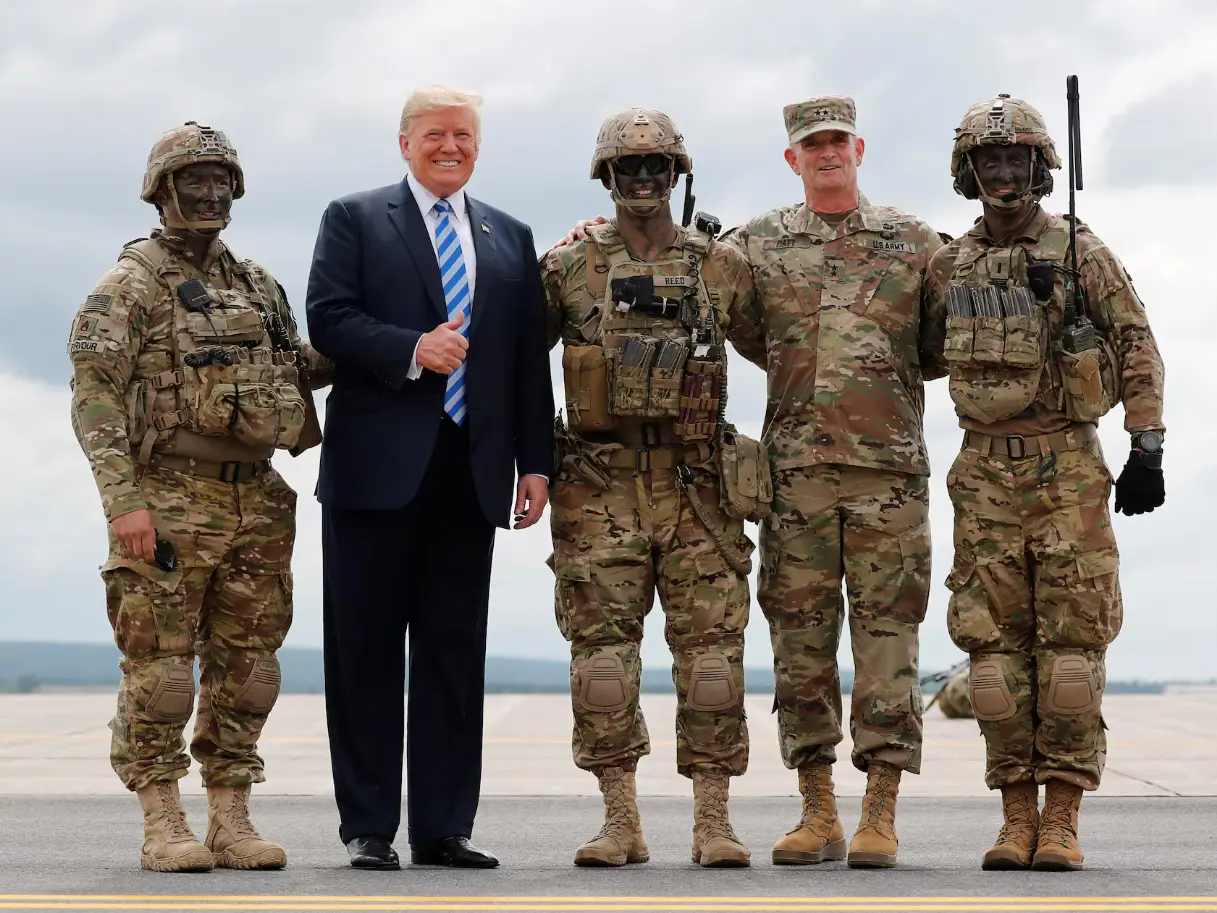
The United States is redrawing its military priorities. President Donald Trump has unveiled a nearly $893 billion defence and national security budget request for 2026, one that reflects a clear pivot towards next-generation warfare. The budget, flat in dollar terms from last year, offers a glimpse into Trump’s evolving vision: a leaner, tech-driven military force, heavy on drones and long-range missiles, but lighter on traditional fighter jets and warships.
But the announcement does not exist in isolation. It comes at a time when the world is witnessing not one, but two active war zones, Russia’s grinding invasion of Ukraine and a dangerous escalation between Israel and Iran. And across the Atlantic, NATO is preparing for a historic increase in defence spending. So, what’s really driving Trump’s latest move?
More missiles, fewer F-35s: Inside the 2026 budget shift
According to documents reviewed by Reuters, Trump has proposed purchasing only 47 F-35 stealth jets, down from 68 approved in President Biden’s final defence budget. The cut has already sparked pushback on Capitol Hill, with the House Appropriations Committee recommending 69 fighter jets as part of its draft legislation. Instead of expanding airpower through fighter jets, the budget prioritises long-range strike capabilities. As per Reuters, the US Air Force plans to increase investment in the Joint Air-to-Surface Standoff Missile - Extended Range (JASSM-ER) and Long Range Anti-Ship Missile (LRASM), systems designed to strike targets at a distance, particularly relevant to rising tensions in the Indo-Pacific.
Meanwhile, orders for the Precision Strike Missile, a successor to the Army Tactical Missile System (ATACMS) used in Ukraine, are being scaled back, signalling a focus on fewer, more advanced platforms.
In another major shift, the budget boosts funding for small tactical drones, a response to battlefield innovations seen in Ukraine, where cheap, unmanned aircraft have proven to be highly effective tools of modern warfare.
Trending Stories
&imwidth=180&imheight=135&format=webp&quality=medium)
'Hell of a beautiful a**': Trump compliments Nicki Minaj as rapper joins him in Michigan rally
&imwidth=180&imheight=135&format=webp&quality=medium)
'Hire the robot, fire the human': Bill Gates's words hint at a bleak future
&imwidth=180&imheight=135&format=webp&quality=medium)
Telangana unveils AI avatar of IT minister D Sridhar Babu at Hyderabad DevFest 2026
&imwidth=180&imheight=135&format=webp&quality=medium)
Who is Eyal Zamir, Israeli army chief, who reportedly clashed with Netanyahu over Iran?
&imwidth=180&imheight=135&format=webp&quality=medium)
Fire breaks out at Delhi’s North Block, thick black smoke seen | VIDEO
&imwidth=180&imheight=135&format=webp&quality=medium)
Grammy-winning singer Chris Brown to be sentenced in London after pleading guilty to nightclub brawl
&im=FitAndFill=(700,400)&imwidth=180&imheight=135&format=webp&quality=medium)
Armoured vehicles vs main battle tanks: What is the real difference?
&imwidth=180&imheight=135&format=webp&quality=medium)
IND vs NZ: Tilak Varma sets world record with most T20I catches in a year
&imwidth=180&imheight=135&format=webp&quality=medium)
Harry Kane favourite to win 2026 Ballon d’Or ahead of Lamine Yamal and Kylian Mbappé
&imwidth=180&imheight=135&format=webp&quality=medium)
FIR filed against opposition MPs for ‘trespassing’ amid Jamia Millia students’ protest
&imwidth=180&imheight=135&format=webp&quality=medium)
WATCH | Virat Kohli returns to training ahead of New Zealand ODI series
&imwidth=180&imheight=135&format=webp&quality=medium)
Can Putin cheat death? All about his daughter’s billion-dollar quest for immortality
&imwidth=180&imheight=135&format=webp&quality=medium)
Daler Mehndi controversy: Mika Singh’s team confirms Subodh Uniyal’s apology
&im=FitAndFill=(700,400)&imwidth=180&imheight=135&format=webp&quality=medium)
How do army night-vision systems see in almost complete darkness?
&imwidth=180&imheight=135&format=webp&quality=medium)
Netanyahu warns Israelis of ‘existential threat’ from Iran, posts AI image of nuclear strike
&imwidth=180&imheight=135&format=webp&quality=medium)
Brazil re-elects factory worker Lula for fourth term; Indian PM Modi congratulates 'dear friend'
&imwidth=180&imheight=135&format=webp&quality=medium)
Pakistan airline PIA unveils new crew uniforms, faces online criticism
&imwidth=180&imheight=135&format=webp&quality=medium)
‘That is a miss’: Ravi Ashwin questions Sooryavanshi’s demotion to No. 3 in 2nd T20I vs NZ
&im=FitAndFill=(700,400)&imwidth=180&imheight=135&format=webp&quality=medium)
Why does this fighter jet have a golden window that looks like alien technology?
&im=FitAndFill=(700,400)&imwidth=180&imheight=135&format=webp&quality=medium)
New OTT releases this week (October 26-November 1, 2026): Baththa, Akka, The One About Matthew Perry- 7 titles coming on Netflix, Prime Video and more
&imwidth=180&imheight=135&format=webp&quality=medium)
Elon Musk’s Grok releases first AI-generated Odyssey episode, months after promising ‘historically accurate’ full-length film
&imwidth=180&imheight=135&format=webp&quality=medium)
'Already tired of his 9-to-5': Baby born with a moustache becomes internet sensation, video goes viral | Watch
&imwidth=180&imheight=135&format=webp&quality=medium)
Serbia’s student-led movement defeats Vucic’s party after 14 years in power: Why it matters
&imwidth=180&imheight=135&format=webp&quality=medium)
'I promised Gautam & Kotak Sir that...': Tilak Varma opens up on match-winning mindset against NZ
&imwidth=180&imheight=135&format=webp&quality=medium)
Maldives opposition leader demands transparency on Muizzu Govt's Pakistan defence, security deals
&im=FitAndFill=(700,400)&imwidth=180&imheight=135&format=webp&quality=medium)
Why do some fighter jets have two engines while others use one?
&imwidth=180&imheight=135&format=webp&quality=medium)
Formula 1: Mercedes' Kimi Antonelli one race and ninth spot finish away from title after US Grand Prix win
&imwidth=180&imheight=135&format=webp&quality=medium)
Delhi's new entry rules for vehicles begin November 1. Here's all you need to know about the ban
&imwidth=180&imheight=135&format=webp&quality=medium)
'Clear overkill': Putin rejects claims Russia is behind mass protests in Europe
&imwidth=180&imheight=135&format=webp&quality=medium)
'I've done my work sincerely': AR Rahman on facing backlash over Ramayana soundtrack
&imwidth=180&imheight=135&format=webp&quality=medium)
Clayface tops North American box office, Elizabeth Holmes documentary follows close behind
&imwidth=180&imheight=135&format=webp&quality=medium)
Nagpur man fails to pay rent, allegedly prints fake Rs 500 notes worth Rs 37 lakh
&imwidth=180&imheight=135&format=webp&quality=medium)
Israel elections 2026: How the country is gearing up for a crucial vote
&imwidth=180&imheight=135&format=webp&quality=medium)
Donald Trump targets Bill Maher in lengthy post after White House dinner, says ‘Don’t call anymore’
&imwidth=180&imheight=135&format=webp&quality=medium)
'He is a red flag': Ex-India strength and conditioning coach on Rohit's fitness regime
Cuts and controversy: What’s being sacrificed?
To offset these investments, the 2026 plan trims other corners of the Pentagon’s arsenal. As per Reuters, the US Navy will reduce its civilian workforce by more than 7,200 jobs, while only three new warships are scheduled for procurement under this budget. Large naval projects like the Virginia-class submarine, jointly built by General Dynamics and Huntington Ingalls Industries, will instead be funded through a separate appropriation.
One of Trump’s most ambitious defence projects, the “Golden Dome” missile defence shield is mostly absent from this request. Instead, funding for the programme has been routed through a separate $25 billion allocation within a larger $150 billion Republican-led defence package dubbed the “One Big Beautiful Bill Act”, which has already passed the House.
How US defence spending in 2024–25
Before Trump’s 2026 pitch, the US already led global military spending. As per Reuters, US defence outlays reached $997 billion in fiscal 2024, rising 5.7 per cent from 2023 and comprising 37 per cent of worldwide military expenditure. For fiscal 2025, Congress approved about $895 billion under the National Defense Authorization Act. This total included a $849.8 billion base budget and additional war-related, emergency funding, in line with the Fiscal Responsibility Act of 2023, which capped growth at just 0.9 per cent over the previous year .
The $849.8 billion base defence budget for fiscal 2025 was divided into several major areas. According to the Department of Defense’s FY 2025 budget overview, around 39 per cent (approximately $330 billion) was dedicated to military personnel and benefits, including pay, housing and healthcare. A similar proportion was allocated to operations and maintenance, covering day-to-day military activities, logistics, training, facility upkeep and ongoing overseas commitments . The combined $300 billion allocated to procurement and research, development, test & evaluation (RDT&E) funded new weapons, advanced technologies, and the next generation of platforms which are vital for modernising the force. This structure reflects a strong focus on sustaining readiness while investing heavily in future capabilities.
Altogether, defence spending comprised just over 50 per cent of the US discretionary budget, which totals around $1.8 trillion, making it the single largest area of government expenditure, as noted by Reuters.
NATO’s 5 per cent pledge: A new arms race?
Across the Atlantic, NATO allies are preparing for a dramatic increase in defence spending. At a summit in The Hague earlier this week, member states agreed to a new goal: defence spending equivalent to 5 per cent of national GDP by 2035, up from the current 2 per cent target set in 2014.
The new benchmark includes 3.5 per cent for core military capability and 1.5 per cent for infrastructure, cyber defence, and supply chain resilience.
But not all NATO members are willing to commit. Spain’s refusal to accept the 5 per cent goal drew a sharp rebuke from Trump, who called Madrid’s decision “terrible” and hinted at trade retaliation. As quoted by Politico, Trump stated that European nations should meet the 5 per cent target but insisted that the US should not be held to the same requirement, given it already spends around 3.4 per cent of GDP on defence. According to Washington Post, only a handful of countries, including Poland, Estonia, Latvia, Lithuania and Norway, are on track to meet the 5 per cent goal.
Two wars, one nervous West
The timing of Trump’s budget is deliberate. It arrives amid two major global crises.
In Ukraine, Russia’s full-scale invasion has entered its third year. The US has been a key supplier of munitions and intelligence, but Trump has repeatedly called for Europe to “step up” and share more of the financial burden. As per Reuters, he remains critical of “blank cheque” approaches to Kyiv.
In the West Asia, tensions between Israel and Iran have escalated rapidly. Israel has carried out targeted strikes on suspected Iranian nuclear infrastructure. In response, Tehran launched waves of drones and missiles, triggering fears of a broader regional war.
These crises appear to have informed the Pentagon’s strategy. The focus on drones, missiles and unmanned platforms reflects an evolving battlefield where precision and distance are more valuable than conventional firepower.
The bigger picture: From conventional to asymmetric warfare
Trump’s 2026 defence budget reflects more than just financial priorities, it signals a shift in American military doctrine. The US is reportedly recalibrating away from high-maintenance legacy systems like the F-35 and large naval platforms, and moving towards rapid, asymmetric capabilities designed for unpredictable and tech-driven theatres of war.
Meanwhile, NATO’s 5 per cent pledge suggests that Europe, too, is bracing for a long-term security challenge. But questions remain over implementation and whether political appetite will keep pace with rising military costs. As the US Congress prepares for heated debates over the budget, and as NATO allies scramble to realign spending, one thing is clear: the global defence landscape is undergoing a fundamental transformation. In a world shaped by drones, missile shields and cyber weapons, Trump’s budget may be setting the tone for the wars of tomorrow.
(With inputs from the agencies)