US economic growth falters as Fed flags tariff burdens and rising uncertainty

&imwidth=600&imheight=450&format=webp&quality=medium "US economic growth falters as Fed flags tariff burdens and rising uncertainty")
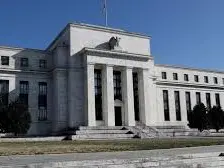
The Federal Reserve building is seen in Washington, US Photograph: (Reuters)
Amid tariff pressure, the Federal Reserve's Beige Book indicates declining economic activity, with businesses citing rising costs and weaker demand.
The United States economy is losing momentum as new data reveals the growing strain from elevated tariffs and persistent policy uncertainty.
According to the Federal Reserve’s latest Beige Book report released on 4 June, economic activity has declined across much of the country, with businesses reporting increased costs, weaker demand, and concerns about the future.
Fed report highlights a cooling economy
The Beige Book, a compilation of anecdotal evidence collected by the US central bank’s 12 regional branches found that only three districts saw growth in recent weeks. In contrast, half reported outright contraction.
This is a sharp deterioration from January 2025, when all 12 districts had registered economic expansion.
As per Reuters, the Fed’s snapshot, based on data gathered through 23 May, stated: “On balance, the outlook remains slightly pessimistic and uncertain, unchanged relative to the previous report.”
Trending Stories
)
)
&im=FitAndFill=(700,400))
)
)
)
)
&im=FitAndFill=(700,400))
)
)
)
)
&im=FitAndFill=(700,400))
)
)
)
)
)
)
)
)
&im=FitAndFill=(700,400))
)
)
&im=FitAndFill=(700,400))
)
)
)
)
)
&im=FitAndFill=(700,400))
)
)
)
)
&im=FitAndFill=(700,400))
)
)
)
The document warned of widespread expectations among business contacts that “costs and prices will rise at a faster rate going forward.”
Businesses across sectors are increasingly concerned about the economic landscape, with some pulling back on stockpiling goods due to escalating costs.
A florist in New York said they had begun adjusting flower varieties based on “rapidly changing costs by source country”, while others reported difficulty forecasting demand due to trade policy uncertainty, as per Reuters.
Tariffs reshape pricing and consumer choices
According to the San Francisco Fed, companies are now explicitly including separate tariff lines in contracts and quotes.
The report noted that price hikes introduced in anticipation of tariffs were not reversed even after some duties were removed.
Retailers are witnessing changes in consumer behaviour. The Cleveland Fed said many car dealerships saw a spike in purchases ahead of planned tariffs but expect sales to decline starting in June due to “tariff-related sticker shock.”
Meanwhile, discretionary spending has pulled back, with some consumers downgrading to less expensive alternatives.
The Boston Fed described sentiment as “a mix of cautious optimism and blunt pessimism.” While some hoped that resolution of trade tensions would unlock growth, others warned that tariff pressures and federal policies may drag demand further.
Employment flat, with regional divergence
The labour market remains broadly stable, but there is variation across regions and industries. The Richmond Fed reported contrasting trends: a Maryland construction firm plans to hire more due to ongoing demand, whereas a fast-casual restaurant chain in the D.C. region has halted hiring amid economic concerns, as per Reuters.
Nationwide, employment was reported as “flat” in most districts. This softening contrasts with official data, which still portrays a relatively healthy labour market.
For example, April’s Personal Consumption Expenditures (PCE) Price Index rose by just 2.1 per cent, the lowest in four years and marginally above the Fed’s 2 per cent inflation target.
Fed data diverging from business sentiment
While hard economic indicators show resilience, such as solid employment levels, policymakers are increasingly leaning on real-time insights like those captured in the Beige Book.
As reported by Reuters, Fed officials are putting a “premium on day-to-day experiences” of businesses and households to make forward-looking decisions.
Additional survey-based data echoes the Fed’s findings. According to a report released on the same day by the Institute for Supply Management, the US services sector contracted in May for the first time in a year, with businesses reporting higher costs for inputs.
IMF warns of weaker 2025 outlook, tight fiscal path
The International Monetary Fund has also revised its 2025 outlook for the US. It now forecasts GDP growth of just 1.9 per cent next year, citing a cooling labour market and tightening fiscal policy.
As per the IMF’s Article IV consultation, consumption is expected to moderate, and inflation risks persist, particularly in services.
The IMF estimates unemployment will rise to 4.2 per cent by next year, from the current level of 4.1 per cent.
Despite easing price pressures, the Fund has warned that global disinflation is slowing, especially in key sectors such as housing, food, and transport.
Fed’s policy dilemma: inflation vs recession
The Federal Reserve has kept interest rates steady in the 4.25–4.50 per cent range since December 2024.
Policymakers now face a tough balancing act: fighting inflation without stifling growth.
Speaking to Bloomberg, Chicago Fed President Austan Goolsbee suggested that if current conditions persist, the Fed may reduce short-term interest rates within the next 12 to 15 months.
However, he cautioned that further escalation in tariffs or a spike in core inflation could delay such a move.
Trump intensifies pressure on Powell
President Donald Trump has renewed calls for rate cuts following weak job numbers. According to Bloomberg, only 37,000 private-sector jobs were added in May, the lowest figure since March 2023 and well below forecasts of 110,000.
Trump criticised Fed Chair Jerome Powell on Truth Social, citing Europe’s recent rate reductions as a benchmark.
Analysts say the disappointing employment figures, coupled with business unease over tariffs, could lead to monetary easing as soon as the Federal Open Market Committee’s next meeting on 17–18 June, as per Reuters.
What lies ahead?
With tariff pressures mounting, policy clarity lacking, and economic activity softening, the Fed’s next steps will be crucial.
The Beige Book has laid bare the fragility beneath surface-level indicators. The central bank must now navigate a narrow path between easing inflation and avoiding a recession , all while under political scrutiny and global uncertainty.
(With inputs from the agencies)